
Is My Boyfriend a Misogynist Quiz
How the Scales are Structured
Who Usually Takes This Test?
See How You Compare
Below is a preview of how scores are typically distributed across each scale.
Example Questions From the Test
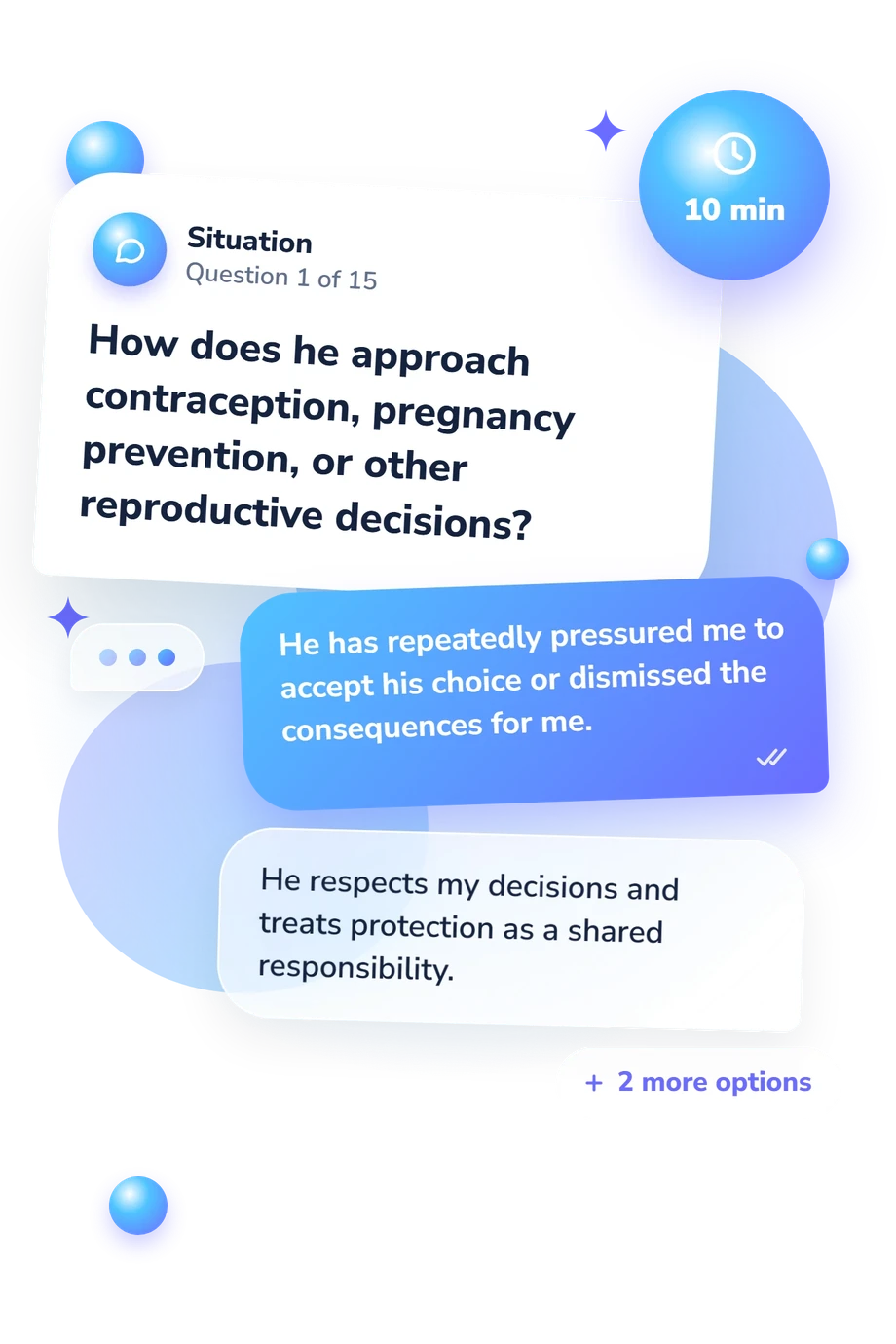
- He has repeatedly pressured me to accept his choice or dismissed the consequences for me.
- He respects my decisions and treats protection as a shared responsibility.
- He has sabotaged protection, ignored an agreement, or threatened consequences over a reproductive decision.
- He has pushed his preference or complained about protection, but stopped when I held my boundary.
- He sometimes jokes or hints that affection is the expected return.
- He does not treat affection or sex as something I owe him.
- He becomes threatening, frightening, or physically forceful when he believes he is owed sexual access.
- He repeatedly uses what he spent or did as leverage to make me feel obligated.
- I regularly plan what to say, where to stand, or how to leave because his reactions can be intimidating.
- I do not anticipate physical intimidation when making ordinary choices or raising concerns.
- I have avoided a topic or changed a plan once because I worried about his temper.
- I change my behavior because he has directly threatened force, used force, or displayed a weapon.
Is My Boyfriend a Misogynist Quiz - Description and methodology of the test
People uneasy about a partner’s attitudes or demands can use this questionnaire to examine gendered disrespect alongside control or intimidation. The Is My Boyfriend a Misogynist Quiz examines conduct in a current or recent relationship through concrete, behavior-focused prompts. For someone asking whether a boyfriend is sexist, this questionnaire gives the is my boyfriend sexist quiz a focus through choices, boundaries, safety, and independence.
What This Assessment Explores
Items examine gendered control in reproductive decisions, money, clothing, opinions, friendships, digital privacy, sexual consent, and boundary responses. They help readers notice warning signs of sexism through observable behaviors across three scales.
The three displayed result areas are:
- Gendered Emotional Control (0-15) indicates pressure, monitoring, degradation, isolation, or threats restricting freedom. Bands: Not endorsed here (0), Indicator present (1-2), and Prompt support (3-15).
- Physical Intimidation and Safety (0-15) reflects frightening conduct, blocked exits, dangerous situations, force, or threats. Bands: Not endorsed here (0), Indicator present (1-2), and Prompt support (3-15).
- Sexual Boundaries and Entitlement (0-15) reflects pressure, retaliation, privacy violations, coercion, or assumed sexual access. Bands: Not endorsed here (0), Indicator present (1-2), and Prompt support (3-15).
A single red-flag response remains serious despite a low displayed score; consider support or safety planning where appropriate.
Methodology and Evidence Base
Each prompt offers four response descriptions, from respectful conduct to occasional, repeated, or severe behavior. The reader chooses the description closest to lived experience rather than rating a broad impression.
As a relationship abuse questionnaire, it focuses on observable situations such as pressure, retaliation, surveillance, isolation, threats, and coercion. Results appear as three displayed scale scores or result areas, but no item-level weighting rule is stated; the numbers should not be reverse-engineered into severity or legal meaning.
CASR-SF is the closest conceptual comparison. Hegarty et al.’s Composite Abuse Scale work and Tolman’s measure of psychological maltreatment support attention to control, degradation, and coercion. The CTS2, developed by Straus et al., adds a framework for physical and sexual tactics.
This online questionnaire is conceptually consistent with these sources, but it is not presented as an adaptation or standardized administration of any one instrument. The displayed bands are unvalidated reflective summaries rather than clinical or legal cutoffs, and current fear, relationship history, and self-report bias can shape responses; use the result to identify patterns for reflection, documentation, boundaries, or support while keeping any safety concern visible rather than dismissing it.
- Ford-Gilboe, Marilyn; Wathen, C. Nadine; Varcoe, Colleen; MacMillan, Harriet L.; Scott-Storey, Kelly; Mantler, Tara; Hegarty, Kelsey; Perrin, Nancy. (2016). Development of a brief measure of intimate partner violence experiences: the Composite Abuse Scale (Revised)-Short Form (CASR-SF). BMJ Open, 6(12), e012824. 10.1136/bmjopen-2016-012824
- Hegarty, Kelsey; Sheehan, Mary; Schonfeld, Cynthia. (1999). A multidimensional definition of partner abuse: development and preliminary validation of the Composite Abuse Scale. Journal of Family Violence, 14(4), 399-415. 10.1023/A:1022834215681
- Tolman, Richard M. (1989). The development of a measure of psychological maltreatment of women by their male partners. Violence and Victims, 4(3), 159-177. 10.1891/0886-6708.4.3.159
- Straus, Murray A.; Hamby, Sherry L.; Boney-McCoy, Sue; Sugarman, David B. (1996). The Revised Conflict Tactics Scales (CTS2): Development and Preliminary Psychometric Data. Journal of Family Issues, 17(3), 283-316. 10.1177/019251396017003001
Updated: