
Inauguration Day Quiz
How the Scales are Structured
Who Usually Takes This Test?
See How You Compare
Below is a preview of how scores are typically distributed across each scale.
Example Questions From the Test
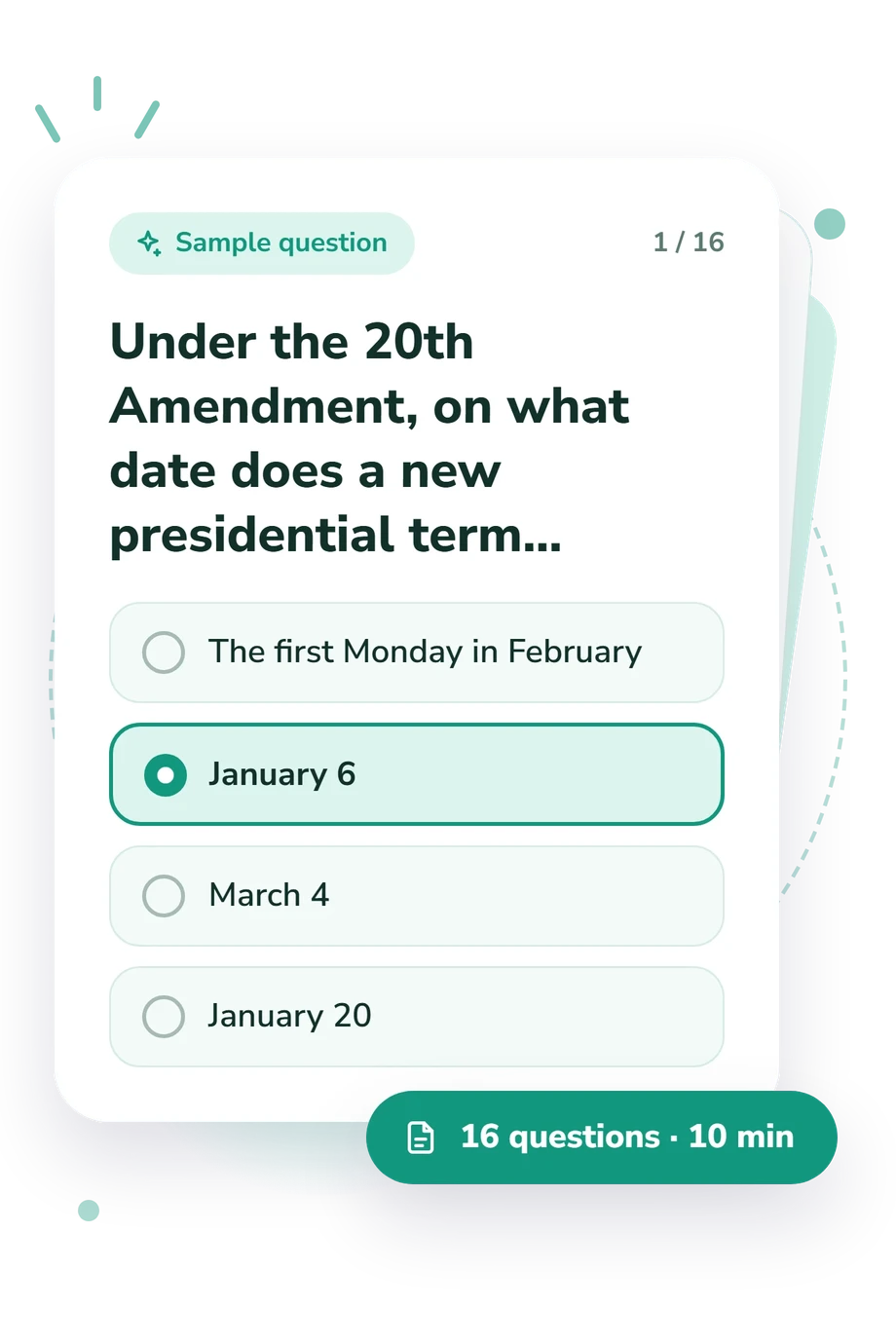
- The first Monday in February
- January 6
- March 4
- January 20
- The 12th Amendment
- The 22nd Amendment
- The 20th Amendment
- The 25th Amendment
- The vice president
- The president
- The Speaker of the House
- The Chief Justice
Inauguration Day Quiz - Description and methodology of the test
Readers who want to understand presidential transitions can use this inauguration day quiz to check their grasp of constitutional timing and oath-taking traditions. It is suited to general readers exploring civic history and the rules surrounding a transfer of power. As an inauguration quiz, this questionnaire presents factual and scenario-based questions, then reports an overall knowledge level and offers a broad indication of themes that may merit review.
What This Assessment Measures
This assessment checks whether you can connect inauguration facts with constitutional rules governing a transfer of presidential power. It suits general readers building civic knowledge through historical recall, legal interpretation, and practical succession scenarios rather than personal opinion.
The main content areas are:
- Constitutional timing and succession show how you apply the Twentieth Amendment to term dates and qualification problems.
- Oath wording and administration measure whether you distinguish constitutional language from ceremony.
- Historical milestones test recognition of Washington’s first oath and the move to January 20.
- Inaugural traditions clarify customary practices, including the address, Bible use, and ceremonial order.
The result appears on Inauguration Day Knowledge, scored from 0 to 16 correct answers: Foundation to Build (0-6), Developing Knowledge (7-12), or Strong Knowledge (13-16). Your result from this presidential inauguration knowledge test gives an overall level; its question themes suggest areas for review.
Methodology and Evidence Base
Each item presents four answer choices, so the format tests recognition of the best-supported response rather than agreement or self-description. The scoring logic is direct: correct responses build the total shown in the result, while the bands describe increasing command of constitutional and historical material covered by the questions.
The content is conceptually consistent with Crane-Hirsch (2013), the constitutional oath provision, and the Twentieth Amendment. The 1937 Senate inaugural record supports details about ceremonial order and official practice. Bernick and Green (2023) provide a constitutional framework for understanding the oath as a public commitment rather than merely a ritual. The questions use their own four-option format, while these constitutional and historical sources provide context for the subject matter.
Used as an inauguration trivia quiz, this questionnaire can support focused review, but performance may also reflect guessing, prior exposure, reading precision, or concentration. Fixed options cannot capture every nuance of constitutional interpretation. Its displayed result should be read as an indication of learning level, not as a comprehensive measure of civic expertise.
- Crane-Hirsch, Audrey Celeste. The Presidential Inauguration: Basic Facts and Information. Congressional Research Service Report R42891, January 9, 2013.
- United States Constitution, Article II, Section 1, Clause 8, and Twentieth Amendment (1787; ratified 1933).
- U.S. Senate, Joint Congressional Committee on Inaugural Ceremonies. 38th Inaugural Ceremonies, January 20, 1937.
- Bernick, Evan D., and Christopher R. Green. “What Is the Object of the Constitutional Oath?” Penn State Law Review, vol. 128, no. 1, 2023, pp. 1-68. Earlier working-paper version: SSRN, 2019. 10.2139/ssrn.3441234.
Updated: