
How Well Do You Know Your Daughter Quiz
How the Scales are Structured
Who Usually Takes This Test?
See How You Compare
Below is a preview of how scores are typically distributed across each scale.
Example Questions From the Test
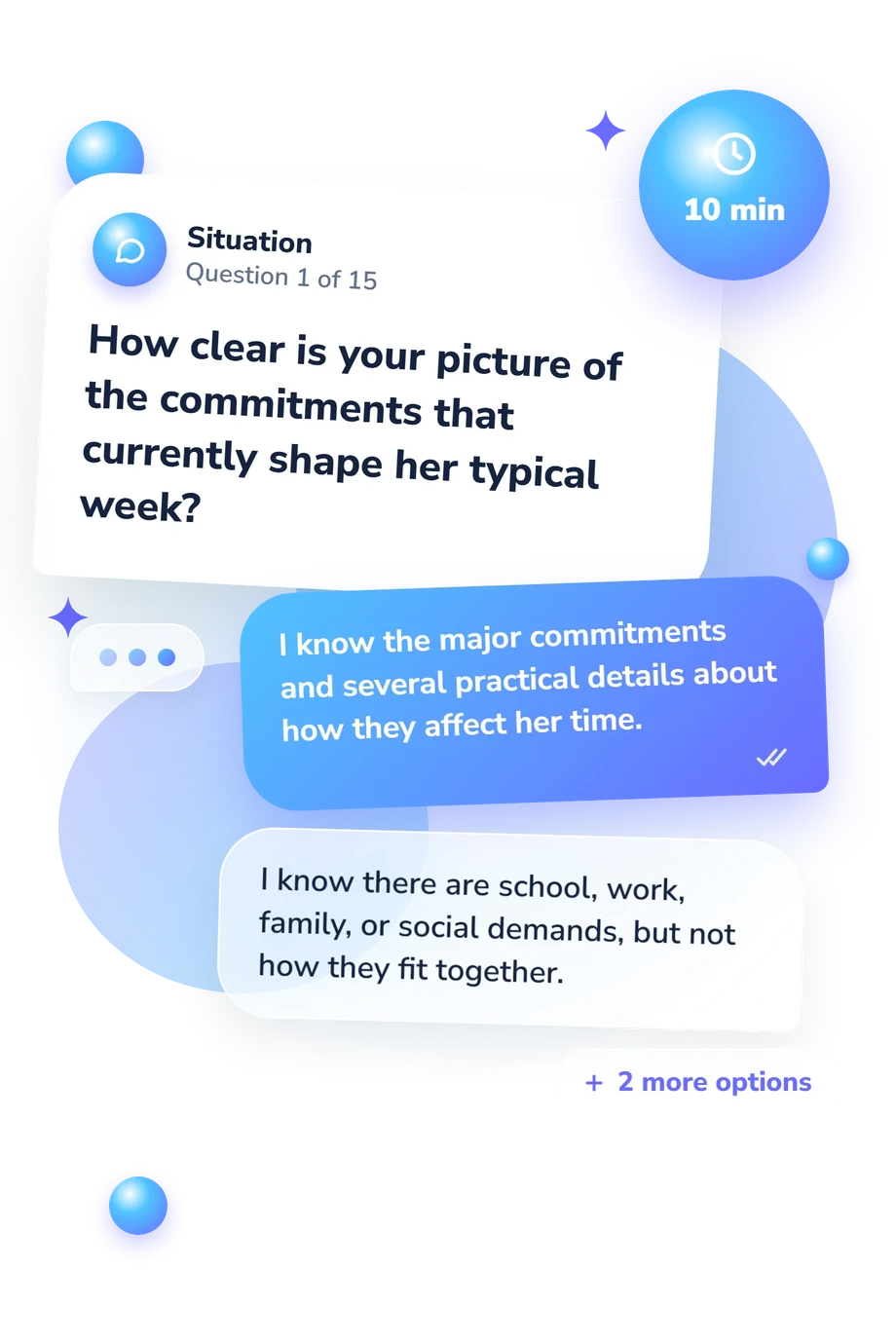
- I know the major commitments and several practical details about how they affect her time.
- I know there are school, work, family, or social demands, but not how they fit together.
- I understand the broad weekly pattern and most of the major demands.
- My picture comes mainly from an older routine or occasional updates.
- I notice the shift but cannot reliably tell what it means for her.
- I can usually interpret it using her specific cues and the situation, while leaving room to check.
- I have no consistent sense of what her quietness communicates.
- I can narrow it to one or two likely meanings based on familiar patterns.
- I could name one or two possibilities, but they would mostly be guesses.
- I could predict a specific choice and explain why it appeals to her lately.
- I would mainly picture what she used to enjoy or what I would choose for her.
- I know the general kind of activity she might choose, though not the likely details.
How Well Do You Know Your Daughter Quiz - Description and methodology of the test
Parents wanting to examine what they currently know about their daughter may find the How Well Do You Know Your Daughter Quiz a useful prompt for reflection. It invites attention to what parents understand about their daughter now, what may be assumed, and where a gentle question could clarify the picture. The result supports respectful understanding rather than competition or ranking of parenting.
What This Assessment Explores
This questionnaire asks how specifically a parent understands a daughter’s current inner and everyday world. It suits parents who respect privacy; a score is not a measure of love or closeness.
Situations cover cues, routines, interests, feelings, boundaries, relationships, goals, and support. The questions turn parent-daughter understanding into concrete reflection areas, helping parents build a specific understanding of their daughter.
Its three dimensions are:
- Communication & Support Preferences (0-15) reflects recognition of cues, boundaries, and preferred support: Signals Still Unclear (0-5); Some Shared Language (6-10); Well-Tuned Understanding (11-15).
- Everyday Life & Preferences (0-15) reflects knowledge of current routines, interests, relationships, and preferences: Older or Partial Picture (0-5); Familiar Picture (6-10); Current, Detailed Picture (11-15).
- Feelings, Values & Goals (0-15) reflects understanding of what matters to her, goals, and emotions: Limited View Inward (0-5); Emerging Understanding (6-10); Nuanced Understanding (11-15).
Methodology and Scientific Basis
As a structured self-report, the questionnaire presents each situation with four response choices. The choices contrast guesses, older assumptions, uncertainty, and more specific understanding of the current situation. Responses produce the three displayed scale results; the questionnaire does not specify how an individual choice contributes to a score.
Its practical aim is to help parents know their daughter better by asking what they can recognize or predict, not what she objectively thinks. Honest answers are more useful than flattering ones.
Conceptually, the closest match is Kerr and Stattin (2000), which distinguishes parental knowledge of a child’s life from monitoring behavior. Smetana et al. (2006) highlight how disclosure and secrecy shape what parents can know. These studies provide conceptual context, not a source instrument or validation study for this questionnaire.
The online version is a reflective questionnaire, and its bands are interpretation labels for the displayed results. Answers depend on self-report, memory, current circumstances, and respect for privacy, so the result is a starting point for noticing what to ask or understand more carefully.
- Margaret Kerr and Håkan Stattin (2000). What parents know, how they know it, and several forms of adolescent adjustment: Further support for a reinterpretation of monitoring. Developmental Psychology, 36(3), 366-380. 10.1037/0012-1649.36.3.366
- Judith G. Smetana, Aaron Metzger, Denise C. Gettman, and Nicole Campione-Barr (2006). Disclosure and secrecy in adolescent-parent relationships. Child Development, 77(1), 201-217. 10.1111/j.1467-8624.2006.00865.x
- Anthony B. Gerard (1994). Parent-Child Relationship Inventory (PCRI) Manual. Los Angeles: Western Psychological Services.
Updated: