
How Much Do I Weigh Quiz
How the Scales are Structured
Who Usually Takes This Test?
See How You Compare
Below is a preview of how scores are typically distributed across each scale.
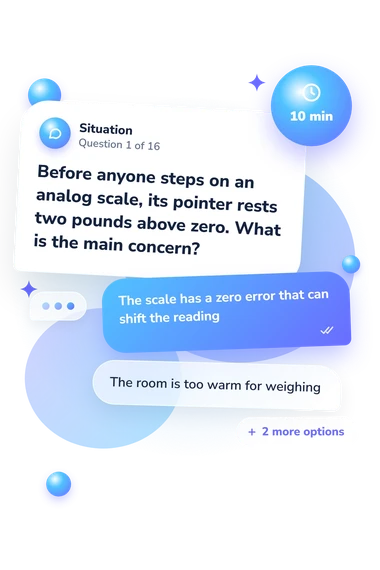
Example Questions From the Test
- The scale has a zero error that can shift the reading
- The room is too warm for weighing
- Analog scales must always begin below zero
- The scale is displaying kilograms as pounds
- 154 pounds
- 140 pounds
- 112 pounds
- 175 pounds
- They have the same body composition
- They have the same clothing size
- Only that their total measured weights are the same
- They have the same health needs
How Much Do I Weigh Quiz - Description and methodology of the test
For readers who want to interpret everyday scale readings, the How Much Do I Weigh Quiz offers a practical check of measurement knowledge rather than an estimate of body weight. It suits people reviewing their weighing habits, troubleshooting a home scale, or learning why numbers shift from day to day. As a body weight knowledge test, it points to habits and concepts that can make routine measurements more consistent.
What This Assessment Explores
The questions examine whether someone can obtain and interpret a dependable body-weight reading. They cover zero error, calibration, hard surfaces, clothing, unit conversion, repeated measurements, and the difference between temporary fluid shifts and lasting changes. Other items test recognition of rapid gain with swelling or breathing difficulty.
The result is a knowledge profile, not a prediction of actual weight, ideal weight, body composition, or health. It suits anyone using a bathroom scale who wants clearer routines and more cautious interpretation. As a scale accuracy quiz, it focuses on conditions that make readings comparable. The displayed scale is Body Weight Knowledge (0-16), with these bands:
- Foundations to build (0-6) indicates that weighing conditions, scale setup, and short-term change need review.
- Developing knowledge (7-12) indicates that many essentials are understood, while some measurement or interpretation details need attention.
- Strong knowledge (13-16) indicates a solid practical grasp of accurate weighing and ordinary fluctuations.
Methodology and Evidence Base
Each item presents a situation with four answer choices. Respondents select the explanation or action that best fits problems involving zero error, scale comparison, unit conversion, child-weight subtraction, salt-related changes, and exercise.
Responses are combined into a displayed total. Individual answer weights are not specified. The catalogue describes this knowledge score as unvalidated and says it cannot reveal actual weight or assess health.
Its evidence base is conceptually consistent with Yorkin et al. (2013), which examined accuracy and consistency in home bathroom scales, and with Stein et al. (2005), which compared scale precision in everyday settings. Maruthur et al. (2010) supports repeated measurements, showing why one reading may not represent stable weight. The questionnaire is conceptually consistent with the measurement issues examined in these studies, but it is not an adaptation of their instruments.
Equipment condition, placement, clothing, timing, and fluid balance all matter for understanding weight fluctuations. Performance may reflect familiarity with weighing equipment and the ability to apply general guidance to a particular situation, while actual habits can vary. This weight measurement quiz gives a practical knowledge snapshot.
- Meredith Yorkin, Kim Spaccarotella, Jennifer Martin-Biggers, Virginia Quick, and Carol Byrd-Bredbenner. Accuracy and consistency of weights provided by home bathroom scales. BMC Public Health. 2013;13:1194. 10.1186/1471-2458-13-1194
- Risa J. Stein, C. Keith Haddock, Walker S. C. Poston, Dana Catanese, and John A. Spertus. Precision in weighing: a comparison of scales found in physician offices, fitness centers, and weight loss centers. Public Health Reports. 2005;120(3):266-270. 10.1177/003335490512000308
- Nisa M. Maruthur, William M. Vollmer, Jeanne M. Clark, Gerald J. Jerome, Lillian F. Lien, Catherine M. Loria, and Lawrence J. Appel. Measurement of Weight in Clinical Trials: Is One Day Enough? Journal of Obesity. 2010;2010:413407. 10.1155/2010/413407