
How German Are You Quiz
How the Scales are Structured
Who Usually Takes This Test?
See How You Compare
Below is a preview of how scores are typically distributed across each scale.
Example Questions From the Test
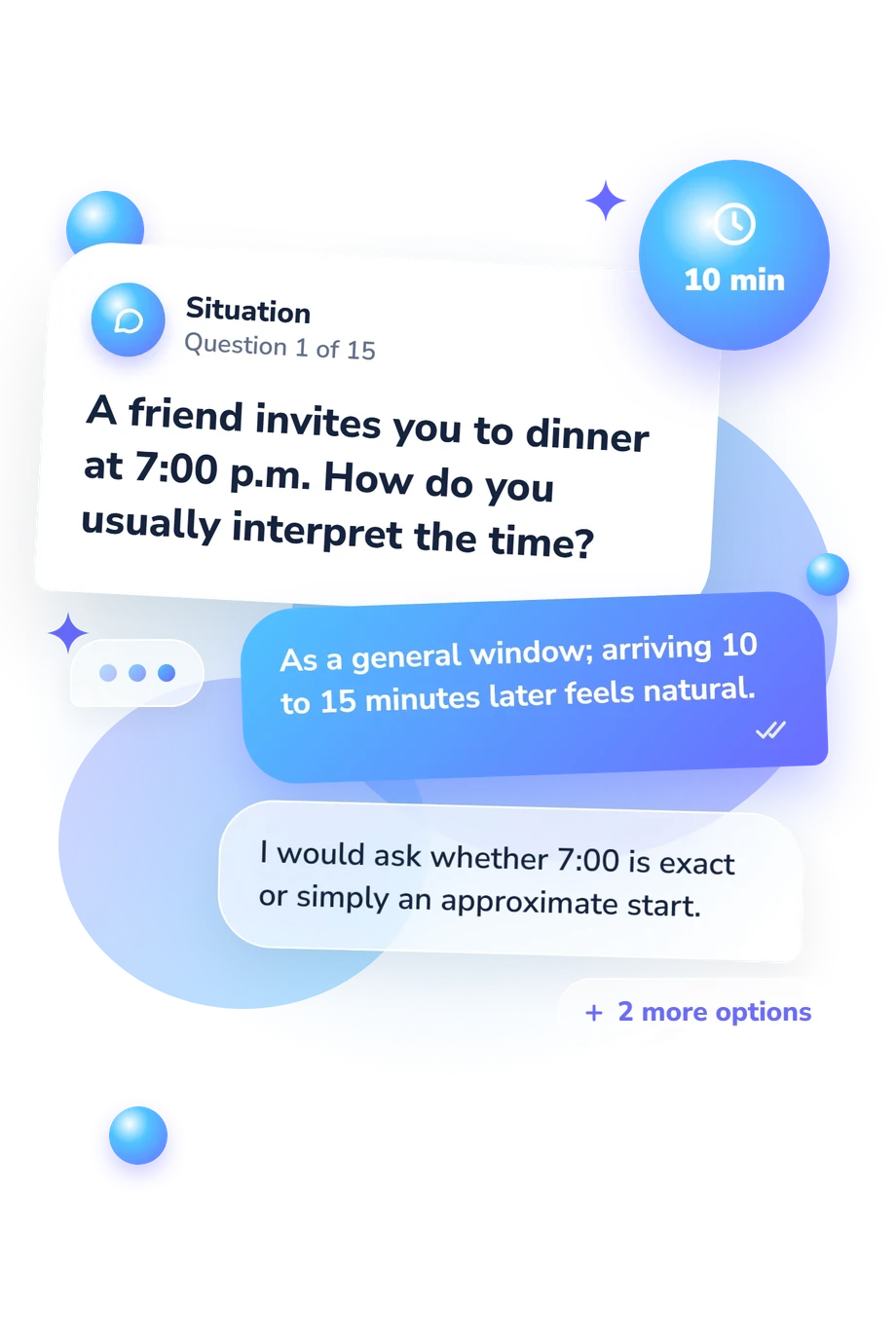
- As a general window; arriving 10 to 15 minutes later feels natural.
- I would ask whether 7:00 is exact or simply an approximate start.
- I aim to be on time and send a message if a delay becomes likely.
- I plan to arrive at 7:00 or a few minutes before, unless told otherwise.
- I usually focus on present-day life rather than historical background.
- I recognize major topics and may visit a museum or memorial when traveling.
- I can connect several historical periods or events to present-day German society.
- I actively seek multiple perspectives on German history and reflect on how memory shapes public life today.
- A quick coffee stop that could happen at almost any time.
- An informal visit where some kind of snack will probably appear.
- An afternoon social gathering centered on coffee and cake.
- A familiar afternoon custom whose exact form can vary by family and region.
How German Are You Quiz - Description and methodology of the test
For readers curious about how communication habits, cultural familiarity, and personal connection shape their relationship with Germany, the How German Are You Quiz offers a structured self-reflection profile. It suits people with German family, travel, language, media, or community experience, including anyone wondering how German they are without treating nationality as a score.
What This Test Measures
The questionnaire uses everyday situations to examine timing, direct feedback, planning, Sunday routines, language, institutions, regional customs, history, media, and community traditions. As a German culture quiz, this questionnaire lets respondents compare their experience with these contexts descriptively.
The profile has three scales:
- Communication and Planning Style (0-15) captures directness, punctuality, planning, and boundaries: Flexible Style (0-5) favors adaptability; Situational Style (6-10) blends structure and flexibility; Structured Style (11-15) favors clear plans and dependable timing.
- Everyday Cultural Fluency (0-15) reflects familiarity with German routines, language, customs, and institutions: Emerging Familiarity (0-5) indicates occasional exposure; Practical Familiarity (6-10) indicates usable recognition; Embedded Fluency (11-15) indicates highly familiar systems.
- Traditions and Cultural Connection (0-15) reflects engagement with history, regional differences, community life, and contemporary culture: Selective Connection (0-5) marks limited engagement; Active Interest (6-10) shows involvement; Deep Connection (11-15) marks recurring personal significance.
Methodology and Evidence Base
Each item presents a familiar social, cultural, or practical situation with four ordered response options. Choices move from lower to higher familiarity, engagement, directness, or planning, but the result is a profile rather than a continuum of national identity. Results are reported through the displayed bands, and each dimension is interpreted on its own terms.
The questionnaire is conceptually consistent with Alexander Thomas’s work on German cultural standards, particularly recurring themes of direct communication, time coordination, rules, and everyday context. That framework offers context for the item themes; it does not make this questionnaire Thomas’s instrument or a validated adaptation.
As an online German culture assessment, this questionnaire organizes reflection on communication preferences, cultural familiarity, and cultural connection rather than identity. Scores can reflect language learning, travel, residence, media use, family experience, or unequal opportunities. Self-report is sensitive to memory, mood, social desirability, and the situations a person chooses to compare. Read separately, they cover coordination preferences, everyday systems, and engagement with traditions and contemporary culture. The profile cannot establish nationality, heritage, citizenship, belonging, or authenticity.
- Ditlmann, Ruth K., and Johannes Kopf-Beck. “The Meaning of Being German: An Inductive Approach to National Identity.” Journal of Social and Political Psychology, vol. 7, no. 1, 2019, pp. 423-447. 10.5964/jspp.v7i1.557
- Maehler, Débora B., Anouk Zabal, and Katja Hanke. “Adults’ Identity in Acculturation Settings: The Multigroup Ethnic & National Identity Measure (MENI).” Identity, vol. 19, no. 4, 2019, pp. 245-257. 10.1080/15283488.2019.1641408
- Phinney, Jean S., and Anthony D. Ong. “Conceptualization and Measurement of Ethnic Identity: Current Status and Future Directions.” Journal of Counseling Psychology, vol. 54, no. 3, 2007, pp. 271-281. 10.1037/0022-0167.54.3.271
Updated: