
Honesty Quiz
How the Scales are Structured
Who Usually Takes This Test?
See How You Compare
Below is a preview of how scores are typically distributed across each scale.
Example Questions From the Test
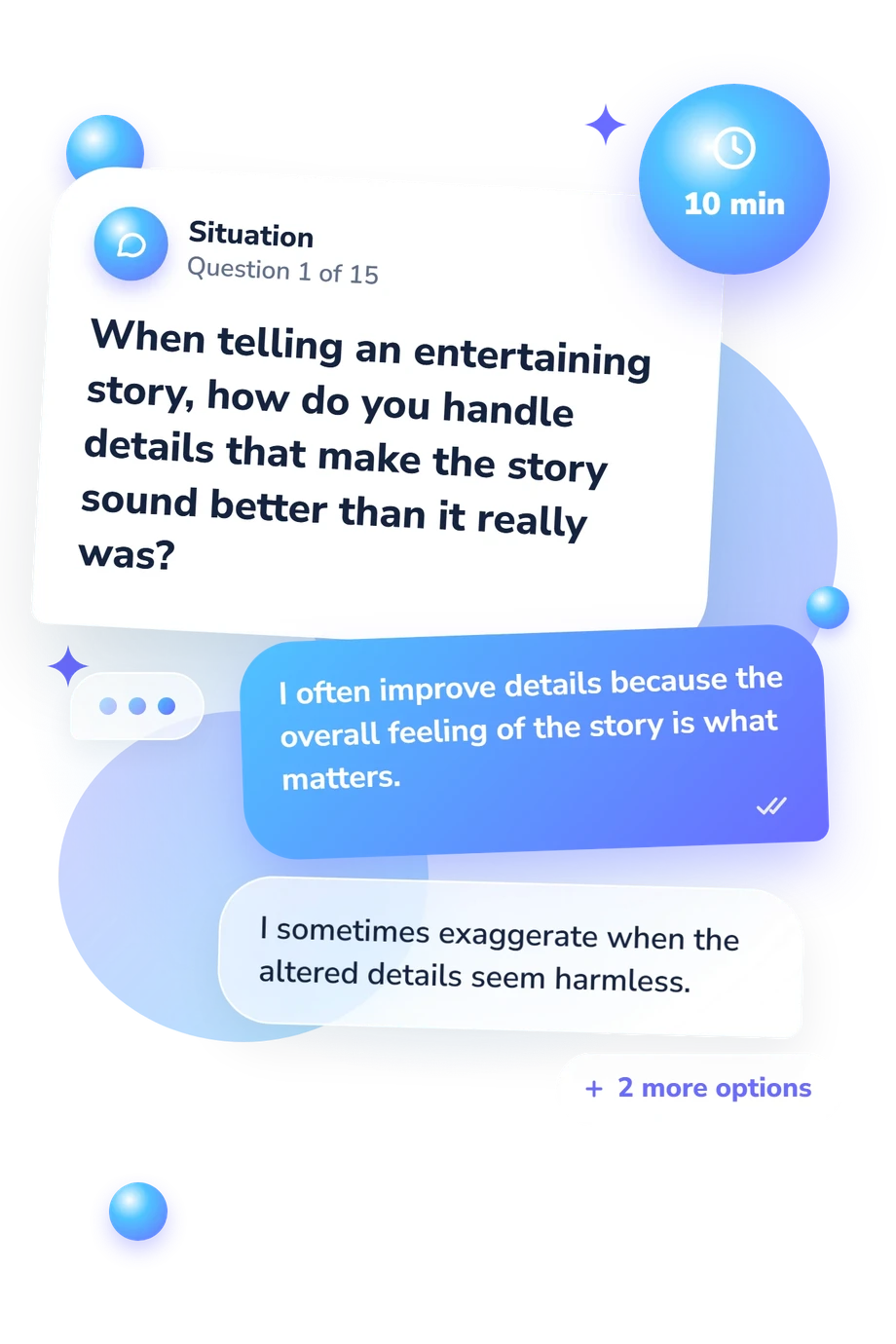
- I often improve details because the overall feeling of the story is what matters.
- I sometimes exaggerate when the altered details seem harmless.
- I may simplify details, but I avoid changing anything consequential.
- I distinguish what happened from guesses or embellishment, even if the story is less impressive.
- Say it is fine so the moment can pass without conflict.
- Hint that something felt off and hope they understand.
- Say I was bothered but ask to discuss the details later.
- Explain calmly what bothered me and why it mattered.
- Give an invented but believable answer to avoid awkwardness.
- Redirect the conversation without addressing the question.
- Offer a limited but truthful answer that preserves my privacy.
- Say directly that I would rather not answer that question.
Honesty Quiz - Description and methodology of the test
People who want to examine how they handle uncomfortable truths, responsibility, boundaries, and conflict may find the honesty quiz useful for focused self-reflection. Framed as a how honest are you quiz, it turns familiar dilemmas into a profile for readers who want to notice whether their choices reflect candor, genuine values, and willingness to repair harm, without reducing honesty to blunt disclosure.
What This Assessment Explores
Honesty here means more than factual accuracy. The items examine choices made when truth could threaten approval, comfort, status, privacy, or being right. The result does more than answer the familiar are you honest quiz question: it separates accountability, inner alignment, and communication, allowing a profile to show different patterns rather than one moral verdict.
The three displayed dimensions are:
- Accountability and Repair (0-15) shows whether you name your part, correct misleading impressions, and participate in repair; its bands are Self-protective response (0-5), Emerging ownership (6-10), and Active accountability (11-15).
- Personal Congruence (0-15) shows how your expressed feelings, motives, limits, and choices align with genuine values; its bands are Adapted alignment (0-5), Developing congruence (6-10), and Strong congruence (11-15).
- Transparent Communication (0-15) shows how you share relevant truth while protecting tact and privacy; its bands are Guarded (0-5), Selective (6-10), and Consistently candid (11-15).
Methodology and Evidence Base
The questionnaire presents 15 everyday dilemmas with four response options. They generally move from concealment, minimization, or indirectness toward acknowledgment, truthful limits, and repair, while leaving room for tact and privacy. As an honesty test, it asks you to choose the response closest to your usual tendency rather than an idealized self-image.
Results provide three separate dimension scores. It gives descriptive ranges and bands, but no point-by-point weighting rule, norm group, reliability estimate, or standardized cutoff. The labels should therefore be read as profile descriptions attached to this questionnaire, not as rankings against a validated population.
Its evidence base is conceptual. Reynolds et al. (2025) offers a trait-and-state framework for truthfulness; Furr et al. (2022) is relevant to moral character and responsibility; and Wood et al. (2008) provides an authenticity framework relevant to personal congruence. The questionnaire is not presented as an adaptation of those instruments.
Self-reported answers can shift with current emotion, self-awareness, and impression management. Use the profile to identify patterns worth examining alongside repeated behavior and the perspectives of people involved.
- Reynolds, C. J., Jayawickreme, E., Wheat, R., Stokes, E., Santos, C., Fleeson, W., & Furr, R. M. (2025). Honesty as truthfulness: New trait and state measures of truthfulness to advance research and theorizing on when and why people are honest. European Journal of Personality. Advanced online publication. 10.1177/08902070251338199
- Furr, R. M., Prentice, M., Hawkins Parham, A., & Jayawickreme, E. (2022). Development and validation of the Moral Character Questionnaire. Journal of Research in Personality, 98, 104228. 10.1016/j.jrp.2022.104228
- Wood, A. M., Linley, P. A., Maltby, J., Baliousis, M., & Joseph, S. (2008). The authentic personality: A theoretical and empirical conceptualization and the development of the Authenticity Scale. Journal of Counseling Psychology, 55(3), 385-399. 10.1037/0022-0167.55.3.385
Updated: