
Harry Potter Soulmate Quiz
How the Scales are Structured
Who Usually Takes This Test?
See How You Compare
Below is a preview of how scores are typically distributed across each scale.
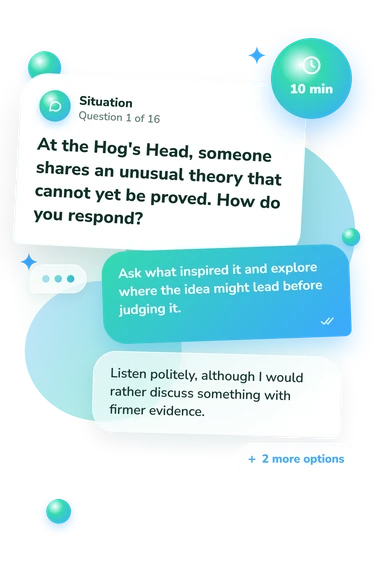
Example Questions From the Test
- Ask what inspired it and explore where the idea might lead before judging it.
- Listen politely, although I would rather discuss something with firmer evidence.
- Compare it with what is known while leaving room for a surprising possibility.
- Redirect the conversation toward a familiar subject everyone can discuss easily.
- Offer private support and let them decide whether they want the issue challenged.
- Document what happened, identify the faulty rule, and make a clear case for changing it.
- Avoid escalating matters unless the person directly asks me to intervene.
- Bring the people involved together and look for a practical compromise.
- Talking through both perspectives and agreeing on a fair, workable resolution.
- Letting the tension pass naturally without analyzing every part of it.
- Reconnecting warmly first and returning to the details only if needed.
- Examining what was said, correcting mistaken assumptions, and deciding what should change.
Harry Potter Soulmate Quiz - Description and methodology of the test
Fans who want to connect fictional chemistry with their own preferences can use this assessment as a playful relationship-style profile. The Harry Potter Soulmate Quiz is intended for readers curious about which character’s habits, values, and emotional rhythms may feel most compatible with theirs. Readers asking who their Harry Potter soulmate might be can use the result to reflect on loyalty, openness, planning, and spontaneity.
What This Assessment Explores
Scenarios cover uncertainty, disagreement, support, planning, loyalty, and change. They turn relationship choices into character-style comparisons, not rankings of character worth. A female-character soulmate match from the quiz shows how your preferences align with different ways of thinking, bonding, and responding under pressure. These four profiles are displayed:
- Hermione Granger Match - Gryffindor (0-12) measures structured, evidence-minded partnership; Different Rhythm (0-4), Shared Ground (5-8), and Strong Affinity (9-12) show fit.
- Luna Lovegood Match - Ravenclaw (0-12) measures curiosity and comfort with unusual ideas; Different Rhythm (0-4), Shared Ground (5-8), and Strong Affinity (9-12) show fit.
- Narcissa Malfoy Match - Slytherin (0-12) measures discretion, strategy, and inner-circle loyalty; Different Rhythm (0-4), Shared Ground (5-8), and Strong Affinity (9-12) show fit without endorsing every canon choice.
- Nymphadora Tonks Match - Hufflepuff (0-12) measures warmth, flexibility, and playful resilience; Different Rhythm (0-4), Shared Ground (5-8), and Strong Affinity (9-12) show fit.
Methodology and Evidence Base
Each item presents a brief Hogwarts situation and four possible reactions. Choices address conflict repair, boundaries, private loyalty, curiosity, social composure, adaptability, and planning; respondents select the response closest to their usual preference.
Responses are combined into four displayed match scores, but the questionnaire does not state how many points each answer contributes. The highest profile is the strongest affinity, while scores within one point form a blended result; the scoring has not been standardized against published population norms.
Conceptually, this Hogwarts soulmate quiz format is consistent with Crysel et al. (2015), which linked Hogwarts houses with broad personality traits. Jakob et al. (2019) examined the Sorting Hat format alongside personality and human values. This questionnaire is not an adaptation or standardized reproduction of either study. Malouff et al. (2010) adds relationship context by connecting partner personality compatibility with satisfaction, not by validating these character-specific scores.
Self-report answers can shift with mood, current relationship experiences, self-awareness, and identification with a favored character, so the result is best read as a snapshot of stated preferences rather than a fixed type.
- Laura C. Crysel, Corey L. Cook, Tatiana Orozco Schember, and Gregory D. Webster (2015). Harry Potter and the measures of personality: Extraverted Gryffindors, agreeable Hufflepuffs, clever Ravenclaws, and manipulative Slytherins. Personality and Individual Differences, 83, 174-179. 10.1016/j.paid.2015.04.016
- Lea Jakob, Eduardo Garcia-Garzon, Hannes Jarke, and Fabian Dablander (2019). The Science Behind the Magic? The Relation of the Harry Potter “Sorting Hat Quiz” to Personality and Human Values. Collabra: Psychology, 5(1), Article 31. 10.1525/collabra.240
- John M. Malouff, Einar B. Thorsteinsson, Nicola S. Schutte, Navjot Bhullar, and Sally E. Rooke (2010). The Five-Factor Model of personality and relationship satisfaction of intimate partners: A meta-analysis. Journal of Research in Personality, 44(1), 124-127. 10.1016/j.jrp.2009.09.004