
Gift Finder Quiz
How the Scales are Structured
Who Usually Takes This Test?
See How You Compare
Below is a preview of how scores are typically distributed across each scale.
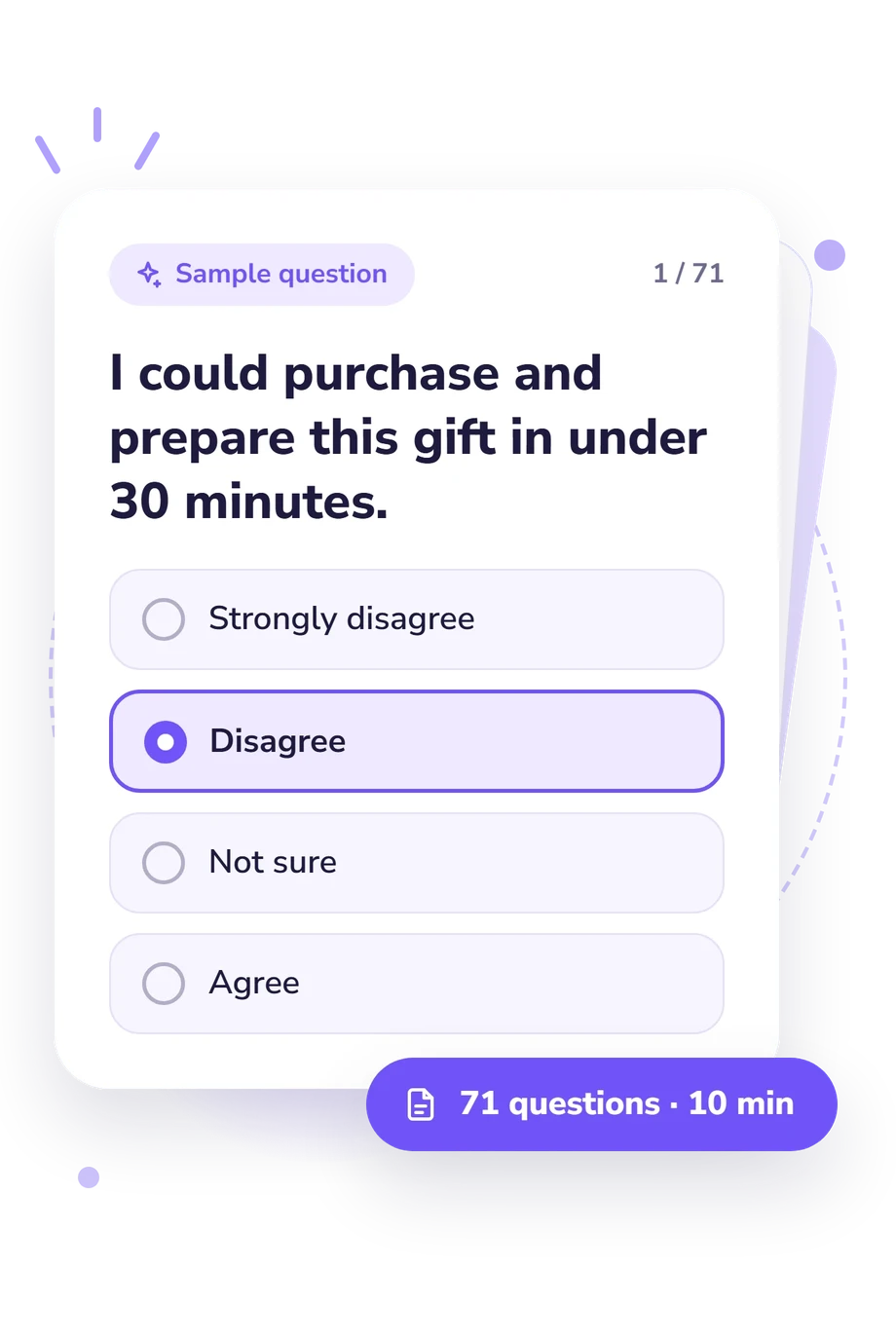
Example Questions From the Test
- Strongly disagree
- Disagree
- Not sure
- Agree
- Strongly disagree
- Disagree
- Not sure
- Agree
- Strongly disagree
- Disagree
- Agree
- Strongly agree
Gift Finder Quiz - Description and methodology of the test
Choosing a present can be difficult when price, personal meaning, and practical effort pull in different directions. This gift finder quiz is intended for people who want to compare those priorities before buying, whether they are shopping for someone close, a colleague, or a recipient whose preferences are not fully known. This gift quiz result turns those choices into a readable profile of how this assessment balances recommendation priorities.
What This Assessment Explores
The questions focus on spending fit, personal relevance, and the effort required to source, send, and use a present. They suit shoppers making an everyday choice, including situations where the recipient’s preferences or the relationship are only partly known. For Christmas shopping, this assessment can serve as a Christmas gift quiz, while its result concerns recommendation fit rather than a particular date.
The result is organized around three dimensions:
- Budget Range Fit (0-20) measures alignment with the stated budget: Low fit 0-8, Moderate fit 9-14, High fit 15-20.
- Personalization Level (0-20) measures how tailored and relationship-specific the ideas are: General 0-7, Personalized 8-14, Highly tailored 15-20.
- Practicality & Ease (0-20) measures sourcing, delivery, effort, and everyday usefulness: Logistics-Heavy 0-7, Moderately Easy 8-14, Highly Practical 15-20.
Together, the profile shows which trade-offs the recommendations handle well and where expectations may need adjustment.
Methodology and Scientific Basis
The questionnaire uses self-report judgments about gift situations and recommendations. Response options are ordered agreement choices ranging from Strongly disagree to Agree, with some items adding Not sure or Strongly agree. Statements address budget realism, personal tailoring, shipping, availability, timing, returns, coordination, and everyday usefulness. The questionnaire functions as a find the perfect gift quiz, converting these judgments into three 0-20 dimensions; the format does not establish how many points each answer contributes.
Research by Fu and colleagues in 2024 on AI gift recommendation tools considers social closeness in evaluating suggestions. Studies by Baskin and colleagues in 2014, Steffel and LeBoeuf in 2014, and Choe and colleagues in 2023 address feasibility, overindividuation, and gift budgeting. The questionnaire is conceptually consistent with these findings, not an adaptation of them; those studies did not validate this online questionnaire.
Interpret the bands as descriptions of recommendation fit rather than clinical thresholds; this questionnaire has no established population norms. Self-report answers may shift with the occasion, knowledge of the recipient, prices, and delivery conditions, so the profile is best used to compare trade-offs before purchase.
- Fu, Y., Dose, D. B., & Dimitriu, R. (2024). Gift Giving in the Age of AI: The Role of Social Closeness in Using AI Gift Recommendation Tools. Psychology & Marketing, 41(10), 2214-2238. 10.1002/mar.22050
- Baskin, E., Wakslak, C. J., Trope, Y., & Novemsky, N. (2014). Why Feasibility Matters More to Gift Receivers than to Givers: A Construal-Level Approach to Gift Giving. Journal of Consumer Research, 41(1), 169-182. 10.1086/675737
- Steffel, M., & LeBoeuf, R. A. (2014). Overindividuation in Gift Giving: Shopping for Multiple Recipients Leads Givers to Choose Unique but Less Preferred Gifts. Journal of Consumer Research, 40(6), 1167-1180. 10.1086/674199
- Choe, Y., Kan, C., & Polman, E. (2023). Divergent Effects of Budgeting for Gifts versus Personal Purchases. Journal of Consumer Research, 50(3), 576-596. 10.1093/jcr/ucad011
Updated: