
Gettysburg Quiz
How the Scales are Structured
Who Usually Takes This Test?
See How You Compare
Below is a preview of how scores are typically distributed across each scale.
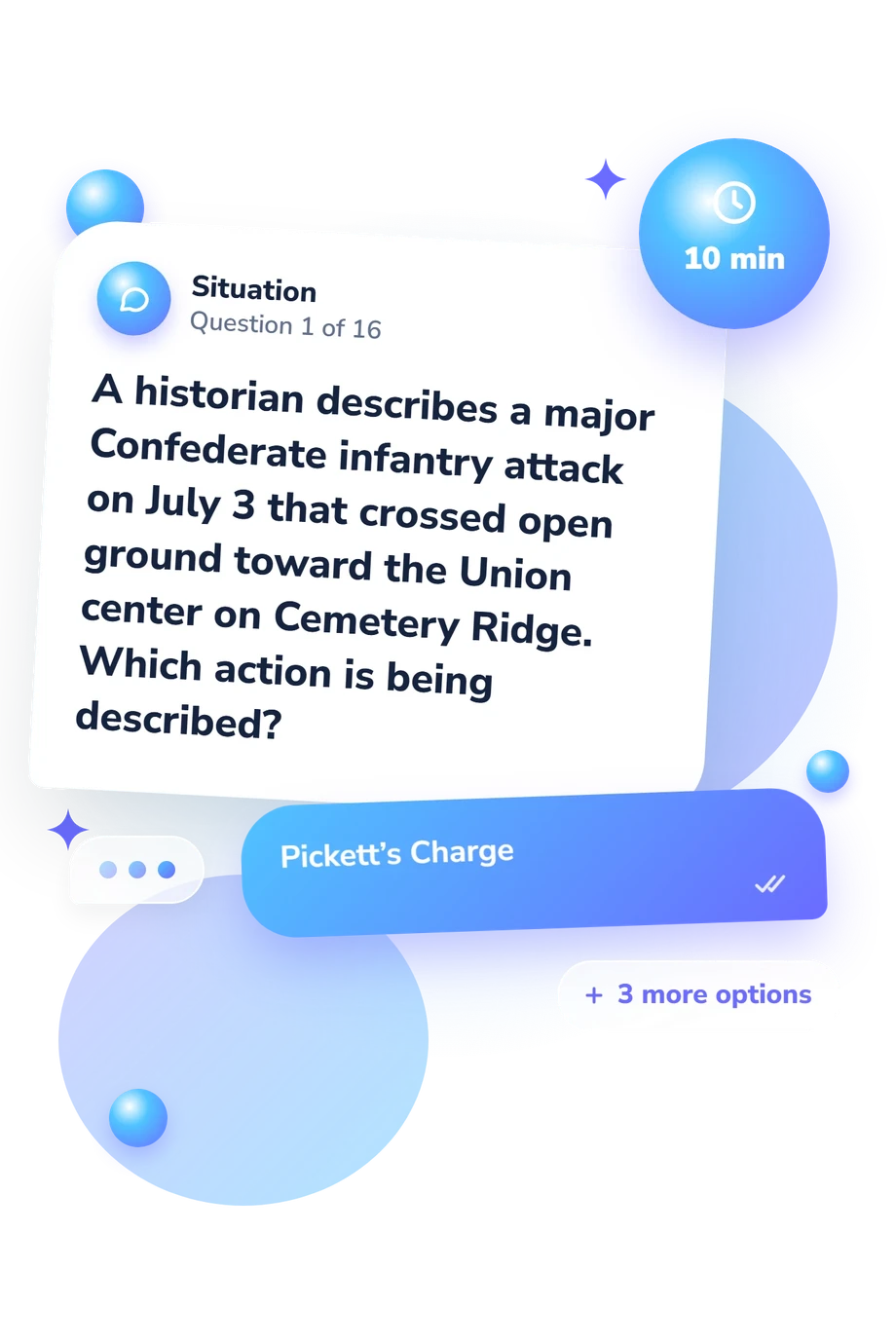
Example Questions From the Test
- September 17–19, 1862
- July 1–3, 1863
- May 1–3, 1863
- November 19–21, 1863
- Joshua Lawrence Chamberlain and the 20th Maine Infantry
- J. E. B. Stuart and the Confederate cavalry
- George Pickett and the Virginia divisions
- John Buford and the 1st Minnesota Infantry
- Lee’s army withdrew from Gettysburg and retreated toward Virginia
- Meade surrendered the Army of the Potomac to Lee
- The Confederate Army occupied Philadelphia
- Both armies remained at Gettysburg until the war ended
Gettysburg Quiz - Description and methodology of the test
Readers who want to test their grasp of the Civil War’s pivotal campaigns can use this Gettysburg Quiz to connect dates, decisions, terrain, and public memory. It suits learners, battlefield visitors, and anyone revisiting the conflict through a focused quiz about the Battle of Gettysburg. The exercise emphasizes why events unfolded, not only whether a name or date looks familiar.
What This Assessment Explores
The questionnaire measures knowledge across chronology, command decisions, battlefield geography, operational consequences, and the Gettysburg Address. Items ask you to identify major actions and explain why Cemetery Hill, Little Round Top, and the town’s roads mattered. The result connects historical knowledge about Gettysburg with place and purpose, showing whether recognition extends to meaning.
Four themes organize the result:
- Events and chronology show whether you place major phases, dates, and retreat in sequence.
- Command and operations indicate whether you recognize leaders, missions, and decisions.
- Terrain and tactics reveal how elevations, open ground, roads, and defensive positions shaped action.
- Address and legacy connect Lincoln’s speech and commemoration with the conflict’s wider meaning.
Gettysburg Knowledge runs from 0-16. Foundations to build (0-6) indicates basic recognition; Developing knowledge (7-12) reflects a solid working grasp; Strong knowledge (13-16) signals a well-developed understanding of events, strategy, and commemoration.
Methodology and Evidence Base
Each item presents a historical question with four answer choices. The format combines recall of dates and commanders with interpretation of cause, tactical exposure, operational purpose, and significance. Several prompts distinguish nearby places or related events, so correct responses depend on context rather than isolated name recognition.
Scoring is straightforward: one point is awarded for each correct answer, and the total maps to the displayed result band. The score describes the Gettysburg knowledge demonstrated by this questionnaire; it does not estimate complete campaign knowledge or determine historical expertise.
The questionnaire is conceptually consistent with the Gettysburg campaign guide by Luvaas and Nelson, while Hessler and Motts provide focused context for Pickett’s Charge and Coddington frames command decisions across the campaign. Schwartz’s study supports treating the Gettysburg Address and its commemoration as public memory, not merely quotation recall.
Because the questions sample selected battles, places, leaders, and commemoration themes rather than every aspect of the campaign, results can reflect prior study, wording interpretation, and current recall. Use them to choose topics for further reading when precision matters.
- Luvaas, Jay, and Harold W. Nelson, eds. Guide to the Battle of Gettysburg. 2nd ed., revised and expanded. University Press of Kansas, 2012.
- Hessler, James A., Wayne E. Motts, and Steven A. Stanley. Pickett’s Charge at Gettysburg: A Guide to the Most Famous Attack in American History. Savas Beatie, 2015.
- Coddington, Edwin B. The Gettysburg Campaign: A Study in Command. Charles Scribner’s Sons, 1968.
- Schwartz, Barry. “Rereading the Gettysburg Address: Social Change and Collective Memory.” Qualitative Sociology 19, no. 3 (1996): 395-422. 10.1007/BF02393278.
Updated: