
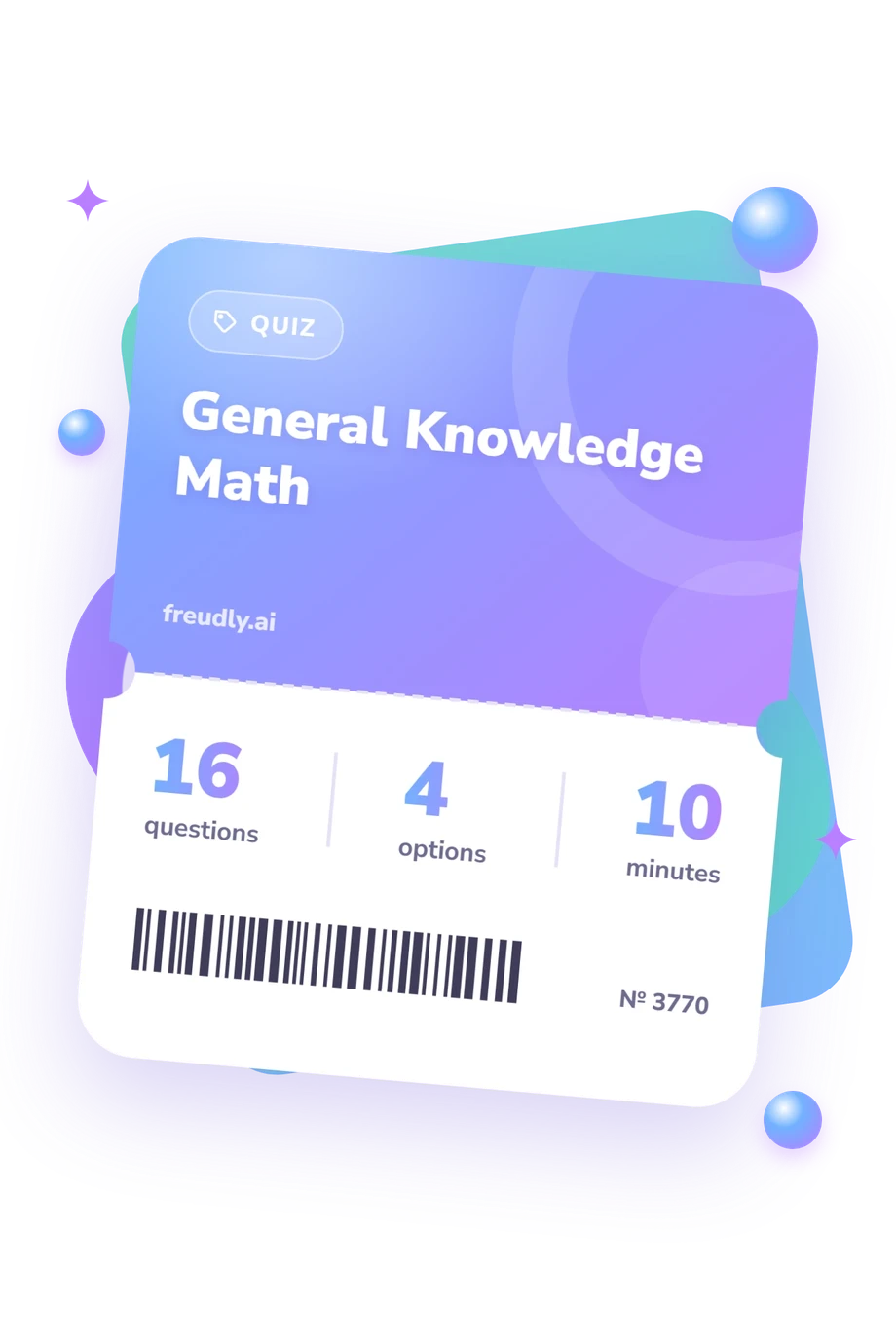
General Knowledge Math Quiz
How the Scales are Structured
Who Usually Takes This Test?
See How You Compare
Below is a preview of how scores are typically distributed across each scale.
Example Questions From the Test
- 20
- 24
- 18
- 14
- 120 miles
- 150 miles
- 144 miles
- 180 miles
- x = 3
- x = 5
- x = 7
- x = 29/3
General Knowledge Math Quiz - Description and methodology of the test
People who want to refresh everyday numeracy or check which school-level skills feel secure can use this short assessment as a structured starting point. The general knowledge math quiz focuses on practical reasoning rather than advanced theory. Its math quiz questions cover familiar calculations and situations, giving learners and independent adults a clear basis for choosing what to review next.
What This Assessment Explores
The questionnaire samples practical mathematics through operations, equations, powers, fractions, percentages, rates, conversions, averages, probability, primes, area, perimeter, and angles. These mathematics quiz questions require the respondent to select and apply the relationship that solves a familiar problem, so the result reflects calculation and interpretation.
Results appear on one descriptive scale: General Knowledge Math Knowledge (0-16). Its bands are Foundations to strengthen (0-6), Developing (7-12), and Strong (13-16). They indicate whether the sampled content calls for core review, continued practice, or extension.
The main areas represented are:
- Number and algebra show how accurately you handle operations, powers, equations, and prime numbers.
- Proportion and measurement show how you work with rates, percentages, conversions, and quantities.
- Geometry shows how you apply formulas and relationships involving area, perimeter, and angles.
- Data and probability show how you interpret means, medians, fractions, and simple chances.
Methodology and Scientific Basis
Each item uses four answer options, and the score counts correct selections. The format asks respondents to choose one of four options for each item, using a set of maths quiz questions with answers to assess recognition, calculation, and concise application rather than written solutions.
Content selection is conceptually consistent with the TIMSS mathematics framework (2019), covering number, measurement, geometry, data, and reasoning. Within that context, the items represent mathematical knowledge, calculation, and basic reasoning rather than establishing coverage of every strand in the five-strand model described by Kilpatrick, Swafford, and Findell (2001). The questionnaire is not an adaptation of either source; its online content sample uses mathematics quiz questions and answers without reproducing a published instrument.
The score is descriptive, and this quiz is not a standardized or norm-referenced assessment. AERA, APA, and NCME (2014) standards support interpreting scores in relation to purpose and evidence. Concentration, prior teaching, and familiarity with the format may affect performance, so use the overall band for broad review guidance and treat the total as a snapshot of this quiz.
- Lindquist, M., Philpot, R., Mullis, I. V. S., & Cotter, K. E. (2019). TIMSS 2019 Mathematics Framework. In I. V. S. Mullis & M. O. Martin (Eds.), TIMSS 2019 Assessment Frameworks (pp. 11-26). TIMSS & PIRLS International Study Center, Boston College, and International Association for the Evaluation of Educational Achievement. ISBN 978-1-889938-41-7.
- National Research Council. (2001). Adding It Up: Helping Children Learn Mathematics. Edited by Jeremy Kilpatrick, Jane Swafford, and Bradford Findell. Washington, DC: National Academy Press. DOI 10.17226/9822.
- American Educational Research Association, American Psychological Association, & National Council on Measurement in Education. (2014). Standards for Educational and Psychological Testing. Washington, DC: American Educational Research Association. ISBN 978-0-935302-35-6.
Updated: