
Full Pottermore Quiz with Percentages
How the Scales are Structured
Who Usually Takes This Test?
See How You Compare
Below is a preview of how scores are typically distributed across each scale.
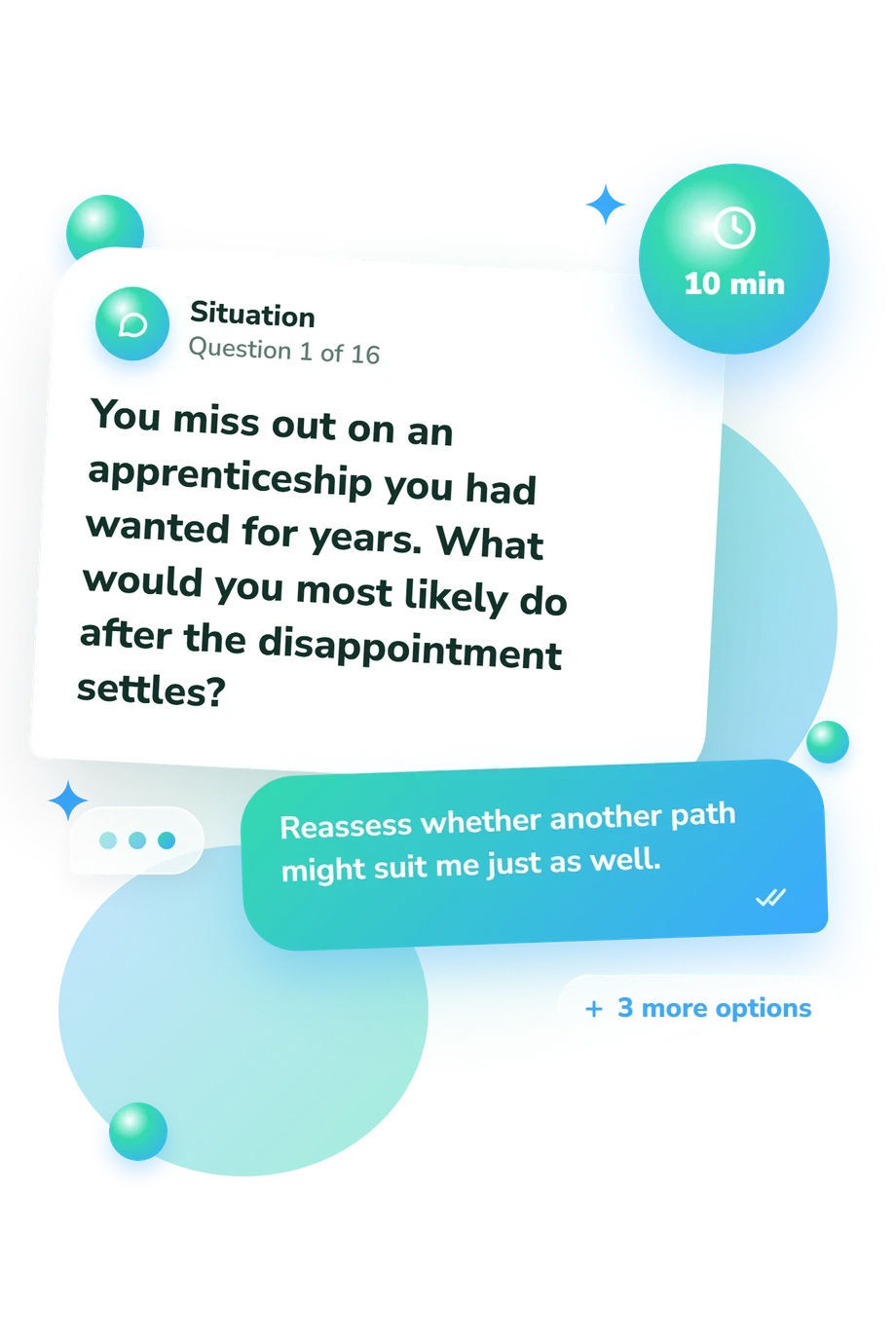
Example Questions From the Test
- Reassess whether another path might suit me just as well.
- Ask for feedback and strengthen the weakest part of my application.
- Map alternative routes to the same goal, build relevant alliances, and prepare for the next opening.
- Seek a related opportunity that keeps some progress going without committing to the original goal.
- Apply only if someone personally encourages me to consider it.
- Decide whether the role fits my goals, then prepare a deliberate case for why I should be chosen.
- Let the more enthusiastic candidates compete for it and focus elsewhere.
- Apply with a clear account of what I have already contributed.
- Take the task that best matches my particular skills so the group finishes efficiently.
- Let everyone choose freely, then select whichever interesting task remains.
- Accept my assigned share and make sure it is completed reliably.
- Help divide the work evenly and take an unpopular task if needed.
Full Pottermore Quiz with Percentages - Description and methodology of the test
People who want a playful but structured way to reflect on Hogwarts-style preferences can use the Full Pottermore Quiz with Percentages to compare four house affinities. Presented as a Harry Potter sorting quiz with percentages, it turns situational choices into a profile rather than a single personality label. It suits fans, curious self-observers, and anyone interested in how courage, loyalty, curiosity, and ambition appear in everyday decisions.
What This Assessment Explores
Questions place you in situations involving setbacks, public challenges, group duties, scarce resources, loyalty, fairness, learning, and responsibility. The profile shows which house qualities are strongest; close scores can indicate a blended result. For an in-depth Hogwarts house quiz percentage profile, compare house percentages across situations rather than treating the outcome as a fixed identity.
The four affinity scales are:
- Gryffindor (0-12) shows an affinity for bold action: Measured Nerve (0-4), preparation; Emerging Bravery (5-8), uncertainty; Daring Spirit (9-12), visible challenges.
- Hufflepuff (0-12) shows an affinity for belonging: Independent Contributor (0-4), personal contribution; Steady Ally (5-8), cooperation; Loyal Heart (9-12), fairness and inclusion.
- Ravenclaw (0-12) shows an affinity for ideas: Practical Thinker (0-4), usable answers; Active Learner (5-8), inquiry; Inquiring Mind (9-12), difficult puzzles.
- Slytherin (0-12) shows an affinity for purpose: Flexible Course (0-4), adaptation; Purposeful Planner (5-8), aims; Ambitious Strategist (9-12), advancement.
Methodology and Scientific Basis
Each item presents a short Hogwarts situation with four response options. They cover pressure, cooperation, uncertainty, recognition, evidence, and opportunity, so the respondent chooses a likely action rather than rates an abstract trait. This is structured self-report, not an open-ended interview.
The four house scores are converted to percentages by dividing each score by 12 and multiplying by 100. The highest score indicates strongest affinity; a score within one point joins a blended profile, while tied highs indicate equal affinities. The percentages from this sorting-hat quiz are comparative, not a ranking of personal worth.
Methodologically, the questionnaire is conceptually consistent with the Sorting Hat Quiz studied by Crysel and colleagues, which examined house-linked personality patterns, and with Jakob and colleagues’ work linking the quiz with human values. Rowling’s house descriptions supply the fictional vocabulary. This online version is not an adaptation of those studies; the cited studies do not provide norms for this online questionnaire. Mood, context, interpretation, and self-presentation can also affect self-report results.
- Crysel, L. C., Cook, C. L., Schember, T. O., and Webster, G. D. (2015). Harry Potter and the measures of personality: Extraverted Gryffindors, agreeable Hufflepuffs, clever Ravenclaws, and manipulative Slytherins. Personality and Individual Differences, 83, 174-179. 10.1016/j.paid.2015.04.016
- Jakob, L., Garcia-Garzon, E., Jarke, H., and Dablander, F. (2019). The Science Behind the Magic? The Relation of the Harry Potter “Sorting Hat Quiz” to Personality and Human Values. Collabra: Psychology, 5(1), 31. 10.1525/collabra.240
- Rowling, J. K. (1997). Harry Potter and the Philosopher’s Stone. London: Bloomsbury.
Updated: