
Figures of Speech Quiz
How the Scales are Structured
Who Usually Takes This Test?
See How You Compare
Below is a preview of how scores are typically distributed across each scale.
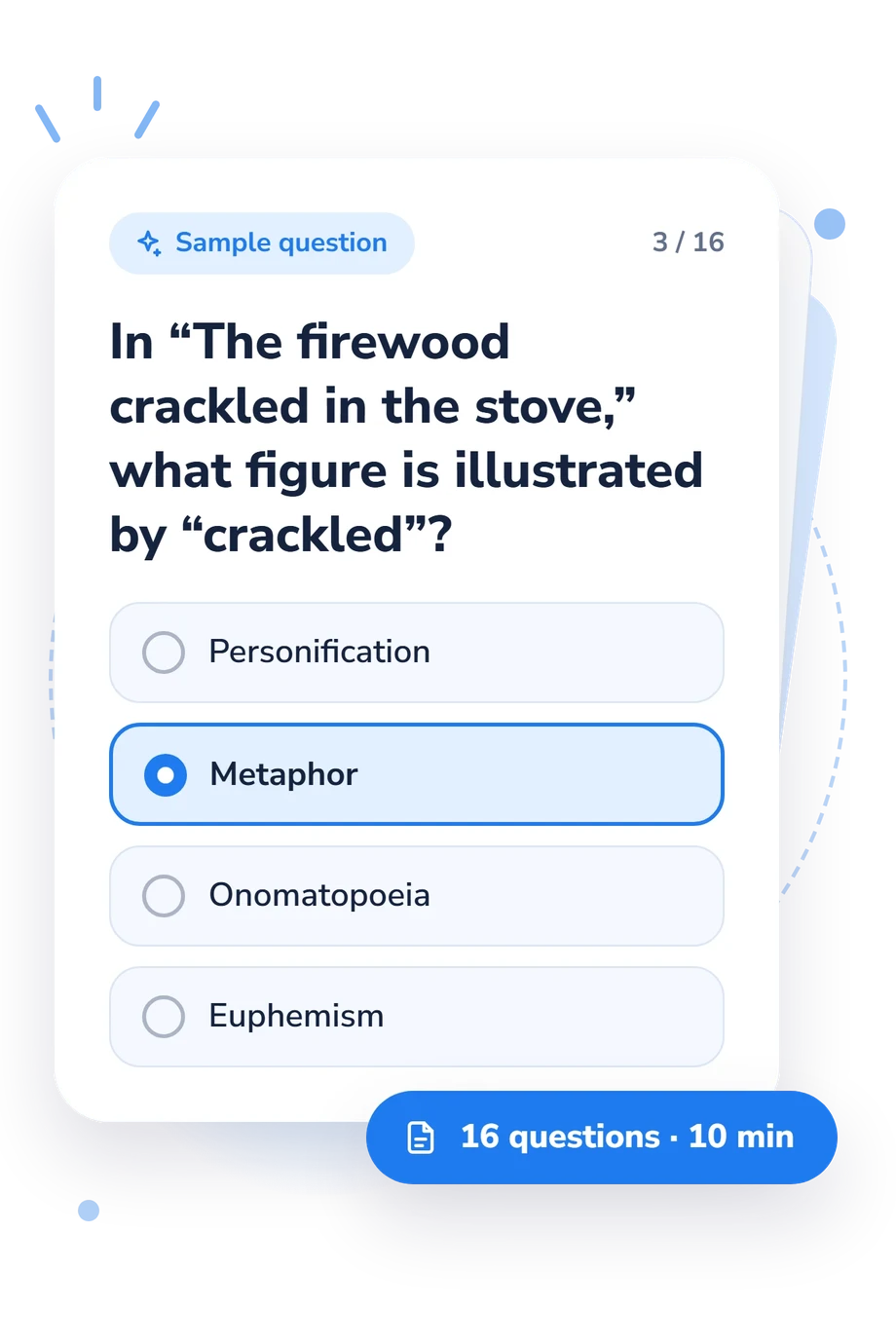
Example Questions From the Test
- Dramatic irony
- Verbal irony
- Hyperbole
- Situational irony
- Understatement
- Paradox
- Apostrophe
- Onomatopoeia
- Personification
- Metaphor
- Onomatopoeia
- Euphemism
Figures of Speech Quiz - Description and methodology of the test
Readers who want to check literary language can use this figures of speech quiz to connect terms with meaning in context. It suits students, teachers, writers, and curious readers who want a focused assessment of rhetorical devices rather than a broad measure of English ability. Questions in this figurative speech quiz span irony, metaphor, sound devices, and euphemism, making this assessment useful for reviewing classroom concepts or testing close reading.
What This Assessment Measures
These devices shape tone, comparison, emphasis, sound, and implied meaning. This multiple-choice quiz about figures of speech tests more than terminology: some items ask what a device contributes to a sentence or situation.
The main groups represented are:
- Comparison and substitution show whether you distinguish simile, metaphor, metonymy, and synecdoche.
- Tone and contrast show how you interpret irony, understatement, hyperbole, euphemism, and oxymoron.
- Human qualities, direct address, and sound show whether you identify personification, apostrophe, alliteration, and onomatopoeia in context.
The Figures of Speech Knowledge score runs from 0-16, with one point for each correct answer. Foundations 0-6 may benefit from reviewing key definitions and examples; Developing 7-12 reflects understanding of many common devices with distinctions to sharpen; Strong 13-16 reflects consistent command of how figures work in context. The profile points to useful practice topics.
Methodology and Conceptual Background
Each item presents a short example, quotation, or situation with four answer choices. Some questions ask you to name the device; others ask about its effect or require a metaphor-to-simile revision. This structure checks terminology and contextual reasoning. Together, these tasks require recall of a label and attention to how figurative language functions in context.
For this rhetorical devices test, the score is a direct tally: each correct response adds one point, and the total is interpreted through the displayed performance bands. Results are a snapshot of current recognition and interpretation, not evidence of complete mastery.
Harris and Lanham provide conceptual background for the terminology and examples, while Lakoff and Turner's conceptual-metaphor framework supports reading metaphor as meaning shaped by comparison. The questionnaire is conceptually consistent with these works; they provide background for its content, not validation or standardization of the online test.
Performance can vary with prior instruction, familiarity with labels, attention to wording, and current context. The result is most useful for selecting review topics and guiding practice across varied reading and writing.
- Harris, Robert A. Writing with Clarity and Style: A Guide to Rhetorical Devices for Contemporary Writers. 2nd ed. Routledge, 2018. 10.4324/9780203712047.
- Lanham, Richard A. A Handlist of Rhetorical Terms. 2nd ed. University of California Press, 1991. 10.1525/9780520912045.
- Lakoff, George, and Mark Turner. More than Cool Reason: A Field Guide to Poetic Metaphor. University of Chicago Press, 1989. ISBN: 9780226468129.
Updated: