
Fiction and Nonfiction Quiz
How the Scales are Structured
Who Usually Takes This Test?
See How You Compare
Below is a preview of how scores are typically distributed across each scale.
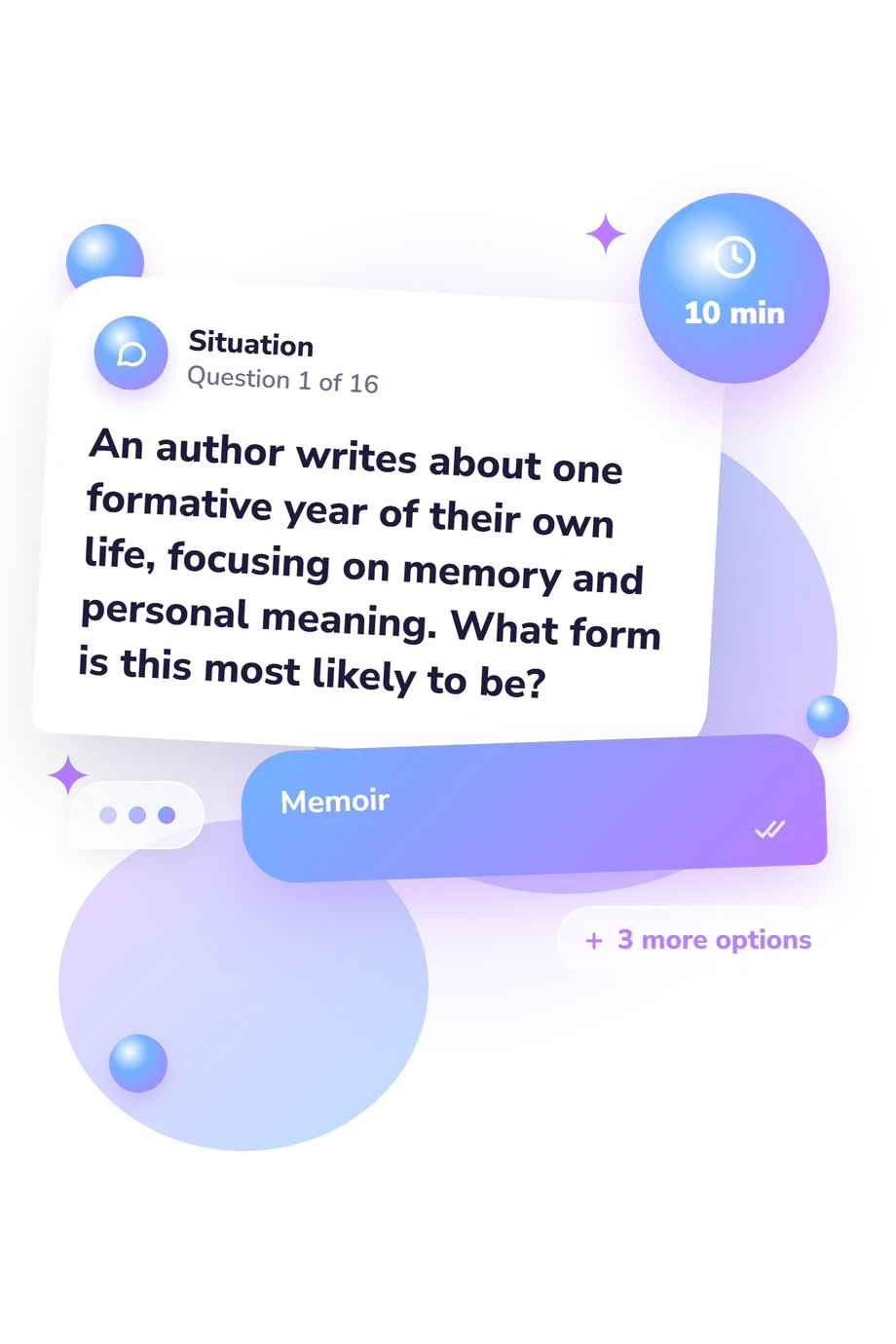
Example Questions From the Test
- Memoir, because it uses diary entries
- Autobiography, because it uses a first-person voice
- Fiction, because the presented life and events are invented
- Biography, because it describes a person's life
- Fantasy
- Realistic fiction
- Historical fiction
- Science fiction
- Reference writing
- Narrative nonfiction
- Biography
- Fiction
Fiction and Nonfiction Quiz - Description and methodology of the test
Readers who want to make more confident decisions about labels, sources, and narrative status can use the fiction and nonfiction quiz to examine how they approach books, articles, and other texts. People interested in literature, journalism, history, or careful reading can approach this non fiction quiz without specialist training. Its result shows which distinctions and interpretive principles deserve closer attention.
What This Assessment Measures
The questions test whether readers separate invented events from claims presented as factual and recognize forms that mix documentary material with narrative technique. Scenarios cover memoir, biography, historical fiction, fantasy, narrative nonfiction, satire, and argumentative essays, making the task one of classification and interpretation.
The genre questions also examine an author's relationship to the material, narrative reliability, and the role of evidence across fiction and nonfiction genres. It suits readers who want to understand why a label fits rather than rely on surface familiarity.
The result appears on the Fiction and Nonfiction Knowledge scale, ranging from 0-16, in bands:
- Foundation to Build (0-6) indicates emerging distinctions, though genres or evidence conventions may blur.
- Developing Knowledge (7-12) shows that important differences apply in familiar cases.
- Strong Knowledge (13-16) shows consistent recognition of major forms, conventions, and uses of evidence.
Methodology and Evidence Base
The fiction and nonfiction test uses multiple-choice items built around short literary or nonfiction scenarios and four answer choices. Each response asks for the best classification or principle. The displayed score awards one point for each correct answer and is interpreted through the three result bands for the scale.
Its conceptual framework is consistent with Amores Fúster (2019), who distinguishes fiction and non-fiction through how meaning and reference are organized. Slugan and Terrone (2021) place the distinction in conversation with documentary studies and analytic aesthetics. Currie's work supports attention to invention, narration, and represented events, while Lejeune helps clarify memoir and autobiographical writing. The questionnaire is conceptually consistent with these works, not an adaptation of any one published instrument.
Interpret the result as an indication of current knowledge of common literary forms and evidence conventions. Performance may reflect reading experience, terminology, attention to wording, or guessing; it cannot establish literary ability, authorial intent, or the truthfulness of a particular book. A single score is most useful when paired with the distinctions that felt uncertain.
- Amores Fúster, Miguel. "Signification as theoretical level for a structural difference between fiction and non-fiction." Actio Nova, no. 3 (2019): 142-165. 10.15366/actionova2019.3.007
- Slugan, Mario, and Enrico Terrone. "The Fiction/Nonfiction Distinction: Documentary Studies and Analytic Aesthetics in Conversation." Studies in Documentary Film 15, no. 2 (2021): 107-113. 10.1080/17503280.2021.1923141
- Currie, Gregory. The Nature of Fiction. Cambridge: Cambridge University Press, 1990. 10.1017/CBO9780511897498
- Lejeune, Philippe. On Autobiography. Edited and with a foreword by Paul John Eakin; translated by Katherine Leary. Minneapolis: University of Minnesota Press, 1989.
Updated: