
Family Quiz
How the Scales are Structured
Who Usually Takes This Test?
See How You Compare
Below is a preview of how scores are typically distributed across each scale.
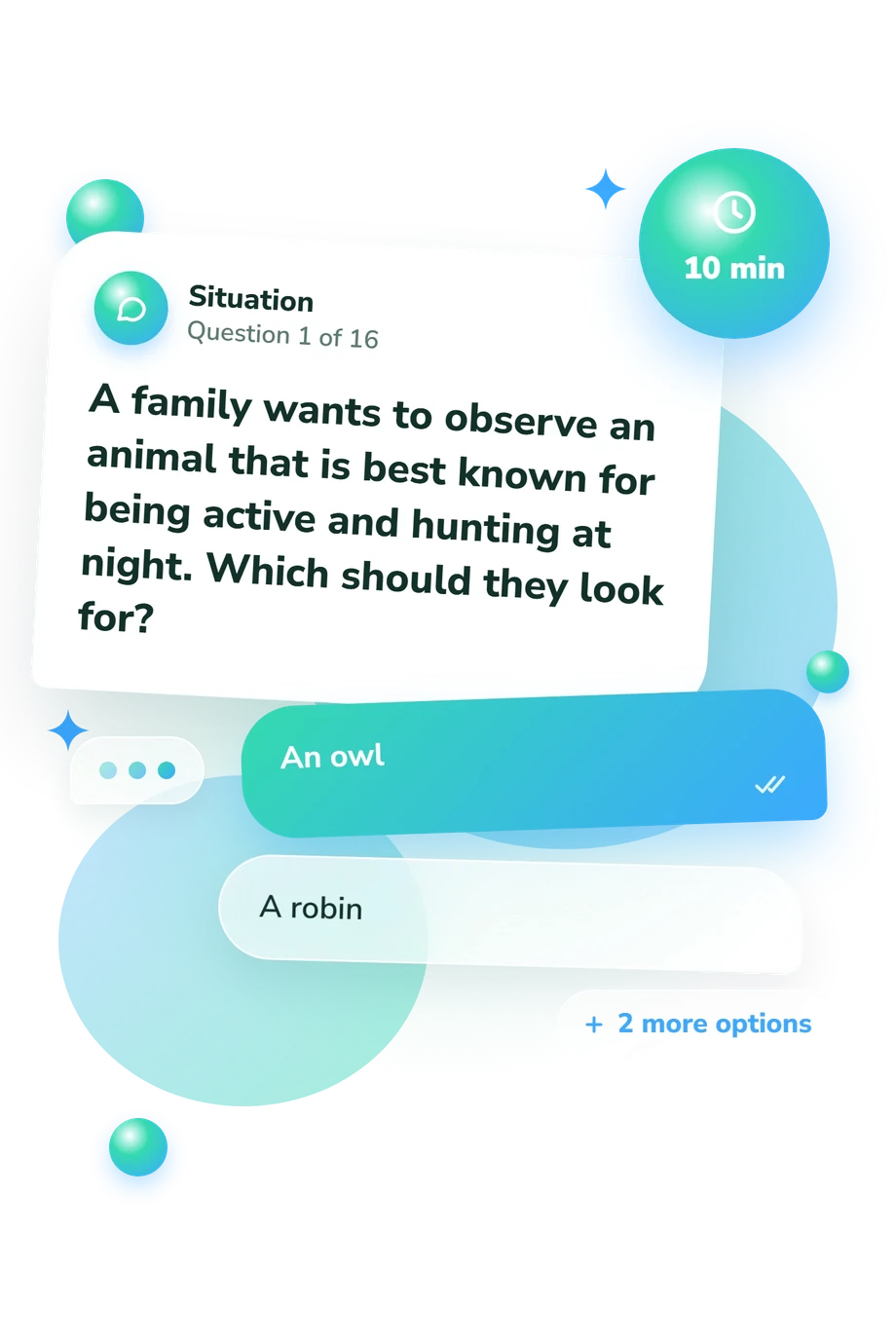
Example Questions From the Test
- An owl
- A robin
- A butterfly
- A squirrel
- Playful
- Puppy
- Ran
- Quickly
- It reflects light from the Sun
- It produces light like a star
- It reflects lights from Earth's cities
- It glows because Earth's atmosphere heats it
Family Quiz - Description and methodology of the test
For relatives seeking a friendly way to compare everyday knowledge, this family quiz offers a shared challenge instead of a formal examination. It suits participants with different strengths, backgrounds, and levels of prior exposure. The result can make quiz questions for all the family more engaging by turning uncertain answers into conversation starters and suggesting subjects worth exploring together.
What This Assessment Explores
This questionnaire samples broad practical knowledge across familiar facts, simple reasoning, and everyday academic content. As a general knowledge quiz, it helps participants notice which areas feel familiar and which invite further learning.
The questions span these thematic groups:
- Nature and science test animals, plants, physical processes, and basic astronomy.
- Language and literature check grammar, vocabulary, and familiar children’s books.
- Geography covers capitals, directions, and world locations.
- Mathematics and time require fractions, equal sharing, and elapsed-time reasoning.
- Everyday knowledge brings recall and practical reasoning together in ordinary situations.
These dimensions help relatives compare strengths without turning the result into a judgment of intelligence, education, or personal worth. A higher score means stronger performance on this particular set of items, while a lower score may reflect unfamiliar topics, attention, or different prior learning.
Methodology and Evidence Base
Each item presents four answer choices with one best answer. The displayed result is the number of correct responses: Family Trivia Knowledge, 0-16, is reported as Curious Starter (0-6), Growing Generalist (7-12), or Trivia Standout (13-16). These bands describe performance on this quiz and are not a scale of intelligence or academic ability.
The closest conceptual comparison is General Knowledge Test (Irwing et al., 2001), which examined broad semantic knowledge and its relationship to a general knowledge factor. This questionnaire is conceptually consistent with that work, not an adaptation of its test or scoring model.
Furnham and Chamorro-Premuzic (2006) offer a related account of general knowledge alongside intelligence and personality. Coane et al. (2023) show that performance on knowledge tests can influence people’s self-ratings of intelligence, knowledge, and memory. Together, these studies support interpreting the result as a snapshot of accessible knowledge rather than a direct estimate of intelligence.
Because this everyday knowledge test has no published norms or demonstrated standardization for its online version, prior learning, language familiarity, guessing, attention, and current context can affect the score. Use the result for self-reflection and shared discussion, not as a clinical or educational decision.
- Irwing, Paul, Tommy Cammock, and Richard Lynn. “Some Evidence for the Existence of a General Factor of Semantic Memory and Its Components.” Personality and Individual Differences, 30(5), 2001, 857-871. 10.1016/S0191-8869(00)00078-7.
- Furnham, Adrian, and Tomas Chamorro-Premuzic. “Personality, Intelligence and General Knowledge.” Learning and Individual Differences, 16(1), 2006, 79-90. 10.1016/j.lindif.2005.07.002.
- Coane, Jennifer H., John Cipollini, Charlotte Beaulieu, Julianna Song, and Sharda Umanath. “The Influence of General Knowledge Test Performance on Self-Ratings of and Perceived Relationships Between Intelligence, Knowledge, and Memory.” Scientific Reports, 13(1), 2023, Article 15723. 10.1038/s41598-023-42205-y.
Updated: