
Either Or Neither Nor Quiz
How the Scales are Structured
Who Usually Takes This Test?
See How You Compare
Below is a preview of how scores are typically distributed across each scale.
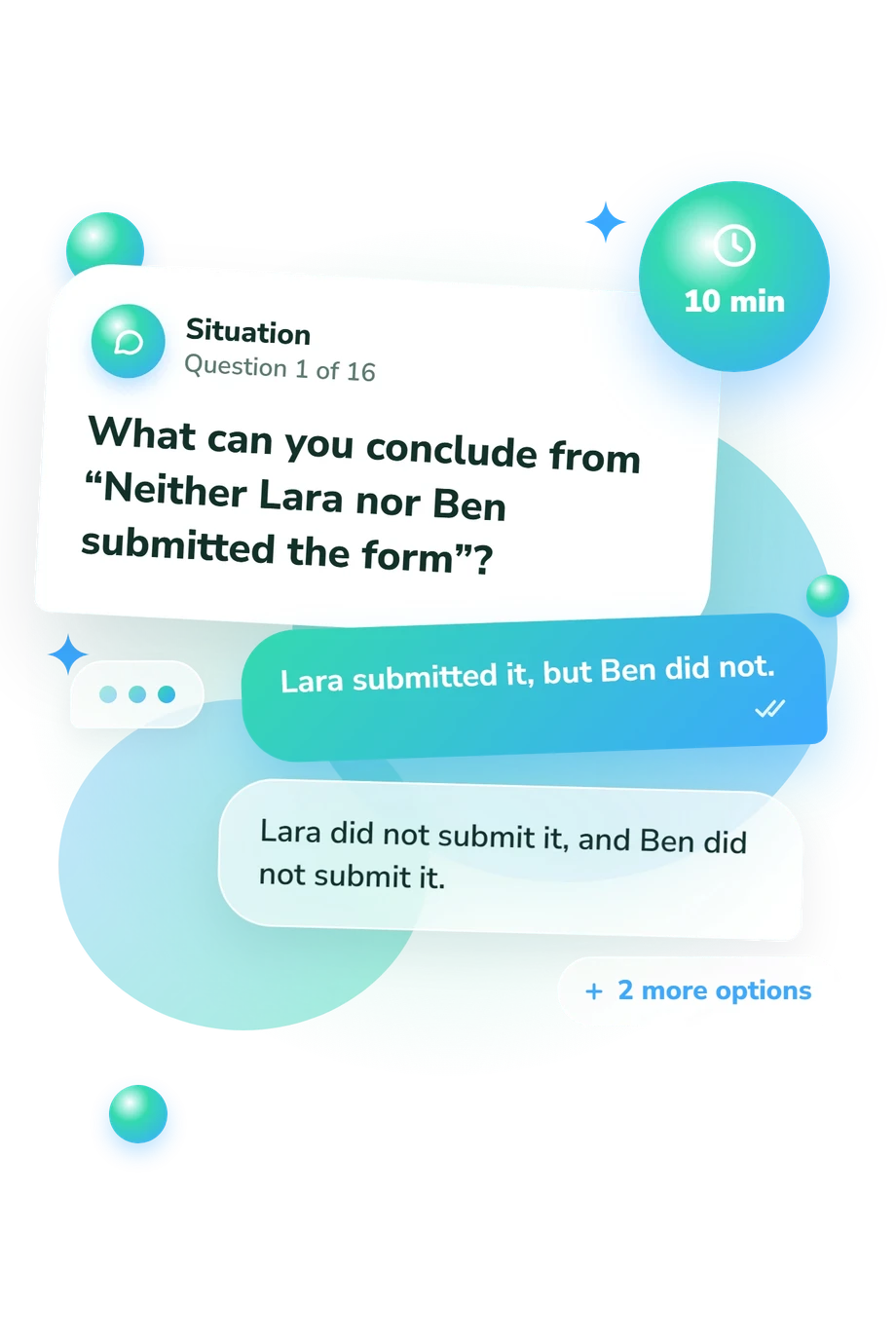
Example Questions From the Test
- Lara submitted it, but Ben did not.
- Lara did not submit it, and Ben did not submit it.
- Exactly one of them submitted it.
- Both submitted separate versions.
- It presents two alternatives and requires both
- It compares two alternatives by degree
- It excludes both of two stated alternatives
- It indicates that at least one alternative is true
- either preparing invoices or to greet clients.
- either prepares invoices or greeting clients.
- either preparing invoices or greeting clients.
- either to prepare invoices or greeting clients.
Either Or Neither Nor Quiz - Description and methodology of the test
Readers who want to check their command of paired conjunctions can use the Either Or Neither Nor Quiz as a focused grammar assessment. It suits learners and writers seeking a paired-conjunction grammar quiz that distinguishes meaning from surface pattern. The result highlights overall performance, while the tested topics provide prompts for review.
What This Assessment Measures
The questionnaire examines how these paired forms express alternatives, exclude options, coordinate equivalent elements, and shape verb agreement. It suits learners and writers who want to distinguish meaning from surface pattern; its questions cover the grammar of neither...nor constructions through choices about pair selection, parallel structure, and verb matching.
The result is reported on the catalogue scale Either...Or and Neither...Nor Knowledge: 0-16. Foundational covers 0-6, Developing 7-12, and Strong 13-16. These labels describe performance on the tested grammar tasks.
The main areas covered are:
- Meaning and logical force show whether either...or presents alternatives and neither...nor excludes both.
- Punctuation and pairing indicate whether the conjunctions are formed and punctuated correctly.
- Parallelism and agreement measure whether coordinated elements match and the verb follows the expected pattern.
Methodology and Evidence Base
Each item presents a sentence, context, or revision task with answer choices. The respondent selects the option matching the intended meaning or construction, so the format tests recognition and application rather than open-ended composition. The questionnaire samples decisions in interpretation, punctuation, parallel form, and proximity agreement.
The score gives one overall knowledge result, summarizing performance across the item set. It describes command of these conjunction patterns, so interpretation should stay within the tested grammar rather than be treated as a measure of broader language ability.
Its treatment of either...or grammar is conceptually consistent with Huddleston and Pullum (2002), whose work addresses coordination, correlative conjunctions, negation, and agreement. Quirk and colleagues (1985) offer a descriptive reference, while Chicago style guidance (2017) informs the punctuation items. These works support the principles tested; this assessment is not presented as an adaptation of any one source.
The displayed bands provide a descriptive progression for the tested tasks: movement upward reflects more accurate handling of meaning, structure, and agreement. Formal and everyday usage can produce different intuitions, especially around proximity agreement; review should consider register.
- Huddleston, Rodney, and Geoffrey K. Pullum. The Cambridge Grammar of the English Language. Cambridge University Press, 2002. ISBN 9780521431460. 10.1017/9781316423530.
- Quirk, Randolph, Sidney Greenbaum, Geoffrey Leech, and Jan Svartvik. A Comprehensive Grammar of the English Language. Longman, 1985. ISBN 0582517346.
- University of Chicago Press. The Chicago Manual of Style. 17th ed. University of Chicago Press, 2017.
Updated: