
Eeveelution Quiz
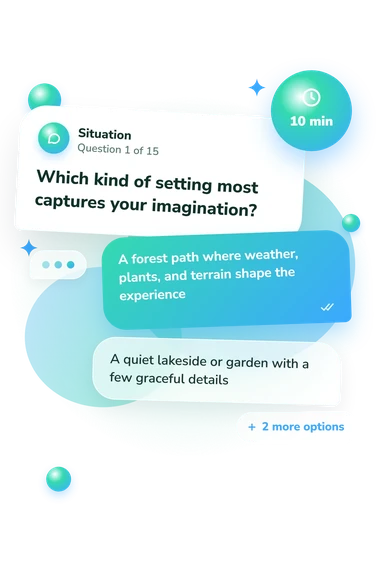
How the Scales are Structured
Who Usually Takes This Test?
See How You Compare
Below is a preview of how scores are typically distributed across each scale.
Example Questions From the Test
- Give them room while quietly signaling that I am available
- Check in privately and let them decide how much to share
- Invite them into a comforting shared activity
- Offer warm reassurance and actively surround them with support
- Comfort, durability, and what feels natural on me
- Comfort first, plus one detail that gives the outfit character
- A coordinated appearance that expresses a particular mood
- A distinctive look that feels playful, elegant, or transformative
- I watch, read, or think about it before committing
- I gather a few basics and begin at an easy pace
- I try it soon and learn through experimentation
- I dive in intensely while the excitement is fresh
Eeveelution Quiz - Description and methodology of the test
Fans who enjoy Pokémon-themed self-reflection may find the Eeveelution Quiz an engaging way to pause over familiar preferences. Character-themed choices invite personal reflection without demanding a single right answer. Its Eevee quiz format suits curious players who prefer a light activity with room for interpretation.
What This Assessment Explores
The questions place choices and social situations side by side: how you respond to an upset friend, enter an unfamiliar gathering, choose surroundings, and react when plans change. This eeveelution personality quiz reflects visible connection, expression, and tempo rather than creativity, sophistication, or emotional depth.
The three dimensions are:
- Bonding Style (0-15) shows visible connection: Selective Circle (0-5) favors privacy and chosen bonds, Flexible Connection (6-10) balances space with companionship, and Openhearted Connection (11-15) expresses visible warmth, not depth of care.
- Expression Style (0-15) shows aesthetic preference, not creativity or sophistication: Natural Element (0-5) favors grounded directness, Mixed Palette (6-10) blends simplicity with refinement, and Enchanted Element (11-15) prefers symbolism and deliberate atmosphere.
- Temperament Tempo (0-15) shows preferred pace: Composed Current (0-5) preserves energy, Adaptive Rhythm (6-10) changes with context, and Energetic Spark (11-15) seeks momentum.
Methodology and Scientific Basis
Each item offers four responses to a preference or situation involving social contact, visual expression, initiative, recovery, or adaptation. The questionnaire therefore works as a structured self-report. Selected answers are aggregated into three displayed scores and an Eeveelution match, but the per-answer weights and aggregation formula are not specified. The result bands are shown with their corresponding scores.
In its present form, the questionnaire is an original online self-reflection tool built around Pokémon-themed choices, not a published personality instrument or an online adaptation of one. No named theory or source instrument establishes these dimensions. They are descriptive features of this questionnaire, and its scores have no published norms, standardization, or validation evidence. It offers a playful response to the what eeveelution are you quiz prompt, but that match is not a psychometric finding.
Because it is an online self-report, results can shift with mood, context, self-awareness, familiarity with Pokémon, and attachment to a favorite character, so the profile is best treated as a reflective snapshot of connection, expression, and pace rather than a clinical category.
- Tsuchisaka, Y., Ozeki, M., & Oka, N. (2014). Expression of Reflection-Impulsivity for Pokémon Non Player Character by Prior Information in Bayesian Estimation. Transactions of the Japanese Society for Artificial Intelligence, 29(1), 213-218. 10.1527/tjsai.29.213
- Khalis, A., & Mikami, A. Y. (2018). Who's Gotta Catch 'Em All?: Individual differences in Pokémon Go gameplay behaviors. Personality and Individual Differences, 124, 35-38. 10.1016/j.paid.2017.11.049
- Spatola, N., Marchesi, S., & Wykowska, A. (2023). The Phenotypes of Anthropomorphism and the Link to Personality Traits. International Journal of Social Robotics, 15, 3-14. 10.1007/s12369-022-00939-1
- DeYoung, C. G., Quilty, L. C., & Peterson, J. B. (2007). Between Facets and Domains: 10 Aspects of the Big Five. Journal of Personality and Social Psychology, 93(5), 880-896. 10.1037/0022-3514.93.5.880
Updated: