
Economics Quiz
How the Scales are Structured
Who Usually Takes This Test?
See How You Compare
Below is a preview of how scores are typically distributed across each scale.
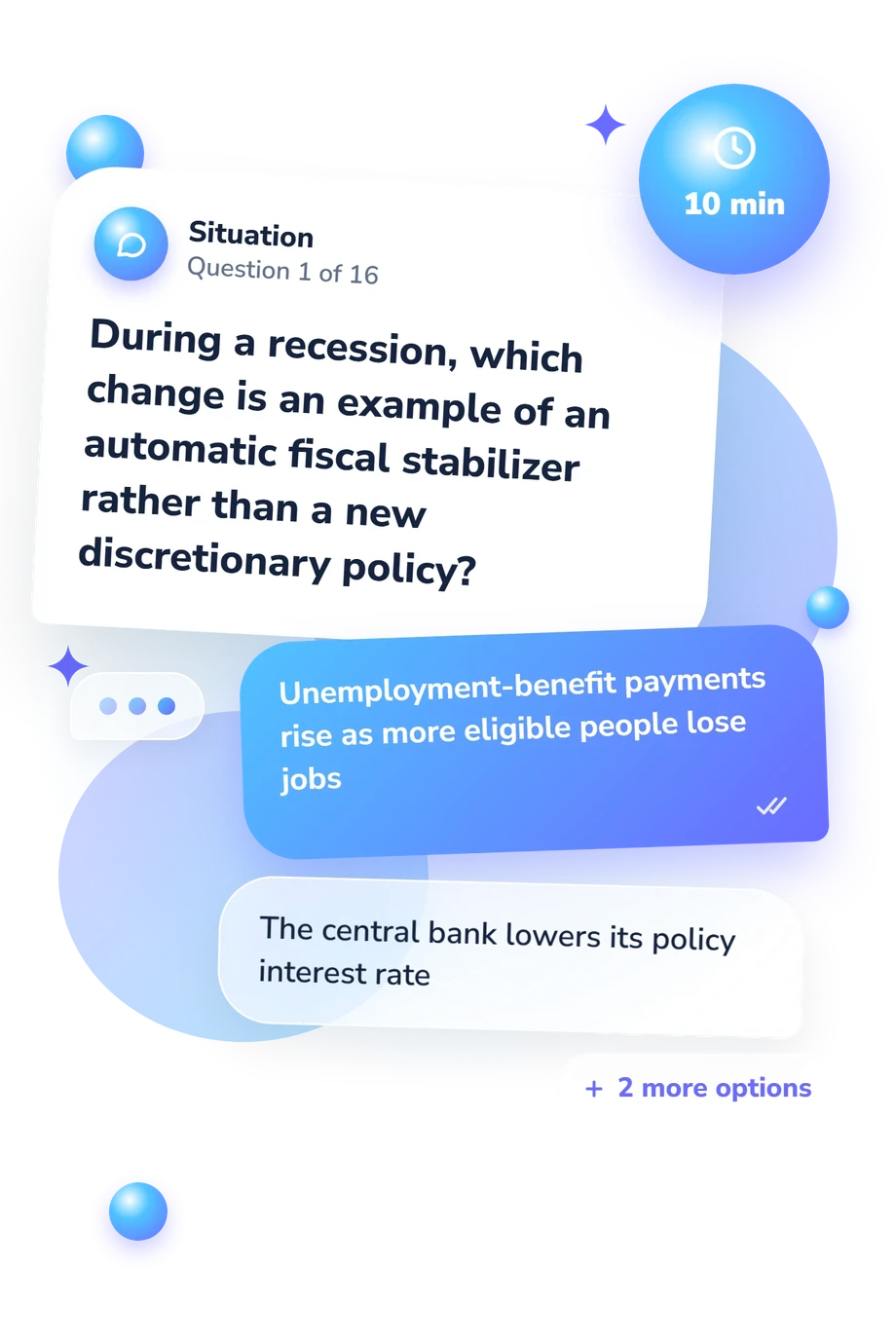
Example Questions From the Test
- A public good
- A normal good
- An inferior good
- A complementary good
- The price falls, increasing quantity demanded further
- Demand shifts left automatically until the shortage disappears
- The price rises, reducing quantity demanded and increasing quantity supplied
- Supply shifts left because sellers are selling out
- Lowering its policy interest-rate target
- Raising its policy interest-rate target
- Purchasing government securities to add reserves
- Encouraging banks to expand lending through cheaper credit
Economics Quiz - Description and methodology of the test
Designed for learners who want a clearer grasp of everyday economic reasoning, this economics quiz checks whether you can connect definitions with practical market and policy situations. It suits students, independent learners, and anyone revisiting introductory economics; taking this econ quiz can show which concepts feel secure and which deserve another pass before a class, exam, or discussion.
What This Assessment Explores
Across the items, the assessment samples microeconomic and macroeconomic reasoning rather than personal opinions. You work with scenarios involving markets, incentives, national income, policy, trade, and external effects. This economics online quiz gives a focused picture of how accurately you recognize relationships between changing conditions and outcomes.
The result is reported on the Economics Knowledge scale, which runs from 0-16. The three bands describe the level of command indicated by your correct responses:
- Emerging foundation (0-6) indicates recognition of some economic ideas, with core terms and cause-and-effect relationships still needing practice.
- Developing knowledge (7-12) shows that many essentials are understood and can be applied in familiar situations, although gaps remain.
- Strong command (13-16) reflects consistent distinction between concepts and accurate economic reasoning across varied scenarios.
Together, these levels help identify whether you need basic review, targeted reinforcement, or more challenging applications.
Methodology and Scientific Basis
The questions use four-option multiple choice, asking you to select the best explanation or prediction in scenarios involving shortages, taxes, purchasing power, and trade-offs. Because each item is multiple choice, scoring records a correct or incorrect answer rather than a degree-of-agreement rating.
One point is awarded for each correct response, creating the total shown in the result. The calculation is transparent, but the resulting level is descriptive of demonstrated knowledge, not a population norm or broad measure of ability.
Its closest reference is the Test of Economic Literacy, an educational instrument covering fundamental economic concepts. Later TEL revision and development work by Walstad, Soper, Rebeck, and Butters provides context for introductory content and multiple-choice assessment. The present questionnaire is conceptually consistent with that work, but it is a separate online questionnaire rather than an adaptation or standardized administration of the published TEL.
Performance on the economy quiz can still be affected by guessing, prior exposure to textbook language, and momentary attention. Use the result to choose review topics; it is a snapshot of performance on these items rather than a complete account of economic reasoning.
- Soper, John C., and William B. Walstad. Test of Economic Literacy: Examiner's Manual. 2nd ed. New York, NY: Joint Council on Economic Education, 1987.
- Walstad, William B., and John C. Soper. "What Is High School Economics? TEL Revision and Pretest Findings." The Journal of Economic Education 19, no. 1 (1988): 24-36. 10.1080/00220485.1988.10845241
- Walstad, William B., Ken Rebeck, and Roger B. Butters. "The Test of Economic Literacy: Development and Results." The Journal of Economic Education 44, no. 3 (2013): 298-309. 10.1080/00220485.2013.795462
Updated: