
Ecology Quiz
How the Scales are Structured
Who Usually Takes This Test?
See How You Compare
Below is a preview of how scores are typically distributed across each scale.
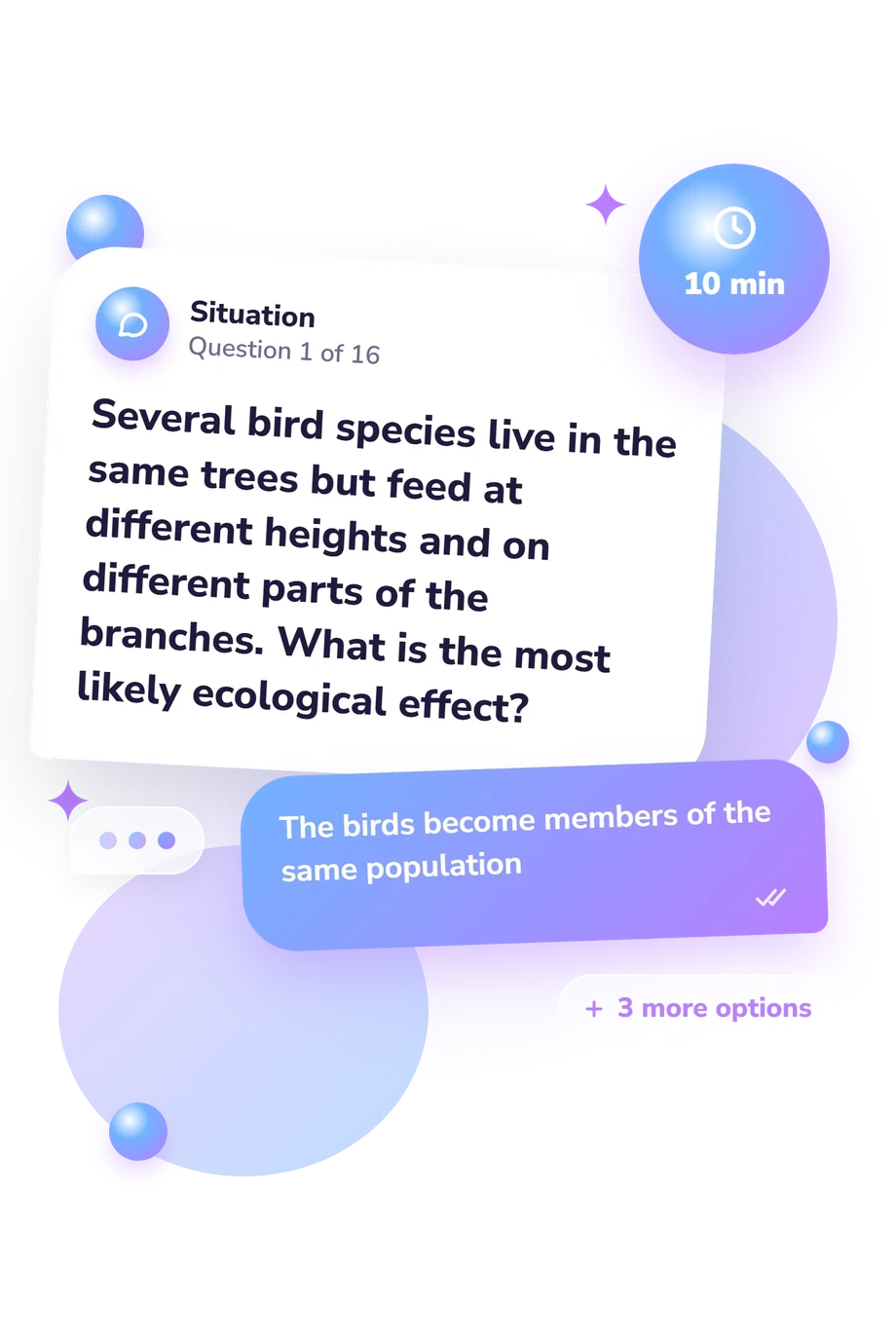
Example Questions From the Test
- Two plant species compete for the same soil nutrients
- A tick feeds on the blood of a deer
- A hawk captures and eats a mouse
- A bee receives nectar while transferring pollen between flowers
- A volcanic eruption
- A sudden seasonal frost
- Transmission of an infectious disease
- A hurricane crossing the habitat
- It increases by 5 individuals
- It remains unchanged
- It decreases by 15 individuals
- It increases by 25 individuals
Ecology Quiz - Description and methodology of the test
Students, teachers, and curious readers can use the ecology quiz to connect ecological principles with concrete situations. It is suited to anyone reviewing biology and ecology assessment topics, preparing for further study, or checking which ideas deserve attention. The result offers a focused snapshot of conceptual understanding, showing where knowledge is secure and where targeted review may be useful.
What This Assessment Explores
These questions assess ecological knowledge through relationships, processes, and brief scenarios. They ask readers to explain how living systems are organized and how conditions affect populations and communities.
The result works as an ecology knowledge test, showing how well a respondent recognizes and applies core principles. It brings together these dimensions:
- Ecosystem organization explains how organisms, communities, and nonliving environments interact.
- Population and community dynamics shows how growth, carrying capacity, variation, niches, competition, and species relationships shape abundance.
- Energy flow and ecological change connects producers, trophic levels, carbon, nutrients, disturbance, succession, adaptation, and habitat shifts.
Ecology Knowledge: 0-16. Foundations to Build 0-6 indicates that core relationships may need review; Developing Knowledge 7-12 reflects understanding of many principles with some processes to strengthen; Strong Knowledge 13-16 reflects a well-developed grasp of ecological principles and ecosystem reasoning.
Methodology and Evidence Base
Each item presents a brief ecological situation or definition with four answer choices. The respondent selects the best explanation, performs a simple population calculation, or applies a principle to a new context. These ecology test questions sample conceptual recognition and reasoning rather than vocabulary recall alone.
The questionnaire is a structured, knowledge-based online assessment, not a self-rating of confidence or behavior. Its total reflects selected-answer performance. The content is conceptually consistent with Pitman and Daniels (2016), and it aligns with Morrone, Mancl, and Carr (2001) and Jordan et al. (2009), whose work identifies ecological knowledge and core ecology understanding as parts of environmental literacy.
Those sources support the themes, but they do not establish this online version as a standardized adaptation. No norms, reliability estimates, or validation results are stated for this item set. Guessing, attention, prior study, and current learning can affect the score, so interpret it as a snapshot that can guide review rather than a population-level conclusion.
- Pitman SD, Daniels CB (2016). Quantifying Ecological Literacy in an Adult Western Community: The Development and Application of a New Assessment Tool and Community Standard. PLoS ONE, 11(3), e0150648. 10.1371/journal.pone.0150648
- Morrone M, Mancl K, Carr K (2001). Development of a Metric To Test Group Differences in Ecological Knowledge as One Component of Environmental Literacy. The Journal of Environmental Education, 32(4), 33-42. 10.1080/00958960109598661
- Jordan R, Singer F, Vaughan J, Berkowitz A (2009). What should every citizen know about ecology? Frontiers in Ecology and the Environment, 7(9), 495-500. 10.1890/070113
Updated: