
Do I Have Fungal Acne Quiz
How the Scales are Structured
Who Usually Takes This Test?
See How You Compare
Below is a preview of how scores are typically distributed across each scale.
Example Questions From the Test
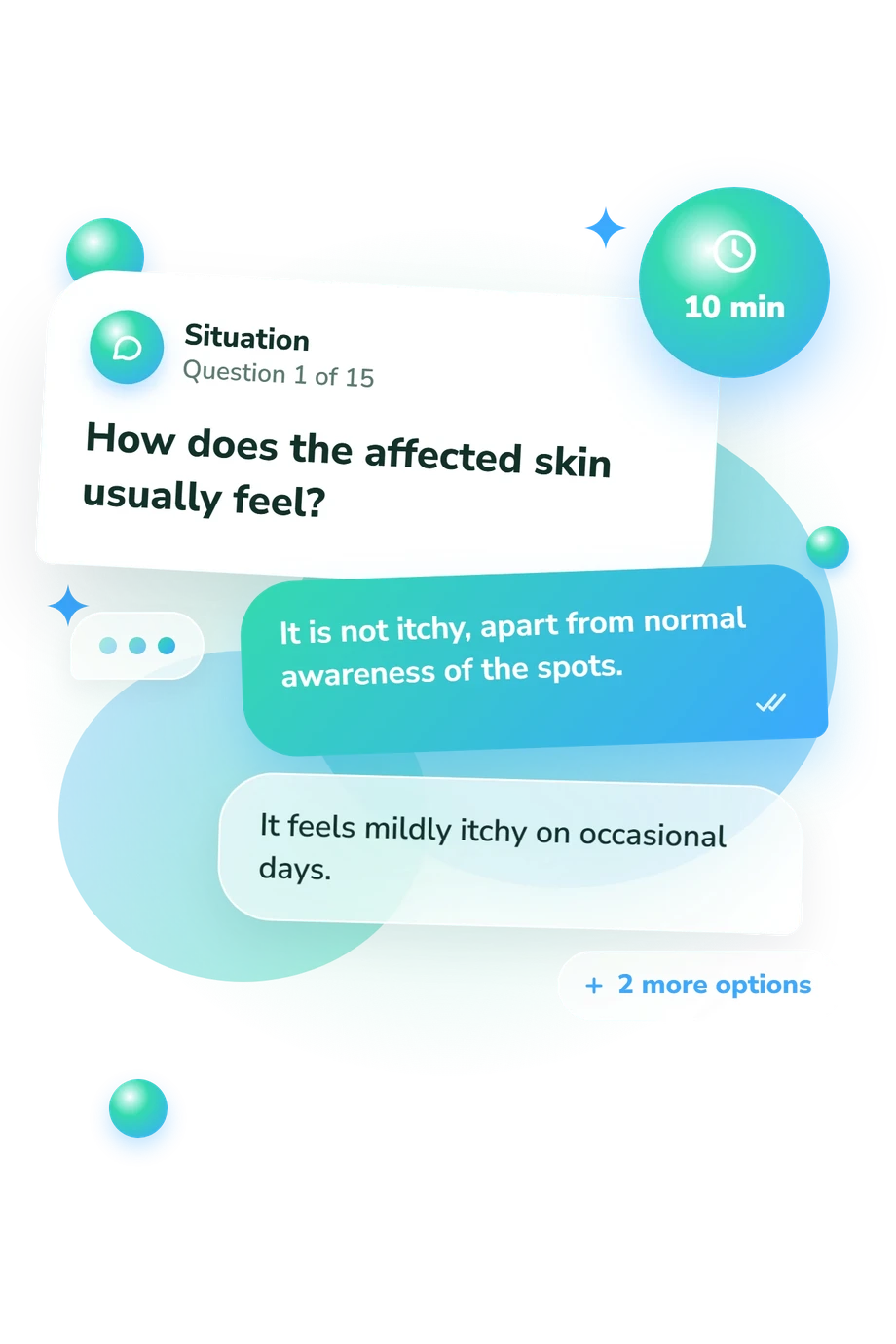
- It is not itchy, apart from normal awareness of the spots.
- It feels mildly itchy on occasional days.
- It itches regularly, especially when warm or sweaty.
- Itching is one of the breakout’s most noticeable or disruptive features.
- It changes gradually, with different types of blemishes appearing at different stages.
- One patch remains while occasional new or different spots appear.
- A fairly uniform crop appeared and stayed visually similar for days.
- Repeated crops of nearly identical small bumps appear in the same general pattern.
- Mostly noninflamed clogged pores or deeper bumps without tiny pustular centers.
- A mixed breakout with an occasional small white-tipped spot.
- Numerous small red bumps, some with tiny white tips.
- Many tiny, follicle-centered bumps or pustules with a very similar appearance.
Do I Have Fungal Acne Quiz - Description and methodology of the test
People with a persistent, itchy, uniform-looking breakout can use the Do I Have Fungal Acne Quiz to organize observations before seeking advice. It focuses on possible Malassezia folliculitis patterns rather than offering a label, helping readers describe symptoms, notice warning signs, and decide whether clinician follow-up is sensible. The questions turn observations often described as fungal acne symptoms into structured self-report, including itch, uniform bumps, course, and treatment response.
What This Assessment Explores
Questions cover appearance, itch, recurrence, heat, sweat, occlusion, scalp changes, treatment response, and warning signs. It groups these observations into possible pattern signals, so the fungal acne quiz helps a reader organize a current or recurring breakout and prepare a clearer account for professional discussion.
The three displayed dimensions are:
- Bump Pattern (0-15) reflects uniform, follicle-centered clustering: No pattern signal (0), Limited pattern signal (1-2), or Assessment warranted (3-15).
- Course and Assessment Needs (0-15) reflects persistence, recurrence, treatment response, and warnings: No course signal (0), Limited course signal (1-2), or Follow-up indicated (3-15).
- Itch, Location, and Environment (0-15) reflects itch, distribution, and heat, sweat, or coverage links: No contextual indicator endorsed (0), Limited contextual signal (1-2), or Assessment warranted (3-15).
Methodology and Scientific Basis
Each item offers four response choices, moving from absent or less typical features toward stronger pattern signals. Chosen responses are mapped across the displayed dimensions, but no standardized point rule is presented for individual choices. The displayed bands are unvalidated summaries, not severity or diagnostic cutoffs; a red-flag response matters independently, and the result alone is not a reason to begin antifungal treatment.
The 110-case Pityrosporum folliculitis review offers the closest subject-specific context. A Malassezia/non-Malassezia comparison study helps distinguish overlapping patterns, while a later position statement summarizes diagnostic and treatment recommendations. This questionnaire is conceptually consistent with those works, not an adaptation or validation of them.
This online self-report questionnaire organizes observations about appearance, context, course, treatment response, and warning signs. The fungal acne test format organizes overlapping observations and helps a reader decide whether a possible eruption merits follow-up. Current products, recent treatment, memory, and uncertainty about skin changes can influence responses. Rapidly spreading redness, severe pain, facial or eye swelling, fever, or feeling seriously unwell warrants prompt medical attention regardless of the result.
- Prindaville B, Belazarian L, Levin NA, Wiss K. Pityrosporum folliculitis: A retrospective review of 110 cases. Journal of the American Academy of Dermatology. 2018;78(3):511-514. 10.1016/j.jaad.2017.11.022
- Song HS, Kim SK, Kim YC. Comparison between Malassezia Folliculitis and Non-Malassezia Folliculitis. Annals of Dermatology. 2014;26(5):598-602. 10.5021/ad.2014.26.5.598
- Henning MAS, Hay R, Rodriguez-Cerdeira C, Szepietowski JC, Piraccini BM, Ferreirós MP, et al. Position statement: Recommendations on the diagnosis and treatment of Malassezia folliculitis. Journal of the European Academy of Dermatology and Venereology. 2023;37(7):1268-1275. 10.1111/jdv.18982
Updated: