
Divergent Faction Quiz
How the Scales are Structured
Who Usually Takes This Test?
See How You Compare
Below is a preview of how scores are typically distributed across each scale.
Example Questions From the Test
- Strongly disagree
- Disagree
- Not sure
- Agree
- Strongly disagree
- Disagree
- Not sure
- Agree
- Strongly disagree
- Disagree
- Not sure
- Agree
Divergent Faction Quiz - Description and methodology of the test
For readers who want to connect their choices with the values of Divergent’s fictional factions, this divergent quiz offers a reflective profile rather than a trivia result. The divergent faction quiz is intended for fans curious about identity, priorities, and decision-making. It can show whether one faction feels dominant, several value systems coexist, or your priorities vary by situation.
What This Test Measures
The questions examine how you identify with contrasting values rather than test knowledge of the novels. They cover conflict responses, honesty, learning, intuition, service, courage, stability, risk, rules, and priorities across work or school, friendships, and family. As a faction test, it helps distinguish a focused identity from a broader blend.
The displayed dimensions are:
- Faction Alignment (0-100) measures fit with your top faction; Mixed Alignment 0-39 signals mixed fit, Moderate Alignment 40-69 a clearer match, and Strong Alignment 70-100 a pronounced match.
- Trait Blend (0-100) measures balance across factions; Single-faction leaning 0-33 signals one style, Mixed traits 34-66 a combination, and Highly Divergent 67-100 a balanced blend.
- Value Consistency (0-20) measures stable core values across situations; Flexible Priorities 0-7 signals shifting priorities, Moderate Consistency 8-14 partial stability, and High Consistency 15-20 a stable value pattern.
Methodology and Evidence Base
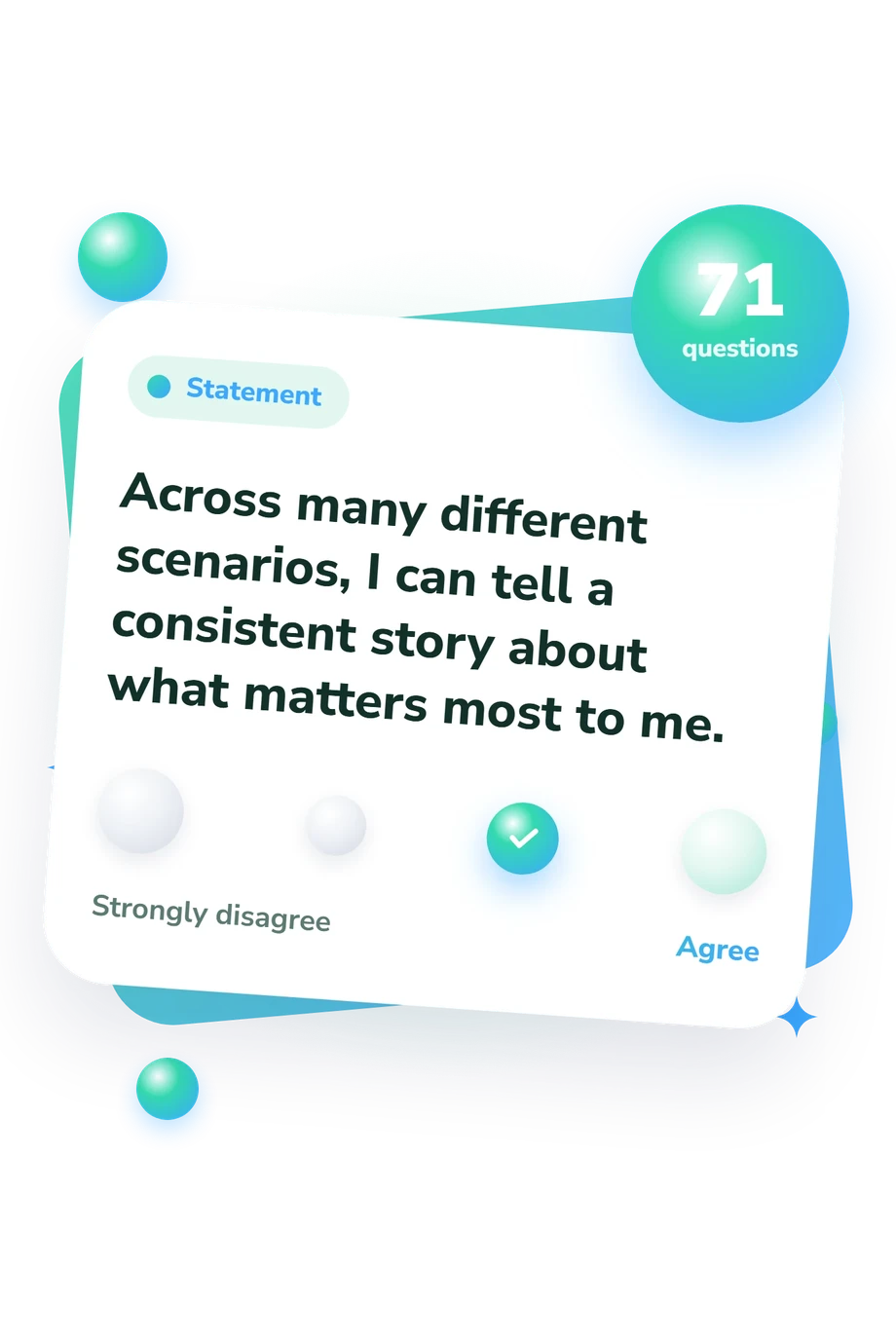
Each statement uses four ordered options-Strongly disagree, Disagree, Not sure, and Agree-so you rate how closely it fits. The items group around faction identification, blended traits, and value stability.
Within this format, the assessment is a structured self-report exercise. Responses are combined into pattern scores rather than one label, but the questionnaire does not specify how many points each answer contributes.
The current faction quiz has its closest research connection to de Souza and Roazzi’s 2017 study, whose multidimensional treatment of faction-linked personality and work-life values is conceptually consistent with these themes. The questionnaire is not a reproduction or validated adaptation of that study. Roth’s Divergent novels provide the fictional contrasts, while Schwartz et al.’s basic-values theory frames competing priorities.
The outputs are catalogue-defined profiles, not population norms or clinical cutoffs. Current context, self-awareness, and response style can influence answers, so results are best read as a reflective snapshot rather than a psychological diagnosis.
- Bruno Campello de Souza and Antonio Roazzi. "What Is Your Faction? Multidimensional Evidence for the Divergent Series As the Basis for a New Model of Personality and Work Life." Frontiers in Psychology, vol. 8, 2017, article 1751. 10.3389/fpsyg.2017.01751
- Roth, Veronica. The Divergent Series Complete Collection: Divergent, Insurgent, Allegiant. HarperCollins, 2013. ISBN 9780062292797
- Schwartz, Shalom H., Jan Cieciuch, Michele Vecchione, et al. "Refining the Theory of Basic Individual Values." Journal of Personality and Social Psychology, vol. 103, no. 4, 2012, pp. 663-688. 10.1037/a0029393
Updated: