
Did I Grow Up Poor Quiz
How the Scales are Structured
Who Usually Takes This Test?
See How You Compare
Below is a preview of how scores are typically distributed across each scale.
Example Questions From the Test
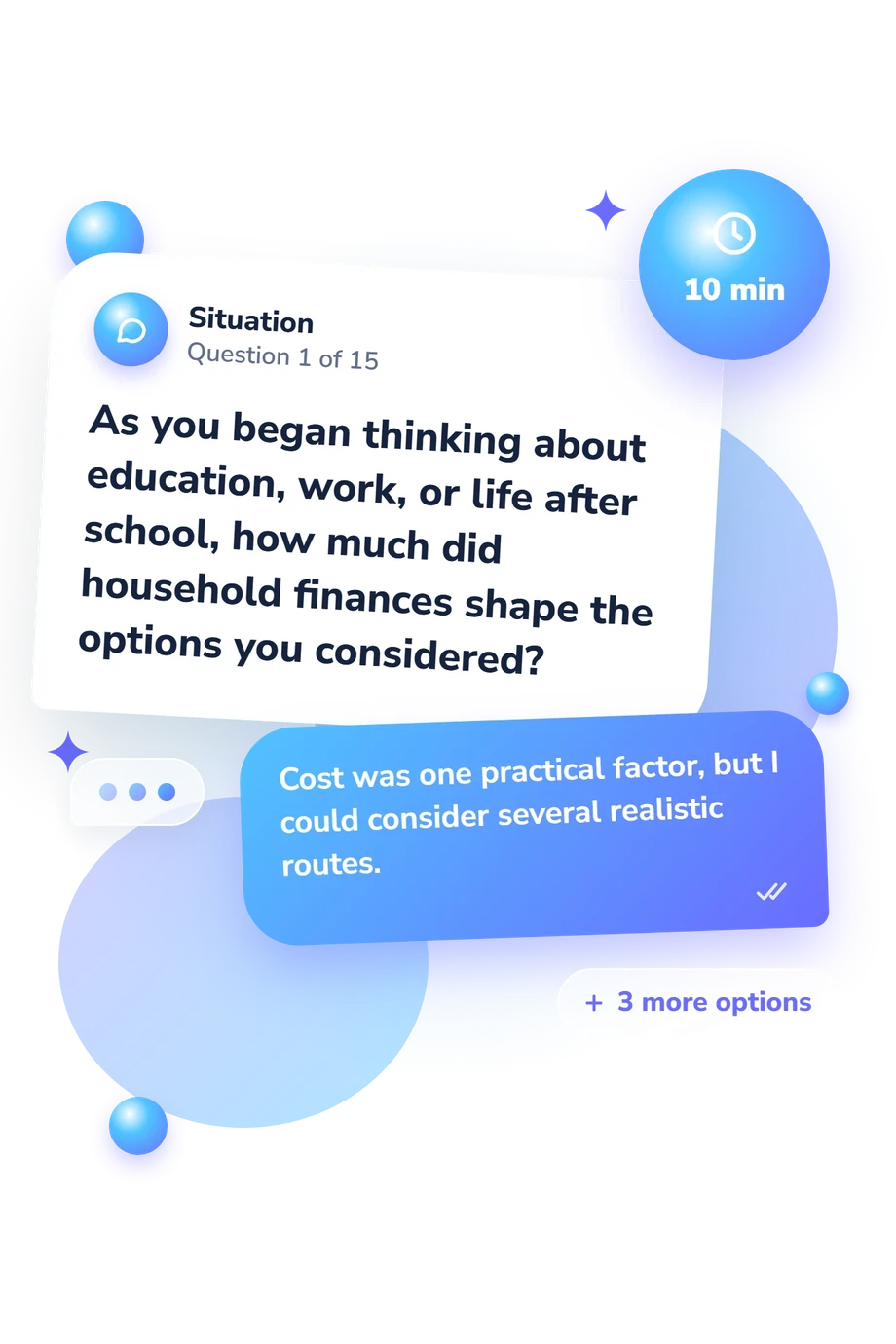
- Cost was one practical factor, but I could consider several realistic routes.
- I ruled out some paths or took on substantial work responsibilities because the household could not support them.
- My choices were based mainly on interests and fit, with family resources available for ordinary transition costs.
- Immediate household needs or unaffordable fees made further study, training, moving, or unpaid opportunities feel effectively unavailable.
- Savings or available income generally absorbed it without major changes.
- Optional spending was reduced, but basic routines remained mostly intact.
- The household cut several ordinary expenses, delayed bills, or sought short-term help.
- Food, housing payments, utilities, transport, or medical needs were directly jeopardized.
- I could generally ask for the money and join without much concern.
- I might suggest a cheaper plan, but I did not usually feel excluded by the cost.
- I regularly invented another reason not to go because admitting we could not afford it felt uncomfortable.
- I often had to decline, save for a long time, or ask whether someone else could cover my share.
Did I Grow Up Poor Quiz - Description and methodology of the test
Adults reflecting on childhood resources can use this questionnaire to examine whether money shaped ordinary safety, care, participation, and future choices. The Did I Grow Up Poor Quiz is intended for readers who want clearer language for experiences that may have felt normal at the time. It offers a structured profile of material hardship; this childhood poverty quiz cannot determine official status or explain every family circumstance.
What This Assessment Explores
Rather than relying on an income label, the questions examine how resources affected essentials, housing, utilities, health care, learning access, clothing, celebrations, participation, and future choices. This assessment addresses whether my family was poor by organizing remembered conditions without judging family worth or personal potential.
- Household Financial Constraint (0-15) shows how strongly money shaped essential decisions: Less visible constraint 0-5; Regular financial pressure 6-10; Pervasive financial constraint 11-15.
- Material Essentials (0-15) summarizes access to basics: More consistent access 0-5; Uneven access 6-10; Persistent material strain 11-15.
- Opportunity and Social Tradeoffs (0-15) reflects limits on participation and plans: Fewer opportunity tradeoffs 0-5; Selective tradeoffs 6-10; Recurring opportunity barriers 11-15.
Methodology and Scientific Basis
Each item presents a childhood situation with four response descriptions, so the reader selects the account that best matches lived experience. The questionnaire is an unvalidated reflective tool with three separate 0-15 summaries; it does not state a standardized point-allocation rule, so the displayed bands are descriptive rather than diagnostic cutoffs.
Conceptually, the questionnaire is consistent with Zilanawala and Pilkauskas (2012), who distinguish material hardship by type, timing, and duration. Ouellette and colleagues (2004) support measuring hardship through concrete access problems, while Conger and colleagues (1994) connect economic stress with family processes. These sources support the construct, but this online questionnaire is not an adaptation or validation of their published instruments or studies.
Read the result as a reflective account of remembered experience, not an income calculation or official poverty classification. Childhood perspective may be incomplete, and memory, current context, comparison with others, and self-report can shape answers. Hunger, homelessness, unsafe conditions, or unmet medical care deserve attention regardless of the combined score. This childhood financial hardship test can clarify patterns, but broader context is needed to understand them.
- Zilanawala, Afshin, and Natasha Pilkauskas. "Material Hardship and Child Socioemotional Behaviors: Differences by Types of Hardship, Timing, and Duration." Children and Youth Services Review, vol. 34, no. 4, 2012, pp. 814-825. 10.1016/j.childyouth.2012.01.008
- Ouellette, Tammy, Nancy Burstein, David Long, and Erik Beecroft. Measures of Material Hardship: Final Report. U.S. Department of Health and Human Services, Office of the Assistant Secretary for Planning and Evaluation, 2004.
- Conger, Rand D., Xiaojia Ge, Glen H. Elder Jr., Frederick O. Lorenz, and Ronald L. Simons. "Economic Stress, Coercive Family Process, and Developmental Problems of Adolescents." Child Development, vol. 65, no. 2, 1994, pp. 541-561. 10.1111/j.1467-8624.1994.tb00768.x
Updated: