
Leadership Effectiveness Scale Test
How the Scales are Structured
Who Usually Takes This Test?
See How You Compare
Below is a preview of how scores are typically distributed across each scale.
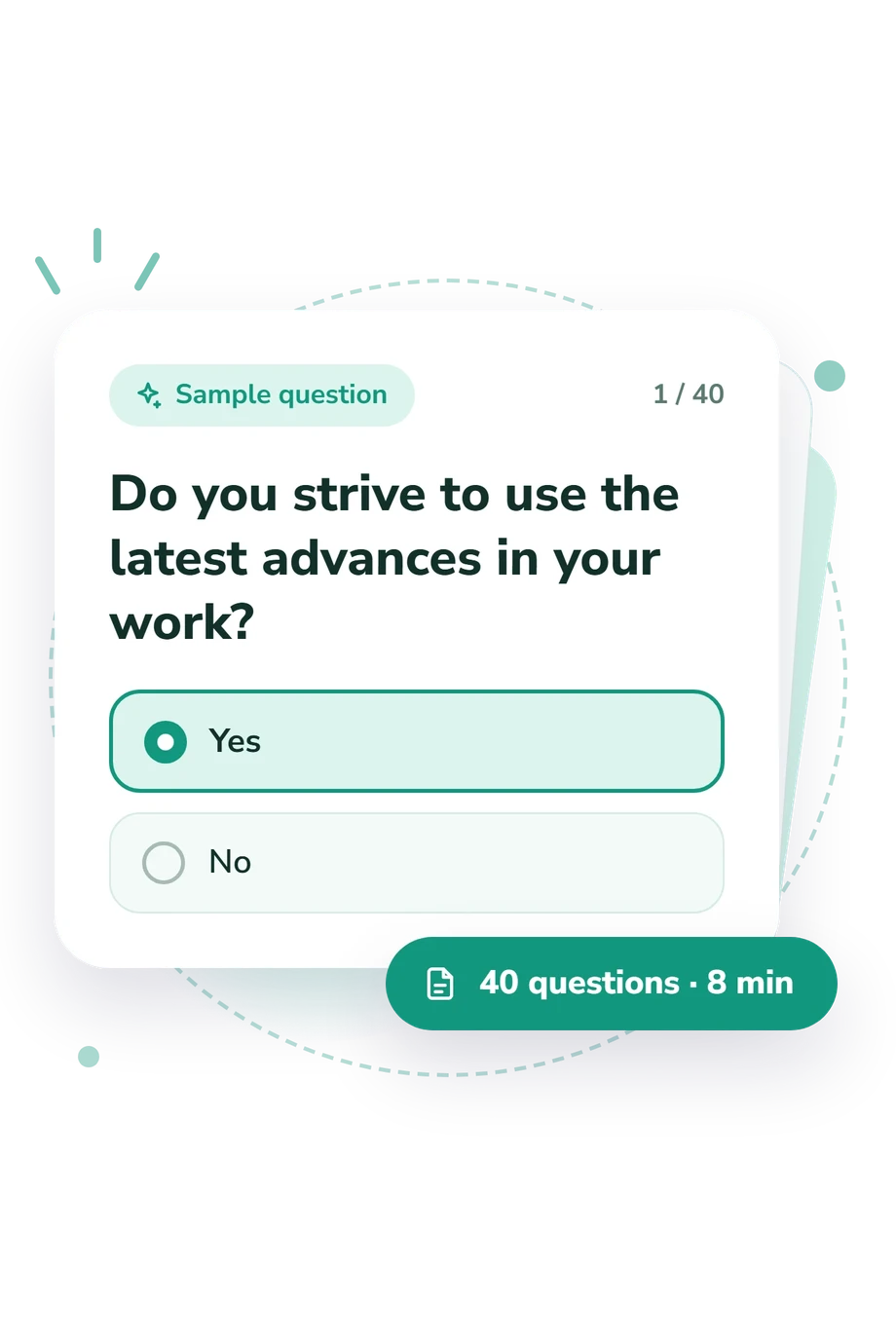
Example Questions From the Test
- Yes
- No
- Yes
- No
- Brief, clear, and precise
- Emotional and vivid, with hints and implied meanings
Leadership Effectiveness Scale Test - Description and methodology of the test
Managers, supervisors, and people preparing to lead can use the Leadership Effectiveness Scale Test to examine how everyday choices shape their impact on a team. The result is most useful as a structured leadership effectiveness assessment for readers considering managerial responsibility or planning development: it highlights patterns in communication, delegation, development, and decision-making that can guide practical self-reflection.
What This Assessment Explores
The questionnaire focuses on observable leadership practices rather than a single personality label. As a leadership style assessment, it addresses cooperation, trust, listening, recognition, information sharing, planning, self-management, flexibility, and the balance between direction and autonomy. The overall result can inform consideration of suitability for managerial responsibility.
The main themes represented in the questions are:
- Leadership Effectiveness: 0-40 gives the overall result. Low effectiveness (0-10) indicates less effective leadership, Moderate effectiveness (11-29) a moderately effective style, and High effectiveness (30-40) a highly effective style.
- Communication and trust show how the respondent explains decisions, listens, shares information, and builds confidence with people who report to them.
- Delegation and supervision describe how the respondent combines freedom of action with follow-up, accountability, and attention to completed work.
- Development and adaptability reflect planning for professional growth, use of strengths, creativity, health, and willingness to adjust a leadership approach.
Methodology and Scientific Basis
The response format is brief and self-report based. The shown questions mostly use Yes or No responses and include at least one choice between feedback settings, in private or in front of others. The questionnaire reports a single total score, but its response weights are not stated; no point value should be inferred for a particular answer.
The questionnaire is conceptually consistent with the Self-Assessment of Bipolar Leadership Effectiveness described by Fetiskin, Kozlov, and Manuilov in 2002, but it is not an adaptation of that published instrument. Fleishman's 1953 work on supervisory behavior and his 1957 Leadership Opinion Questionnaire offer a related framework joining task organization with human relations.
This leadership behavior questionnaire functions as an online self-reflection measure. The questionnaire displays three interpretation bands that organize the total score into broad levels. Current role demands, workplace culture, self-awareness, and the wish to appear competent can affect responses. Use the result as one structured snapshot alongside observed behavior and feedback when setting development priorities.
- Fetiskin, N. P., Kozlov, V. V., & Manuilov, G. M. (2002). Socio-Psychological Diagnostics of Personality Development and Small Groups. Moscow: Institute of Psychotherapy. ISBN 5-89939-086-7.
- Fleishman, E. A. (1957). The Leadership Opinion Questionnaire. In R. M. Stogdill & A. E. Coons (Eds.), Leader Behavior: Its Description and Measurement (pp. 120-133). Columbus, OH: Bureau of Business Research, Ohio State University.
- Fleishman, E. A. (1953). Leadership Climate, Human Relations Training, and Supervisory Behavior. Personnel Psychology, 6(2), 205-222. 10.1111/j.1744-6570.1953.tb01040.x
Updated: