
Leadership Assessment Test
How the Scales are Structured
Who Usually Takes This Test?
See How You Compare
Below is a preview of how scores are typically distributed across each scale.
Example Questions From the Test
- Not at all true
- True to a small extent
- True to some extent
- True to a great extent
- Completely true
- Not at all true
- Slightly true
- Somewhat true
- Mostly true
- Completely true
- Not true at all
- Slightly true
- Somewhat true
- True to a large extent
- Completely true
Leadership Assessment Test - Description and methodology of the test
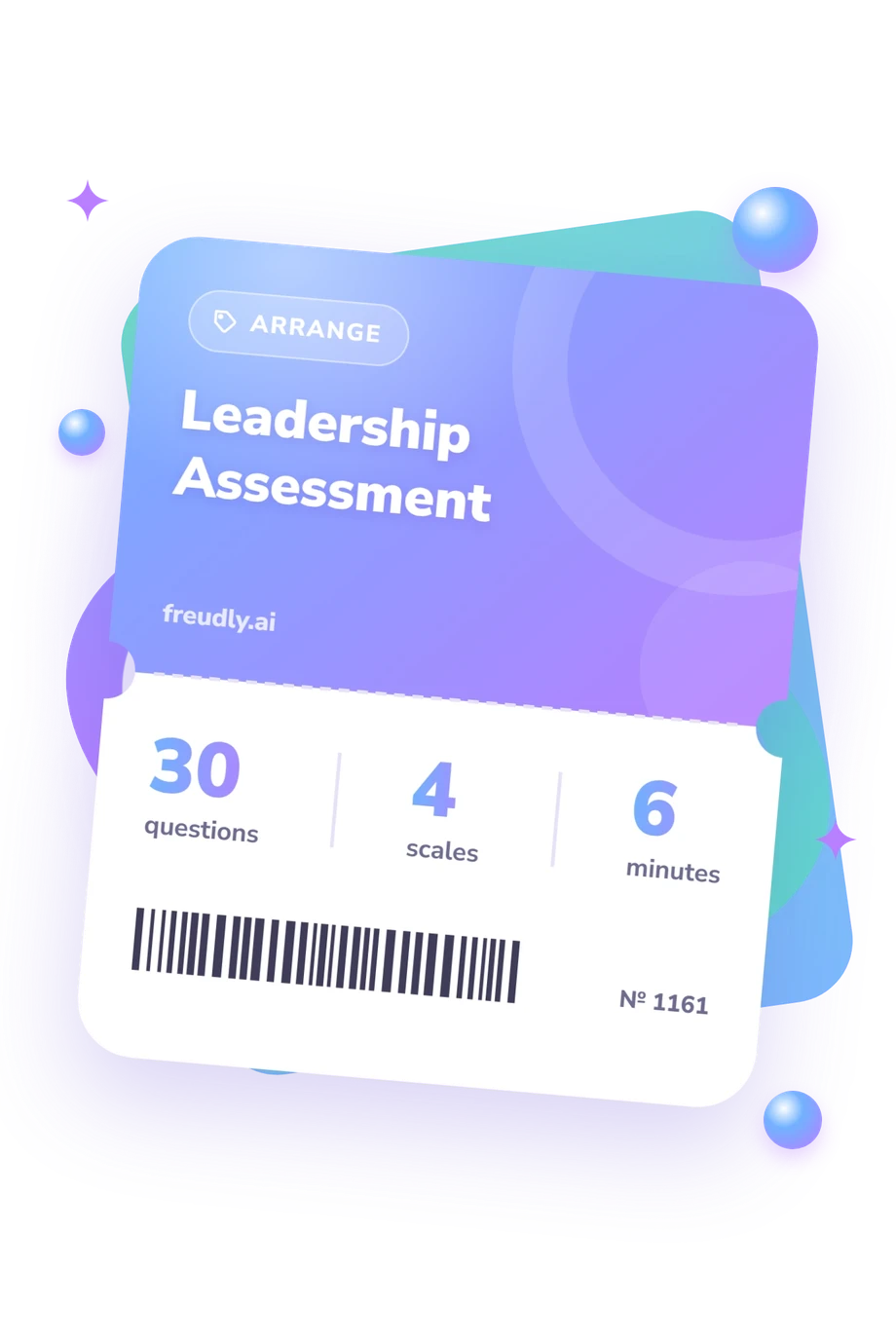
For managers, team leads, and professionals examining how leadership is practiced, this Leadership Assessment Test offers a structured view of behaviors that shape confidence at work. It is useful when a leadership evaluation needs more than a general impression: the result presents leadership conduct alongside employees' overall trust in their leader. This view can support reflection on current practice and help identify areas for discussion or development.
What This Assessment Explores
The questionnaire reports four constructs. Statements cover direction, priorities, decisions, development, openness, fairness, reliability, and results. As a leadership skills assessment, it suits leaders reflecting on conduct; the result is defined as employees' trust in their leader.
These are the displayed dimensions:
- Care (10-50) measures a leader's attention and support for employees: Low care 10-22; Moderate care 23-37; High care 38-50.
- Integrity (10-50) measures perceived honesty, fairness, and ethical conduct in a leader: Low integrity trust 10-22; Moderate integrity trust 23-37; High integrity trust 38-50.
- Results Orientation (10-50) measures goal achievement and task completion: Low effectiveness 10-22; Moderate effectiveness 23-37; High effectiveness 38-50.
- Overall Trust in Leadership (30-150) measures employees' overall trust in their leader: Low trust 30-69; Moderate trust 70-110; High trust 111-150.
Methodology and Evidence Base
Each item offers five ordered choices, from not at all true or slightly true to completely true. Respondents rate how accurately each first-person statement describes their own leadership conduct, creating a structured self-report rather than an open-ended exercise.
The questionnaire reports the displayed domain results and the overall result in the catalogue's supplied bands. These displayed bands are descriptive result categories for this questionnaire; the cited instruments do not validate this online questionnaire itself.
Dirks and Ferrin (2002) provide the closest evidence for the trust component, treating trust in direct leaders as an important workplace construct. The framework is also conceptually consistent with Avolio and Bass (2004) and with Avolio, Bass, and Jung (1999), who examined the factor structure of the Multifactor Leadership Questionnaire. This questionnaire is not the MLQ itself or a validated adaptation of it.
As a leadership effectiveness test, the result is best read in context. Current events, expectations, power relationships, and self-awareness can shape self-report answers, so one profile is a starting point for reflection rather than a complete account of leadership behavior.
- Dirks, K. T., & Ferrin, D. L. (2002). Trust in Leadership: Meta-Analytic Findings and Implications for Research and Practice. Journal of Applied Psychology, 87(4), 611-628. 10.1037/0021-9010.87.4.611
- Avolio, B. J., & Bass, B. M. (2004). Multifactor Leadership Questionnaire: Manual and Sampler Set (3rd ed.). Redwood City, CA: Mind Garden.
- Avolio, B. J., Bass, B. M., & Jung, D. I. (1999). Re-examining the Components of Transformational and Transactional Leadership Using the Multifactor Leadership Questionnaire. Journal of Occupational and Organizational Psychology, 72(4), 441-462. 10.1348/096317999166789
Updated: