
Comparative and Superlative Quiz
How the Scales are Structured
Who Usually Takes This Test?
See How You Compare
Below is a preview of how scores are typically distributed across each scale.
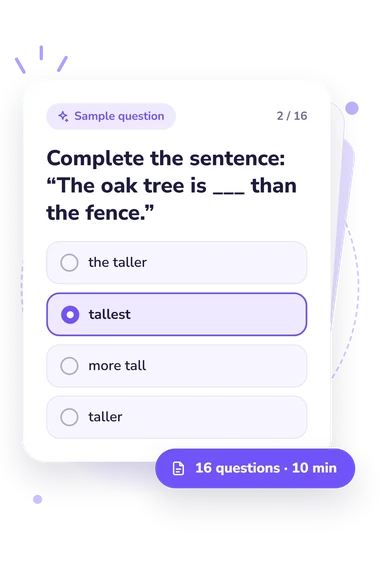
Example Questions From the Test
- It was her better performance.
- It was her best performance.
- It was her most good performance.
- It was her more better performance.
- the taller
- tallest
- more tall
- taller
- The balloon is rising higher and higher.
- The balloon is becoming highest and highest.
- The balloon is rising more high and more high.
- The balloon is rising the higher and the higher.
Comparative and Superlative Quiz - Description and methodology of the test
Designed for learners who want to check how confidently they handle English comparison, the comparative and superlative quiz focuses on choosing forms that fit real sentence meaning. It suits students, independent learners, and anyone reviewing grammar before writing or speaking. The result shows the overall level of knowledge represented by the single scale and its band, making this comparative-superlative quiz a practical starting point for revision.
What This Assessment Explores
The questions test whether a learner can match a form to the meaning of a comparison. Short contexts cover two items, a larger group, equal degree, quantity, adverbs, intensifiers, and irregular forms.
As a comparative and superlative grammar test, it covers these areas:
- Regular comparisons show whether forms such as taller, larger, and more carefully are used accurately.
- Superlatives show whether the highest or lowest degree is expressed within a group.
- Irregular forms show whether better, worse, less, and least are chosen when regular patterns do not apply.
- Equality and emphasis show whether matching degree or a strengthened comparative is expressed correctly.
The single scale, Comparative and Superlative Knowledge (0-16), uses Foundations to review (0-6), Developing knowledge (7-12), and Strong knowledge (13-16). These labels describe grammar control shown by the answers rather than general language ability.
Methodology and Scientific Basis
Each item presents a sentence or situation with four answer choices. The respondent selects the option that is both grammatically correct and appropriate to the relationship; distractors include errors such as double comparatives, incorrect irregular forms, and misuse of “than” or “of.”
Scoring is direct: each correct answer contributes one point to the total. The result reflects performance on the tested questions rather than overall English proficiency or writing ability.
The method is consistent with the grammatical distinctions discussed by Huddleston, Pullum, and Reynolds (2022), including comparison within pairs and groups, equality, degree modification, and irregular forms. Parrott (2010) offers a complementary teaching perspective on using these structures in context. The questionnaire is conceptually consistent with both sources, not an adaptation of either publication.
Applied choices make the comparative and superlative exercises useful for checking whether a rule transfers to a new sentence. The displayed bands function as instructional descriptions of performance on these items, while scores may vary with recent study, attention, guessing, prior exposure, or familiarity with a similar sentence pattern.
- Huddleston, Rodney, Geoffrey K. Pullum, and Brett Reynolds. “Comparatives and Superlatives.” In A Student’s Introduction to English Grammar, 2nd ed., pp. 297-310. Cambridge University Press, 2022. 10.1017/9781009085748
- Parrott, Martin. “Comparatives and Superlatives.” In Grammar for English Language Teachers, pp. 79-93. Cambridge University Press, 2010. 10.1017/9781009406536.008