
Civil Rights Quiz
How the Scales are Structured
Who Usually Takes This Test?
See How You Compare
Below is a preview of how scores are typically distributed across each scale.
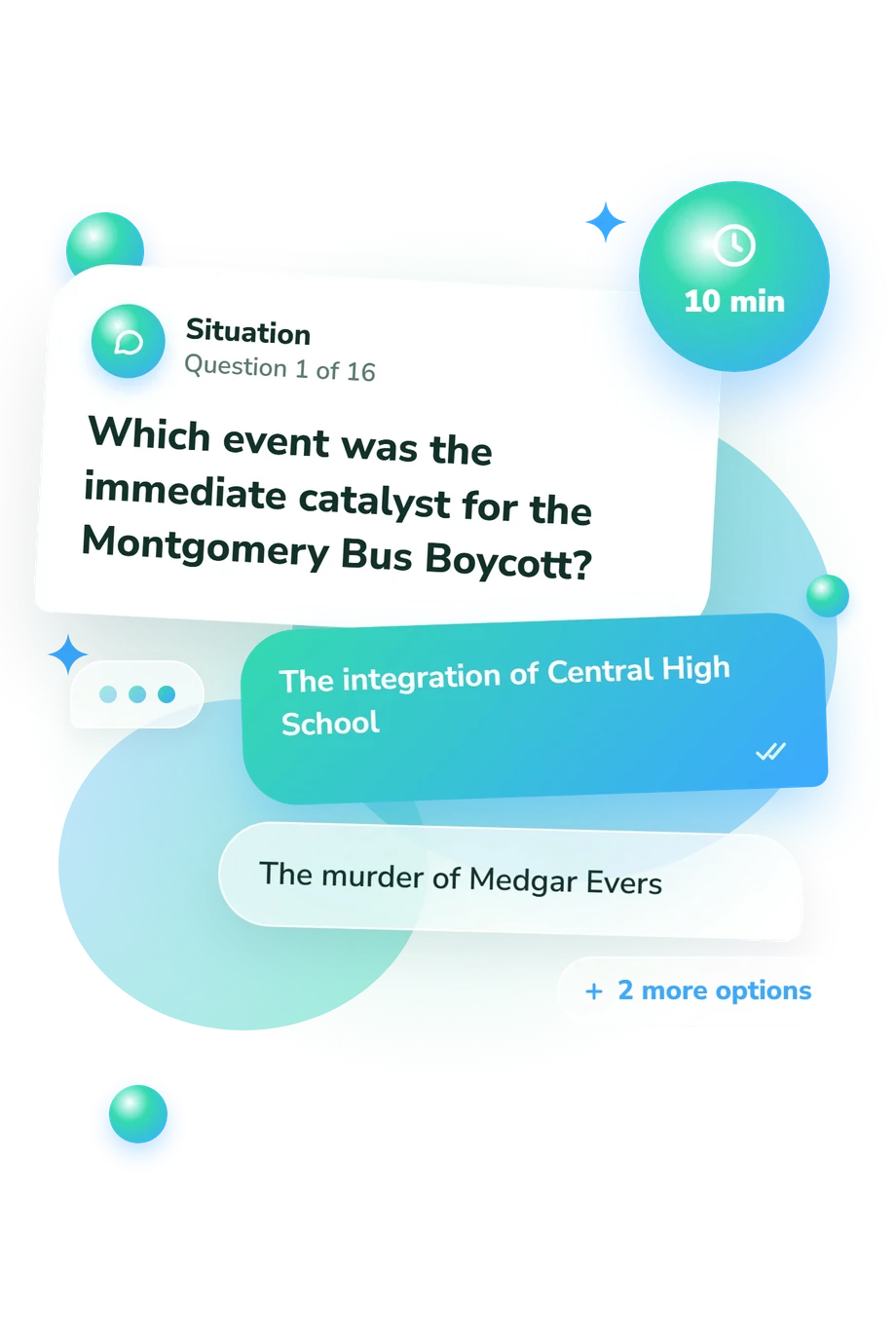
Example Questions From the Test
- The integration of Central High School
- The murder of Medgar Evers
- The bombing of the 16th Street Baptist Church
- Rosa Parks's arrest after she refused to surrender her bus seat
- States could maintain segregated schools if funding was equal
- Racial segregation in public schools was unconstitutional
- School segregation was solely a matter for Congress
- Only universities were required to desegregate
- The right to integrated interstate travel
- The right to equal access to housing
- The right to attend desegregated universities
- The right to register and vote without racial discrimination
Civil Rights Quiz - Description and methodology of the test
Readers who want a structured review of United States civil rights history can use this civil rights quiz to check recognition of landmark events, laws, court decisions, leaders, and constitutional protections. It suits students, educators, and independent learners who want a focused starting point for further study. This civil rights movement quiz links event recall with the aims, legal outcomes, and longer consequences of organized campaigns.
What This Assessment Measures
Questions cover chronology, legal change, organizations, and direct action. They ask why events occurred, what a ruling or law changed, and which right or strategy a situation represents. Examples include Montgomery, Little Rock, the Freedom Rides, Birmingham, Selma, Brown v. Board, voting rights, fair housing, and equal protection.
Beyond facts, this civil rights history test shows how you connect law, participation, and movement strategy.
The result uses Civil Rights Knowledge (0-16) to measure knowledge of major events, strategies, laws, and constitutional context. Its three bands are:
- Foundations to Build (0-6) indicates emerging recognition and a need to review the movement’s timeline, constitutional amendments, and major laws.
- Developing Knowledge (7-12) shows familiarity with central people and events, with room to connect legal rulings, campaigns, and outcomes.
- Strong Knowledge (13-16) indicates a strong command of the movement’s major events, strategies, laws, and constitutional context.
Methodology and Evidence Base
Each item offers four answer choices and asks for the best historical or legal answer. The set combines event identification, cause-and-effect reasoning, organization comparison, and applying a law or amendment to a situation. Scoring condenses responses into one total and assigns the displayed band; the score range does not show how many points any individual answer contributes.
Buchanan (2015) connects civil rights learning with historical thinking and the use of counter-narratives. The Southern Poverty Law Center’s 2011 report and the National Assessment Governing Board’s 2010 framework support attention to chronology, civic participation, constitutional principles, and movement complexity. Alderman, Kingsbury, and Dwyer (2013) provide a contextual lens for the Montgomery Bus Boycott. Together, these works provide context for the questionnaire’s attention to chronology, civic participation, constitutional principles, and movement complexity.
Individual responses on this civil rights knowledge assessment can reflect recall, guessing, prior exposure, and attention as well as understanding, so performance may vary with context. The reported result is a descriptive snapshot of connections among familiar episodes, law, participation, movement strategy, and constitutional protections.
- Buchanan, Lisa Brown. "Fostering Historical Thinking toward Civil Rights Movement Counter-Narratives: Documentary Film in Elementary Social Studies." The Social Studies 106, no. 2 (2015): 47-56. 10.1080/00377996.2014.973012
- Southern Poverty Law Center. Teaching the Movement: The State of Civil Rights Education in the United States 2011. Principal researcher and writer Kate Shuster. Montgomery, AL: Southern Poverty Law Center, 2011.
- Alderman, Derek H., Paul Kingsbury, and Owen J. Dwyer. "Reexamining the Montgomery Bus Boycott: Toward an Empathetic Pedagogy of the Civil Rights Movement." The Professional Geographer 65, no. 1 (2013): 171-186. 10.1080/00330124.2012.658728
- National Assessment Governing Board. U.S. History Framework for the 2010 National Assessment of Educational Progress. Washington, DC: U.S. Department of Education, 2010.
Updated: