
Christopher Columbus Quiz
How the Scales are Structured
Who Usually Takes This Test?
See How You Compare
Below is a preview of how scores are typically distributed across each scale.
Example Questions From the Test
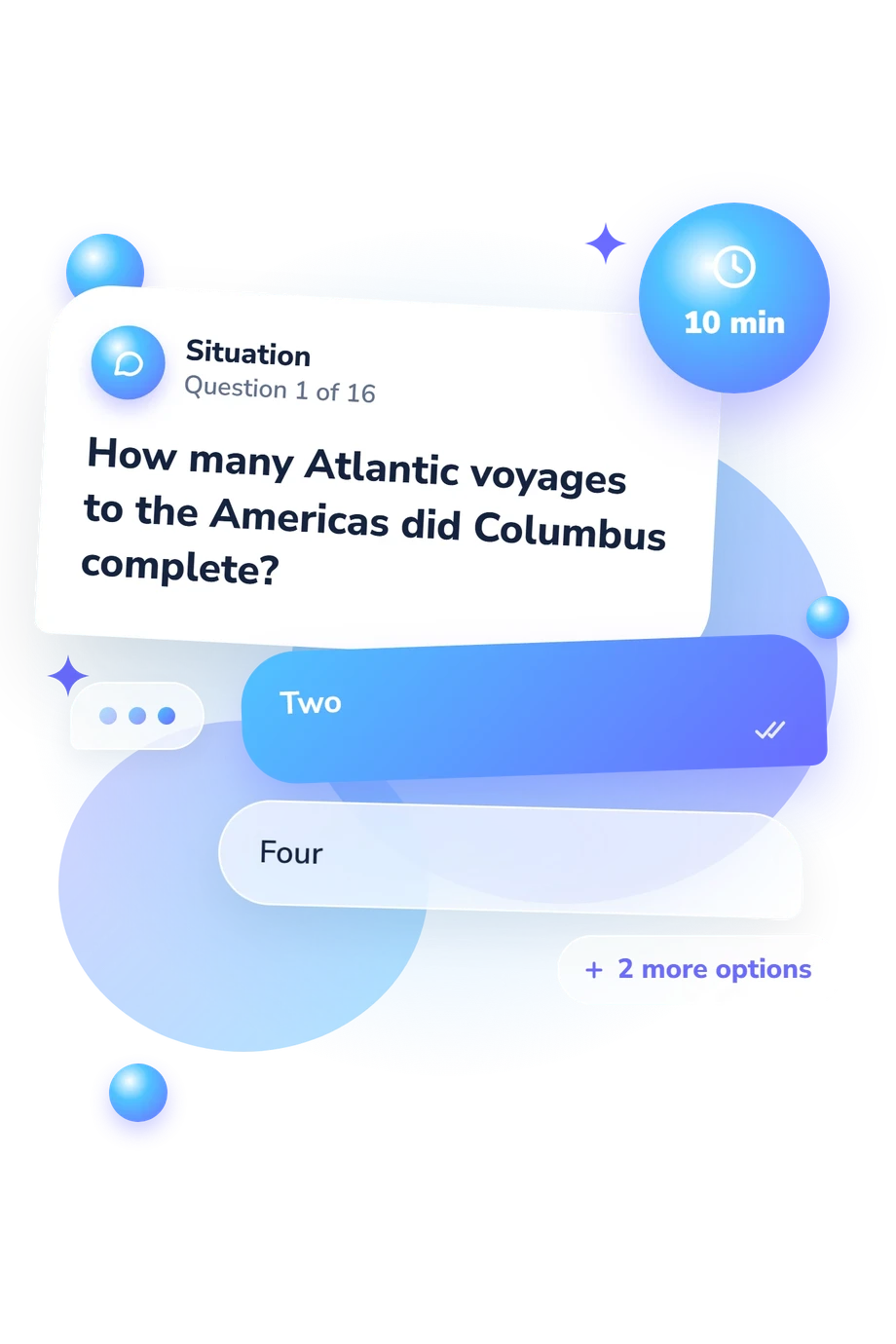
- Two
- Four
- Three
- Five
- Sail south around Africa to reach India
- Cross North America to find a Pacific passage
- Sail west across the Atlantic to reach Asia
- Establish a fishing route to Newfoundland
- It was repaired and led the return voyage to Spain
- Its timbers were used to help build the settlement of La Navidad
- It was replaced by a ship purchased in Cuba
- Its crew abandoned the Caribbean and sailed to Portugal
Christopher Columbus Quiz - Description and methodology of the test
Readers who want a focused check of Columbus’s voyages and historical context can use the Christopher Columbus Quiz to test recall and interpretation rather than personal opinion. The assessment is intended for learners, history enthusiasts, and anyone revisiting the subject; this Columbus quiz offers an overall knowledge level that can suggest broad areas for further review.
What This Assessment Explores
The questions connect navigation, sponsorship, encounters, settlement, exchange, and the consequences of European expansion. They ask readers to distinguish accurate claims from myths, place events in sequence, and consider why the voyages mattered on both sides of the Atlantic.
The result is reported on one scale:
- Christopher Columbus Knowledge (0-16) shows how accurately your answers cover Columbus’s voyages, historical setting, Indigenous context, navigation, and complex legacy. Foundational (0-6) indicates recognition of some major details; Developing (7-12) reflects a solid grasp with areas to refine; Strong (13-16) indicates broad, accurate knowledge.
The birthplace item also shows how this quiz can raise the question of what nationality Christopher Columbus was without treating nationality as the item’s stated subject: birthplace is factual, while national identity is interpretive.
Methodology and Historical Evidence
Each item presents a question with four answer choices. Some test recall of ships, routes, rulers, places, peoples, and agreements; others use scenarios to test interpretation of historical consequences. The questionnaire displays a knowledge scale, but it does not state an item-by-item point allocation, so interpretation follows the displayed categories rather than an inferred scoring rule.
Its historical framing is conceptually consistent with the First-voyage Diario by Dunn and Kelley, Rouse’s account of Taíno society and contact, Crosby’s Columbian Exchange framework, and Keegan’s discussion of chronology and geography. These works help situate items about voyages, Indigenous communities, exchange, and European claims; the questionnaire is not presented as an adaptation of any one publication.
As a Christopher Columbus history quiz, it offers an educational self-assessment; its bands describe performance on this set of questions rather than mastery of all Columbus scholarship. Results can reflect prior exposure, wording, guessing, and concentration, so the score guides further learning rather than defining expertise.
- Columbus, Christopher. The Diario of Christopher Columbus’s First Voyage to America, 1492-1493: Abstracted by Fray Bartolomé de las Casas. Transcribed and translated by Oliver Charles Dunn and James Edward Kelley, Jr. Norman: University of Oklahoma Press, 1989.
- Rouse, Irving. The Tainos: Rise and Decline of the People Who Greeted Columbus. New Haven: Yale University Press, 1992.
- Crosby, Alfred W. The Columbian Exchange: Biological and Cultural Consequences of 1492. 30th Anniversary Edition. Westport, CT: Praeger, 2003.
- Keegan, William F. “The Columbus Chronicles.” The Sciences 29, no. 1 (1989): 47-55. 10.1002/j.2326-1951.1989.tb02138.x
Updated: