
Cell Organelle Quiz
How the Scales are Structured
Who Usually Takes This Test?
See How You Compare
Below is a preview of how scores are typically distributed across each scale.
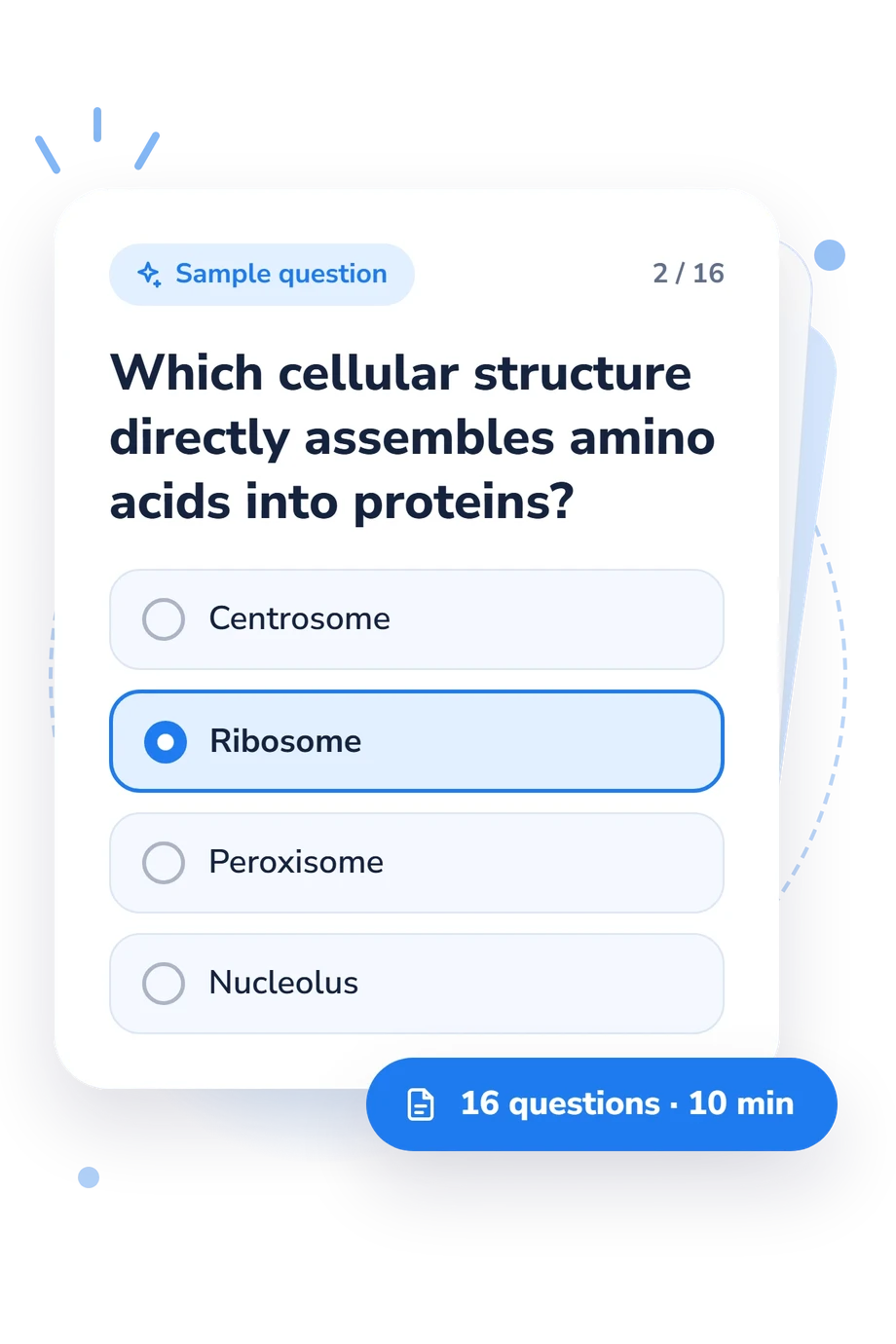
Example Questions From the Test
- Centrosome
- Ribosome
- Peroxisome
- Nucleolus
- Nucleus
- Golgi apparatus
- Lysosome
- Central vacuole
- Golgi apparatus → rough ER → nucleus → plasma membrane
- Smooth ER → lysosome → ribosome → plasma membrane
- Rough ER → Golgi apparatus → secretory vesicle → plasma membrane
- Nucleus → mitochondrion → Golgi apparatus → lysosome
Cell Organelle Quiz - Description and methodology of the test
Students who want to strengthen their understanding of cell biology can use a cell organelle quiz to connect familiar names with the jobs those structures perform. For revision, this quiz about cell organelles and their functions suits learners checking coursework, preparing for an introductory class, or identifying topics that need another pass. The result highlights how accurately you identify organelles, distinguish their functions, and connect structures with processes in plant, animal, and other eukaryotic cells.
What This Assessment Measures
Questions emphasize recognition rather than isolated naming. They connect organelles with protein secretion, ATP production, photosynthesis, recycling, storage, movement, and cell division, so, as an organelle function quiz, this assessment checks whether you understand how structures contribute to living cells.
The result uses one scale, Cell Organelle Knowledge (0-16). Each correct answer adds one point, and the bands are Foundations to Review (0-6), Developing Knowledge (7-12), and Strong Knowledge (13-16). Together, they show whether understanding is emerging, partly connected, or well developed.
The sampled themes include:
- Protein production and processing show how cells make, modify, and export proteins.
- Energy and photosynthesis show how mitochondria and chloroplasts support cellular energy conversion.
- Storage and recycling show how vacuoles, lysosomes, and peroxisomes maintain cell conditions.
- Structure and division show how nuclei, centrosomes, and flagella contribute to cellular organization and movement.
Methodology and Evidence Base
Each item uses four-option multiple choice. Some describe a biological situation; others ask about a structure’s role or a sequence of cellular events. One point goes to each correct response, producing the displayed total.
The method is conceptually consistent with the Introductory Molecular and Cell Biology Assessment (IMCA), which uses diagnostic questions to expose conceptual gaps. It also reflects Wilson et al. (2006), who emphasize tracing matter through dynamic cell systems. Alberts et al. (2022) supplies the cell-biology framework for the functions tested. This questionnaire is related to those works, not a reproduction or validated adaptation.
After completion, this organelle quiz is most useful when you revisit the tested concepts. For interpretation, the assessment works best when you ask whether you can apply the same principle to a new cell situation.
The questionnaire provides fixed descriptive bands for this item set, reflecting performance on structure, function, and process questions. Guessing, attention, recent instruction, and confidence can influence a self-administered score, so treat it as a focused snapshot rather than a complete measure of mastery.
- Shi J, Wood WB, Martin JM, Guild NA, Vicens Q, Knight JK. A diagnostic assessment for introductory molecular and cell biology. CBE-Life Sciences Education. 2010;9(4):453-461. 10.1187/cbe.10-04-0055
- Wilson CD, Anderson CW, Heidemann M, Merrill JE, Merritt BW, Richmond G, Sibley DF, Parker JM. Assessing students’ ability to trace matter in dynamic systems in cell biology. CBE-Life Sciences Education. 2006;5(4):323-331. 10.1187/cbe.06-02-0142
- Alberts B, Heald R, Johnson A, Morgan D, Raff M, Roberts K, Walter P. Molecular Biology of the Cell. 7th ed. New York: W. W. Norton & Company; 2022.
Updated: