
CBD Quiz
How the Scales are Structured
Who Usually Takes This Test?
See How You Compare
Below is a preview of how scores are typically distributed across each scale.
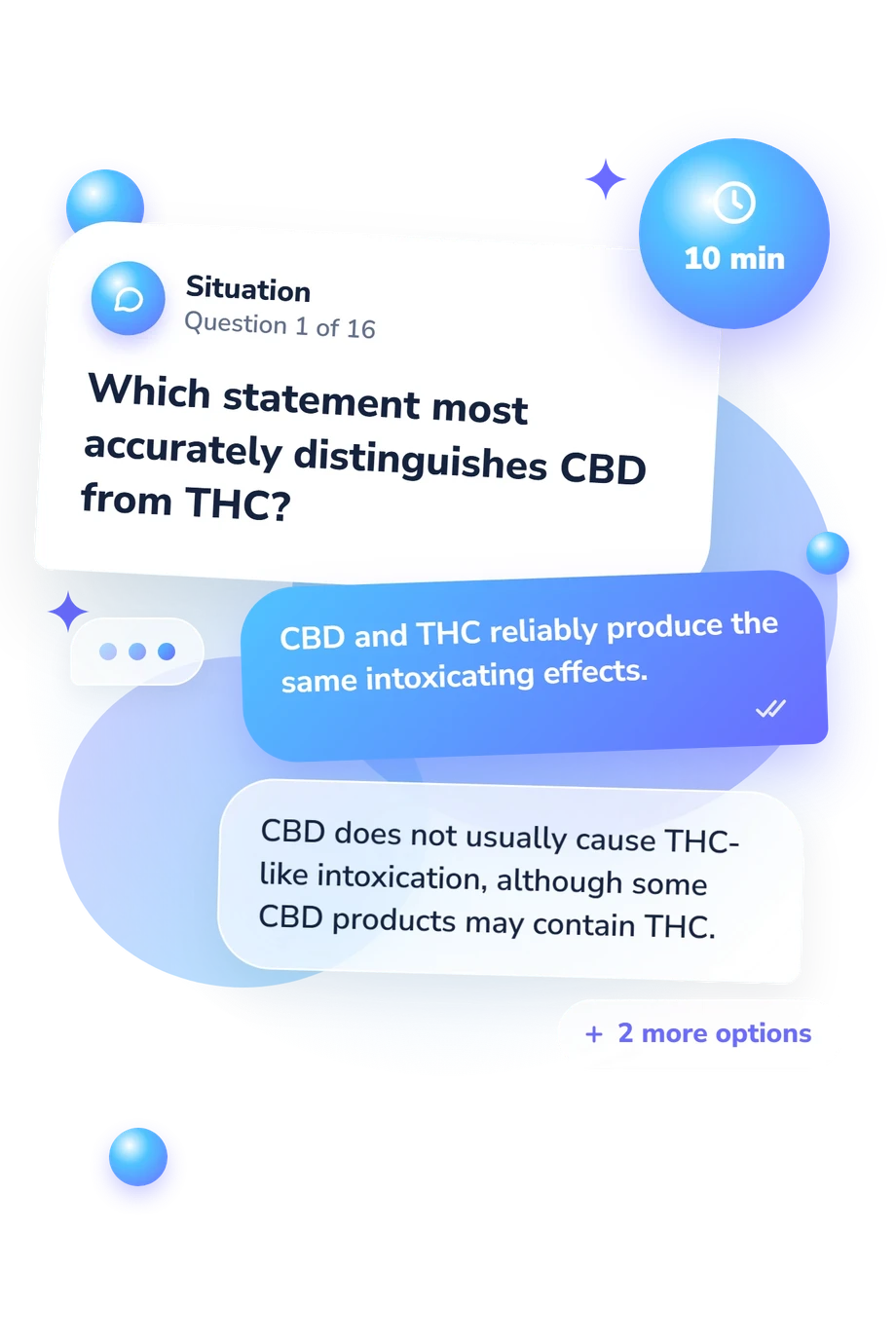
Example Questions From the Test
- The product may have contained trace or inaccurately labeled THC.
- Every drug test identifies CBD itself as illegal THC.
- Positive THC results cannot occur when a product is sold as CBD.
- The body always converts pure CBD into large quantities of THC.
- Tetrahydrocannabinol
- Cannabidivarin
- Cannabinol
- Cannabidiol
- A predictable increase in energy for every user
- Permanent immunity to medication side effects
- Complete prevention of nausea from other substances
- Diarrhea, appetite changes, or sleepiness
CBD Quiz - Description and methodology of the test
Readers who want to check how confidently they understand cannabidiol can use the CBD Quiz as a focused educational self-check. It suits people comparing products, considering use, or preparing questions for a pharmacist or clinician. Its CBD product safety questions cover practical decisions such as comparing labels, recognizing warnings, and deciding what to ask before trying a product.
What This Assessment Explores
The questionnaire measures practical CBD knowledge, not symptom severity, personality, or treatment response. Its themes test whether respondents can distinguish CBD from THC, recognize product categories, interpret marketing and laboratory information, and identify safety-sensitive situations.
The result is reported on the CBD Knowledge scale, which runs from 0-16. The displayed bands are:
- Foundation to build - 0-6 indicates that basic understanding needs stronger evidence, label, and safety checks.
- Developing knowledge - 7-12 indicates that many core ideas are understood, with room to improve product and health-safety judgment.
- Strong knowledge - 13-16 indicates a well-rounded grasp of CBD facts and practical precautions.
This CBD safety quiz supports self-reflection for people seeking responsible understanding of CBD. It can reveal learning priorities, but it cannot determine an appropriate product, amount, or route for an individual.
Methodology and Scientific Basis
Each item presents a question with four answer options. The set tests definitions, product categories, label claims, adverse effects, medicine interactions, procedural precautions, and when professional advice matters. Because the items have right and wrong answers, the result functions as a CBD knowledge test rather than an attitude scale.
The result is a single educational score summarizing performance; the questionnaire does not specify how individual responses are weighted. It can identify topics for further learning, while performance may vary with guessing, prior exposure, and attention to wording.
Gidal and colleagues provide content relevant to label accuracy, batch evidence, and contamination. Devinsky and colleagues support the narrower point about purified prescription cannabidiol for certain drug-resistant seizures. Chesney and colleagues, together with Balachandran and colleagues, support attention to adverse effects and interactions. The questionnaire is conceptually consistent with these findings, not an adaptation of them.
These studies support content areas, not psychometric evidence for this questionnaire: it has no stated standardization or validation against a published CBD knowledge instrument. The bands are educational descriptors rather than clinical norms.
- Gidal BE, Vandrey R, Wallin C, Callan S, Sutton A, Saurer TB, Triemstra JL. Product labeling accuracy and contamination analysis of commercially available cannabidiol product samples. Frontiers in Pharmacology. 2024;15:1335441. 10.3389/fphar.2024.1335441
- Devinsky O, Cross JH, Laux L, Marsh E, Miller I, Nabbout R, Scheffer IE, Thiele EA, Wright S; Cannabidiol in Dravet Syndrome Study Group. Trial of Cannabidiol for Drug-Resistant Seizures in the Dravet Syndrome. New England Journal of Medicine. 2017;376(21):2011-2020. 10.1056/NEJMoa1611618
- Chesney E, Oliver D, Green A, Sovi S, Wilson J, Englund A, Freeman TP, McGuire P. Adverse effects of cannabidiol: a systematic review and meta-analysis of randomized clinical trials. Neuropsychopharmacology. 2020;45(11):1799-1806. 10.1038/s41386-020-0667-2
- Balachandran P, Elsohly M, Hill KP. Cannabidiol Interactions with Medications, Illicit Substances, and Alcohol: a Comprehensive Review. Journal of General Internal Medicine. 2021;36(7):2074-2084. 10.1007/s11606-020-06504-8
Updated: