
Career Quiz
How the Scales are Structured
Who Usually Takes This Test?
See How You Compare
Below is a preview of how scores are typically distributed across each scale.
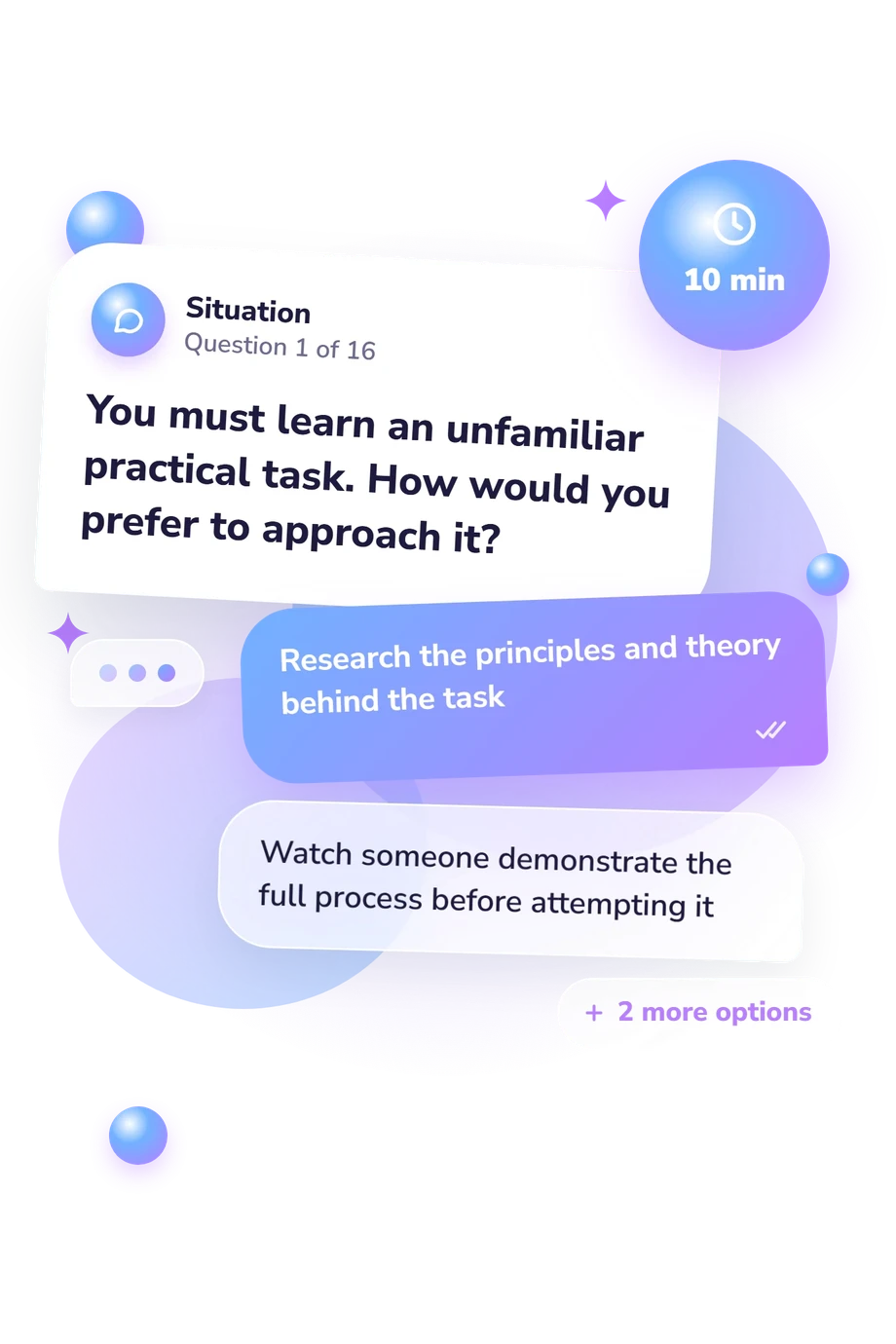
Example Questions From the Test
- Ask what feels unclear and tailor your support to their response
- Introduce them to useful contacts and explain where to find help
- Demonstrate the workflow so they can follow a concrete example
- Record the recurring onboarding issue for a future process review
- Coach volunteers as they build confidence in their roles
- Coordinate schedules and keep everyone informed
- Deliver a prepared update to attendees
- Maintain the project's budget and progress tracker
- Compare evidence to determine why customer retention changed
- Map an existing process and identify a likely bottleneck
- Develop concepts for a new awareness campaign
- Coordinate a mentoring event for new colleagues
Career Quiz - Description and methodology of the test
People considering a change, choosing a field, or trying to understand their preferred work style can use this career quiz to organize reflection. A job quiz of this kind compares the activities and contributions that feel engaging instead of declaring one ideal occupation. Its profile can suggest work environments and tasks worth examining, helping turn broad preferences into concrete options.
What This Assessment Explores
Four orientations cover investigation, creative expression, helping people, and practical delivery. Situations involving learning, teamwork, problem-solving, and tangible results reveal preferred activities. This format uses a what career is right for me quiz to identify affinities, not promise one occupation. The displayed dimensions are:
- Analytical & Investigative (0-12) shows attraction to evidence and complex questions: Background 0-4; Supporting 5-8; Leading 9-12.
- Creative & Expressive (0-12) shows attraction to original ideas: Background affinity 0-4; Supporting affinity 5-8; Leading affinity 9-12.
- People-Centered & Guiding (0-12) shows attraction to supporting or teaching people: Background affinity 0-4; Supporting affinity 5-8; Leading affinity 9-12.
- Practical & Hands-On (0-12) shows attraction to building and observable results: Background 0-4; Supporting 5-8; Leading 9-12.
Methodology and Scientific Basis
Each item presents a work situation with four response options. The choices contrast investigative, creative, interpersonal, and practical approaches, so respondents select what feels natural rather than rate skill.
Selections produce four displayed totals. The highest is the strongest affinity, while scores within one point form a blended result. The ranges show bands, not how many points each answer contributes.
Methodologically, the questionnaire is conceptually consistent with the RIASEC model (Holland, 1997): interests can help consider fit between a person and a work environment. Its four-group profile is simplified, not a full administration or adaptation. Holland (1959) supplies the vocational-choice framework, and Tracey and Rounds (1996) describe interests as multidimensional.
For someone using it as a what job should i have quiz, compare the result with real tasks and settings. The online self-report scoring has no stated occupational norms or standardized cutoffs, so its bands organize reflection rather than rank people. Van Iddekinge and colleagues (2011) found broad associations between vocational interests and work outcomes, including performance and retention, but those findings do not predict one person's outcome. Self-report can shift with context and self-awareness.
- Holland, John L. (1997). Making Vocational Choices: A Theory of Vocational Personalities and Work Environments (3rd ed.). Odessa, FL: Psychological Assessment Resources.
- Tracey, Terence J. G., & Rounds, James (1996). The spherical representation of vocational interests. Journal of Vocational Behavior, 48(1), 3-41. 10.1006/jvbe.1996.0002
- Holland, John L. (1959). A theory of vocational choice. Journal of Counseling Psychology, 6(1), 35-45. 10.1037/h0040767
- Van Iddekinge, Chad H., Roth, Philip L., Putka, Dan J., & Lanivich, Stephen E. (2011). Are you interested? A meta-analysis of relations between vocational interests and employee performance and turnover. Journal of Applied Psychology, 96(6), 1167-1194. 10.1037/a0024343
Updated: