
Freudly+971 508685814hello@freudly.ai
Freudly
business

Self-Management Ability Assessment Test
Take the online Self-Management Ability Assessment Test - AI psychologist FreudlyYou can take Self-Management Ability Assessment Testhere. Online version of a simple and accurate psychological test with interpretation.en
Understand your self-management strengths across focus, control, and growth in about 7 minutes. Get clear, actionable insight to spot blind spots, set goals, and build daily habits that stick.
Start Online Test
Questions: 367 minutes
08:30
October 2, 2025
October 2, 2025
Material has been updated
October 2, 2025
Material has been published
20,361 view
2,045 completions
1,032 likes
Verified by Daniel Hall
Psychologist with 25 years of experience
Share
Scale Explorer

How the Scales are Structured

example score
7/12
Self-Development (SD)
Assesses the tendency and capacity to deliberately work on oneself to improve personal, professional, and creative qualities.
Low
Moderate
High
46: Low | 79: Moderate | 1012: High
A score of 7 indicates a moderate level of self-development, suggesting a generally present growth orientation that may be applied inconsistently across situations.
example score
9/12
Self-Suggestion (SS)
Measures the ability to use autosuggestion to influence your state, guide behavior, and reduce emotional tension through inner dialogue.
Limited
Moderate
Strong
46: Limited | 79: Moderate | 1012: Strong
A score of 9 indicates a moderate ability to use autosuggestion to steady emotions and support self-directed behavior, though it may not be consistently strong in more demanding situations.
example score
8/12
Self-Evaluation (SE)
Measures how objectively a person evaluates their personal qualities and performance without marked over- or underestimation.
Low objectivity
Balanced
Highly objective
46: Low objectivity | 79: Balanced | 1012: Highly objective
A score of 8 falls in the Balanced range, suggesting generally realistic self-evaluation with only occasional bias toward being too critical or too lenient.
example score
7/12
Self-Control (SC)
Measures the ability to regulate emotions and behavior to adapt to changing conditions and complete tasks accurately and efficiently.
Low
Moderate
High
46: Low | 79: Moderate | 1012: High
A score of 7 falls in the Moderate range, suggesting generally adequate self-control with occasional slips under stress or changing demands.
example score
7/12
Self-Reliance (SR)
Measures autonomy, initiative, and independence in actions and decision-making.
Low autonomy
Moderate autonomy
High autonomy
46: Low autonomy | 79: Moderate autonomy | 1012: High autonomy
A score of 7 suggests a moderate level of autonomy and initiative, with independent action present but not consistently expressed across situations.
example score
8/12
Capacity for Self-Realization (CfSR)
Measures the ability to translate personal abilities and creative potential into real activity and growth-oriented goals.
Developing
Moderate
Strong
46: Developing | 79: Moderate | 1012: Strong
A score of 8 indicates a moderate capacity for self-actualization, with generally consistent expression of strengths and creative potential alongside areas that may still benefit from further development.
example score
6/12
Self-Organization (SO)
Assesses how well a person plans activities, uses resources efficiently, and organizes daily life to reach goals.
Needs Structure
Developing Discipline
Strong Self-Discipline
46: Needs Structure | 79: Developing Discipline | 1012: Strong Self-Discipline
A score of 6 suggests self-discipline is still forming, with a tendency to need more external structure or clearer routines to follow plans consistently.
example score
8/12
Self-Determination (SD)
Measures the ability to clearly identify personal goals and needs while anticipating obstacles to achieving them.
Needs clarification
Developing
Well-defined
46: Needs clarification | 79: Developing | 1012: Well-defined
A score of 8 indicates a developing level of self-determination, with generally clear goals and emerging skill in anticipating obstacles.
example score
8/12
Toward Self-Knowledge (TSK)
Measures self-awareness—the ability to recognize one’s strengths and weaknesses, knowledge level, and personal and professional qualities.
Limited self-awareness
Developing self-awareness
Strong self-awareness
46: Limited self-awareness | 79: Developing self-awareness | 1012: Strong self-awareness
A score of 8 indicates developing self-awareness, with a generally clear sense of personal qualities and areas for growth that may still benefit from further reflection.
example score
60/108
Self-Management Abilities (SMA)
Measures overall self-regulation and self-management abilities such as goal-setting, planning, self-monitoring, and personal development.
Lower
Moderate
High
3659: Lower | 6083: Moderate | 84108: High
A score of 60 falls in the Moderate range, suggesting generally adequate self-regulation skills with some areas that may benefit from further strengthening for more consistent goal achievement.
Start Online Test
just completed the test
DATA-BASED USER COHORTS

Who Usually Takes This Test?

Goal-focused self improvers
41%OF USERS
People who want to get more disciplined and clear about goals, habits, and follow-through in everyday life.
Stressed professionals and managers
34%OF USERS
Working adults who feel overloaded and want to assess planning, self-control, and emotional regulation at work.
Students and early-career starters
25%OF USERS
Learners and new employees who want to understand their self-organization, initiative, and growth areas for study or career planning.
BASED ON AGGREGATED, ANONYMIZED DATA FROM TENS OF THOUSANDS OF FREUDLY USERS.
Benchmarking

See How You Compare

Once you complete the test, your results are compared with real-world data from people in your country.
Below is a preview of how scores are typically distributed across each scale.
To self-development (Ts)
Average
7.2
Normal range
5.98.5
min.
4
max.
12
This curve shows how scores are typically distributed.
Once you complete the test, your result will appear on the scale so you can see how you compare.
On Autosuggestion (OA)
Average
9.2
Normal range
8.210.2
min.
4
max.
12
This curve shows how scores are typically distributed.
Once you complete the test, your result will appear on the scale so you can see how you compare.
To Self-Esteem (TS)
To Self-Esteem (TS)
Average
9.2
Normal range
8.210.2
min.
4
max.
12
This curve shows how scores are typically distributed.
Once you complete the test, your result will appear on the scale so you can see how you compare.
On Self-Control (OS)
Average
7.3
Normal range
5.98.6
min.
4
max.
12
This curve shows how scores are typically distributed.
Once you complete the test, your result will appear on the scale so you can see how you compare.
To amateur performance (Tap)
Average
8.7
Normal range
7.310.2
min.
4
max.
12
This curve shows how scores are typically distributed.
Once you complete the test, your result will appear on the scale so you can see how you compare.
Towards self-actualization (Ts)
Average
9
Normal range
7.710.3
min.
4
max.
12
This curve shows how scores are typically distributed.
Once you complete the test, your result will appear on the scale so you can see how you compare.
Towards Self-Discipline (TS)
Average
9.2
Normal range
7.910.6
min.
4
max.
12
This curve shows how scores are typically distributed.
Once you complete the test, your result will appear on the scale so you can see how you compare.
To Self-Determination (TS)
Average
6.6
Normal range
5.57.7
min.
4
max.
12
This curve shows how scores are typically distributed.
Once you complete the test, your result will appear on the scale so you can see how you compare.
To self-discovery (Ts)
Average
7
Normal range
5.58.5
min.
4
max.
12
This curve shows how scores are typically distributed.
Once you complete the test, your result will appear on the scale so you can see how you compare.
Self-Regulation Abilities (SA)
Average
61.2
Normal range
51.570.8
min.
36
max.
108
This curve shows how scores are typically distributed.
Once you complete the test, your result will appear on the scale so you can see how you compare.
Featured On
SAMPLE QUESTIONS

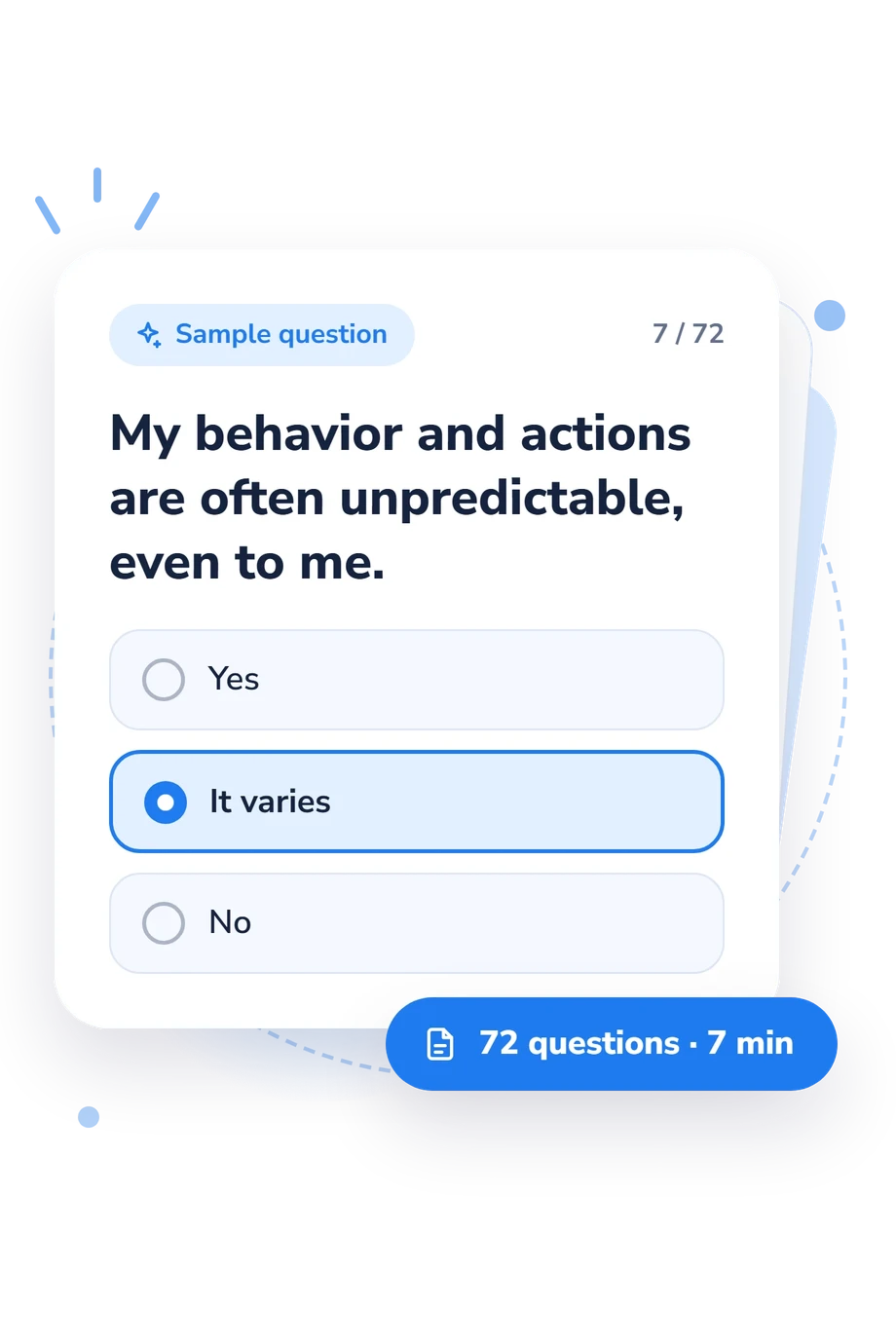
Example Questions From the Test

    • Very often
    • Often
    • Rarely
    • I do not think so
    • It depends
    • Yes
    • Yes
    • Sometimes
    • No
WHAT THE TEST MEASURES
About This Assessment
Assessment of Self-Management Abilities Test

Self-Management Ability Assessment Test - Symptoms and Signs

business
self-efficacy
self-regulation

This instrument is designed to assess perceived self-regulatory and self-management skills across everyday contexts. The Self-Management Ability Assessment uses self-report responses to characterize how an individual typically approaches goal setting, organization, self-monitoring, and follow-through.

It consists of 36 items and typically takes about 7 minutes to complete. Results are intended to support clinical formulation and treatment planning by identifying relative strengths and areas that may benefit from targeted skills practice or coaching.

The Self-Management Ability Assessment is attributed to Albert Bandura.

Author: Albert Bandura
Literature: Bandura, A. Self-efficacy: The exercise of control. W. H. Freeman. 1997.
Popular tests
Comments
Leave a Comment