
Creative Personality Ability Questionnaire Test
How the Scales are Structured
Who Usually Takes This Test?
See How You Compare
Below is a preview of how scores are typically distributed across each scale.
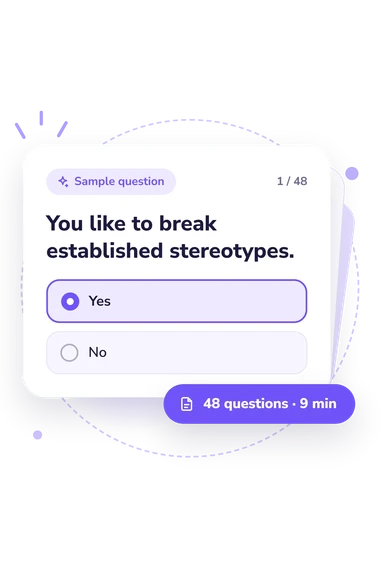
Example Questions From the Test
- Yes
- No
- Yes
- No
- Yes
- No
Creative Personality Ability Questionnaire Test - Description and methodology of the test
For readers who want a structured look at how they approach novelty, challenge, and self-expression, the Creative Personality Ability Questionnaire Test offers a focused form of self-assessment. It is intended for people exploring creative strengths in everyday learning, work, communication, or problem solving. As a creative personality questionnaire, it describes a tendency profile that can make familiar habits easier to notice.
What This Assessment Explores
Questions sample novelty, uncertainty, challenge, and self-expression. Curiosity, imagination, initiative, persistence, social confidence, and flexible problem solving are behavioral routes into creative ability, not separate result scales. The result concerns overall creative ability-originality, cognitive flexibility, and new-idea generation-rather than artistic talent.
Sampled themes are:
- Curiosity and openness show willingness to explore and seek knowledge.
- Originality and imagination show whether ideas are varied and practical.
- Flexibility and problem solving show attention to obstacles and alternatives.
- Initiative and persistence show how the respondent starts and pursues goals.
As a creative ability test, it produces one Creative Personality Ability Level score, 0-48. Result bands are Low 0-17, Average 18-28, and High 29-48. These bands describe a tendency: Average suggests developed but not exceptional ability, High may indicate pronounced creativity, and Low may indicate difficulty expressing a creative approach.
Methodology and Evidence Base
Each item uses a Yes/No response and describes an everyday reaction or behavior rather than a performance task. Answers feed one displayed overall score rather than separate subscale scores; standardized scoring, population norms, and validation are not documented for this online form.
The Torrance-Barron V4 version is attributed to E. Paul Torrance and Frank Barron. Its themes are closest to Barron’s 1957 study of originality, personality, and intellect and to the Questionnaire of Creative Personality Abilities described by Shlyapnikova and Kashapov in 2012; this is a conceptual relationship, not evidence that the online form is a standardized instrument.
As a creativity self-assessment, it organizes reflection on uncertainty, ideas, obstacles, and initiative. The result is descriptive rather than a population norm or clinical threshold. Self-reported answers can be affected by mood, self-awareness, social desirability, and current circumstances. Compare the pattern with concrete examples from daily life, where behavior may vary across settings.
- Kashapov, M. M., & Poshekhonova, Yu. V. (Eds.). (2012). Creative Activity of a Professional in the Context of Cognitive and Metacognitive Approaches. Yaroslavl: Yaroslavl State University.
- Kashapov, M. M., & Skakunova, O. A. (2019). Creativity as a Cognitive Resource in the Practice of Novice Doctors. The Bulletin of Irkutsk State University. Series Psychology, 27, 16-31. DOI 10.26516/2304-1226.2019.27.16