
Capital of Indian States Quiz
How the Scales are Structured
Who Usually Takes This Test?
See How You Compare
Below is a preview of how scores are typically distributed across each scale.
Example Questions From the Test
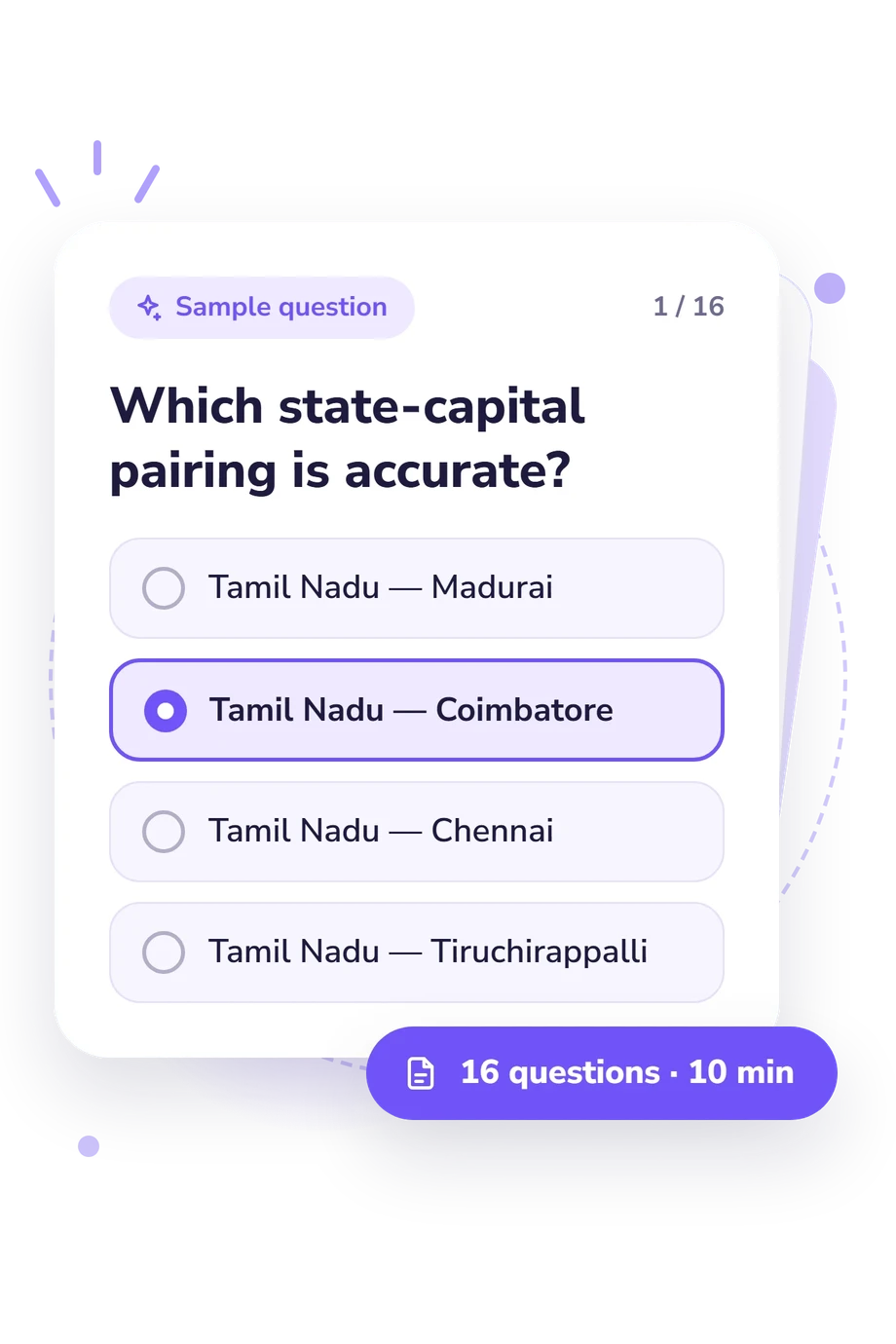
- Tamil Nadu — Madurai
- Tamil Nadu — Coimbatore
- Tamil Nadu — Chennai
- Tamil Nadu — Tiruchirappalli
- Nagpur
- Pune
- Mumbai
- Nashik
- Ranchi
- Bokaro
- Jamshedpur
- Dhanbad
Capital of Indian States Quiz - Description and methodology of the test
For learners, travelers, students, and curious readers, this cash flow statement quiz checks whether you can distinguish official Indian capitals from larger or more familiar cities. The result shows where recall is secure and which city-state pairs deserve review. As an Indian geography quiz, it offers a focused way to refresh practical knowledge of India.
What This Assessment Explores
This assessment measures recognition of Indian state-capital pairings, especially when a familiar city could distract from the official answer. Its scenarios include government appointments, travel, regional clues, and direct matching, so the reader must connect a place with the correct state. For an Indian state capitals quiz, the result reflects accuracy across the locations represented here, not complete mastery of India’s geography.
The displayed scale is Indian State Capitals Knowledge, 0-16. Foundation 0-6 indicates some recognition with confusion; Developing 7-12 indicates many known pairings with weaker areas; Strong 13-16 indicates consistent accuracy across the included states. The questions use three recurring task types:
- Direct pairings test state-capital matching.
- Contextual prompts test retrieval in travel, government, or study situations.
- Contrast items test separation of capitals from prominent non-capital cities.
Methodology and Evidence Base
Each item offers four answer choices with one intended best answer. Some ask for a direct pairing; others place the capital in a meeting, travel, government, or study scenario. This format makes the state capitals test a check of recognition and discrimination among plausible alternatives rather than requiring a written explanation.
The score is presented as accuracy across the selected items, and the result is descriptive of the included state-capital items. The bands describe performance on this quiz set and are not presented as normative comparisons.
Government of India state-capital listings provide a factual reference for the answer set. Al-Rukban discusses general multiple-choice construction, which is relevant to the four-option format but does not define this questionnaire’s scoring. These references address factual content and response design, not normative comparisons for the quiz bands.
Performance can vary with memory, attention, prior study, and momentary uncertainty. An incorrect answer may show an unfamiliar pairing or lapse in recall, so the result is best used to target review rather than define a fixed ability.
- Government of India, Know India Programme. "State/UTs and Capitals." National Portal of India, n.d.
- Spate, Oskar Hermann Khristian, and Andrew Thomas Amos Learmonth. India and Pakistan: A General and Regional Geography. 3rd ed., Methuen, 1967.
- Huang, Zixian, Yulin Shen, Xiao Li, Yuang Wei, Gong Cheng, Lin Zhou, Xinyu Dai, and Yuzhong Qu. "GeoSQA: A Benchmark for Scenario-based Question Answering in the Geography Domain at High School Level." Proceedings of the 2019 Conference on Empirical Methods in Natural Language Processing and the 9th International Joint Conference on Natural Language Processing, 2019, pp. 5866-5871. 10.18653/v1/D19-1597.
- Al-Rukban, Mohammed O. "Guidelines for the Construction of Multiple Choice Questions Tests." Journal of Family and Community Medicine, 13(3), 2006, pp. 125-133. 10.4103/2230-8229.97543.
Updated: