
Canada Citizenship Quiz
How the Scales are Structured
Who Usually Takes This Test?
See How You Compare
Below is a preview of how scores are typically distributed across each scale.
Example Questions From the Test
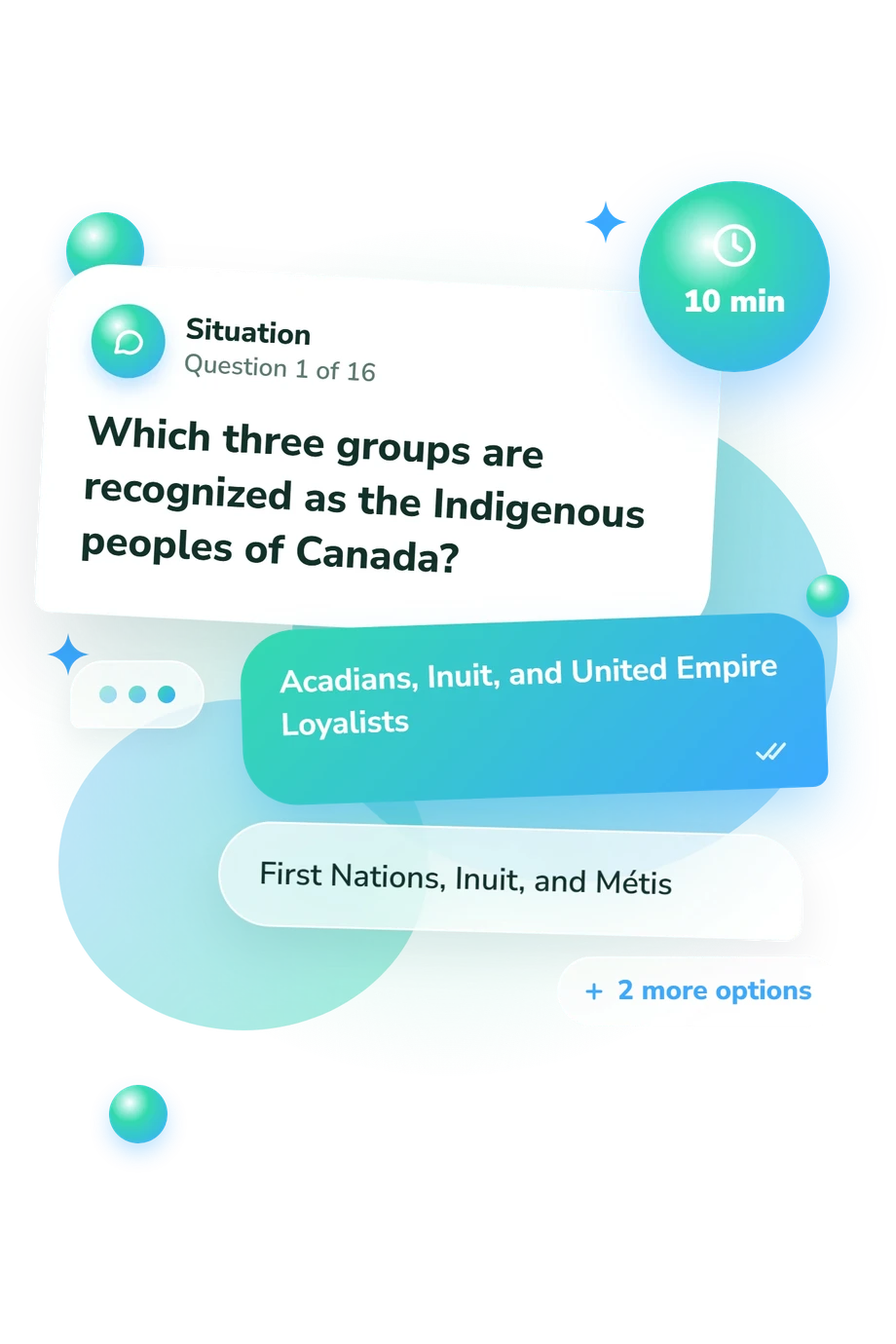
- Acadians, Inuit, and United Empire Loyalists
- First Nations, Inuit, and Métis
- First Nations, Québécois, and Métis
- Inuit, Francophones, and Anglophones
- Respond to the summons and serve unless legally excused
- Ignore it unless jury service was requested voluntarily
- Vote in the next election instead of attending
- Transfer the summons to a police officer
- The municipal government
- The Senate
- The provincial lieutenant governor personally
- The federal government
Canada Citizenship Quiz - Description and methodology of the test
People preparing for Canadian citizenship can use the Canada Citizenship Quiz to turn a broad study task into a clear next step. It gives learners a concrete basis for organizing a citizenship study plan and deciding where to concentrate their attention. The questionnaire presents civic and historical situations with clear answer choices, while the result indicates whether further study may be useful.
What This Assessment Explores
The questions sample civic knowledge rather than personality or opinion. They connect responsibilities with situations involving jury duty, voting eligibility, local services, national defence, and freedom of expression. Other items cover Confederation, Indigenous peoples, Parliament, Remembrance Day, Ottawa, the Crown, and the official languages.
The main thematic groups are:
- Government and civic duties show how responsibilities are divided across levels of government.
- Rights and participation test recognition of freedoms, voting rules, democratic safeguards, and public obligations.
- History and national identity check recall of people, events, symbols, places, and institutions.
The displayed result from this citizenship knowledge test guides review toward weaker subject areas by showing where another pass is needed. The Canada Citizenship Knowledge scale runs from 0-16 and measures performance on this practice set. Its displayed bands are Foundations to review (0-6), Developing knowledge (7-12), and Strong knowledge (13-16).
Methodology and Evidence Base
Each item uses a short question followed by four answer choices. The respondent selects the option that best fits the civic or historical situation, so the format tests recognition and application rather than open-ended writing. Distractors distinguish federal, provincial, territorial, and municipal roles or separate constitutional concepts.
Scoring produces one practice-set total for the 16 questions and presents it through descriptive bands. The displayed result can therefore help organize review by pointing to guide sections that deserve another pass and confirming topics that already feel secure.
These features make it a structured online practice set for civic knowledge, using a selected-response assessment method rather than a personality measure.
The content reference is Discover Canada, the Canadian citizenship study guide published by Immigration, Refugees and Citizenship Canada. Its subject areas correspond to the knowledge sampled here, including government, history, rights, and responsibilities.
Read the total as feedback for choosing what to review next; the questions provide a focused snapshot of the knowledge represented here. This unofficial score describes performance on this practice set and does not guarantee an official test result.
- Immigration, Refugees and Citizenship Canada. (2021). Discover Canada: The Rights and Responsibilities of Citizenship. Ottawa, ON: Government of Canada. ISBN 978-0-660-39274-5.
- Immigration, Refugees and Citizenship Canada. (2020). Evaluation of the Citizenship Program. Research and Evaluation Branch.
- Arias, Angel, Rachelle Vessey, and Jaffer Sheyholislami. (2022). Jumping Through Hoops in the Canadian Immigration System: A Critical View of the Immigrant's Journey to Citizenship. TESOL Quarterly, 56(4), 1430-1444. DOI 10.1002/tesq.3184
Updated: