
Business Law Quiz
How the Scales are Structured
Who Usually Takes This Test?
See How You Compare
Below is a preview of how scores are typically distributed across each scale.
Example Questions From the Test
- Respondeat superior
- The first-sale doctrine
- The parol evidence rule, which may exclude the prior contradictory term
- The automatic stay
- Transfers of real estate
- Sales of movable goods
- Employment relationships
- Professional service contracts
- Duty, breach, causation, and legally recognized harm
- Intent, offer, acceptance, and consideration
- Ownership, registration, copying, and commercial use
- Authority, ratification, disclosure, and profit
Business Law Quiz - Description and methodology of the test
For students, entrepreneurs, managers, and anyone seeking a structured introduction to everyday legal concepts, this business law quiz offers a focused way to check practical understanding. It turns situations involving agreements, companies, workplace conduct, and commercial information into an educational summary of the respondent’s overall foundation in business law, while the covered topics can guide closer study. This business law test connects familiar business decisions with the rules that organize them.
What This Assessment Measures
Short scenarios ask readers to apply a rule rather than repeat a definition. The content spans contracts, sales, intellectual property, negligence, agency, business entities, fiduciary conduct, and bankruptcy. It suits anyone building a foundation or locating study gaps.
Rather than testing vocabulary alone, the business law questions focus on facts such as changed terms, secrecy measures, authority, and personal liability.
The main thematic groups are:
- Contracts show how agreement, consideration, interpretation, and damages shape obligations.
- Commerce and intellectual property distinguish sales rules from protection for brands, inventions, and confidential information.
- Organizations and liability explain how entities, agency, negligence, and bankruptcy allocate risk.
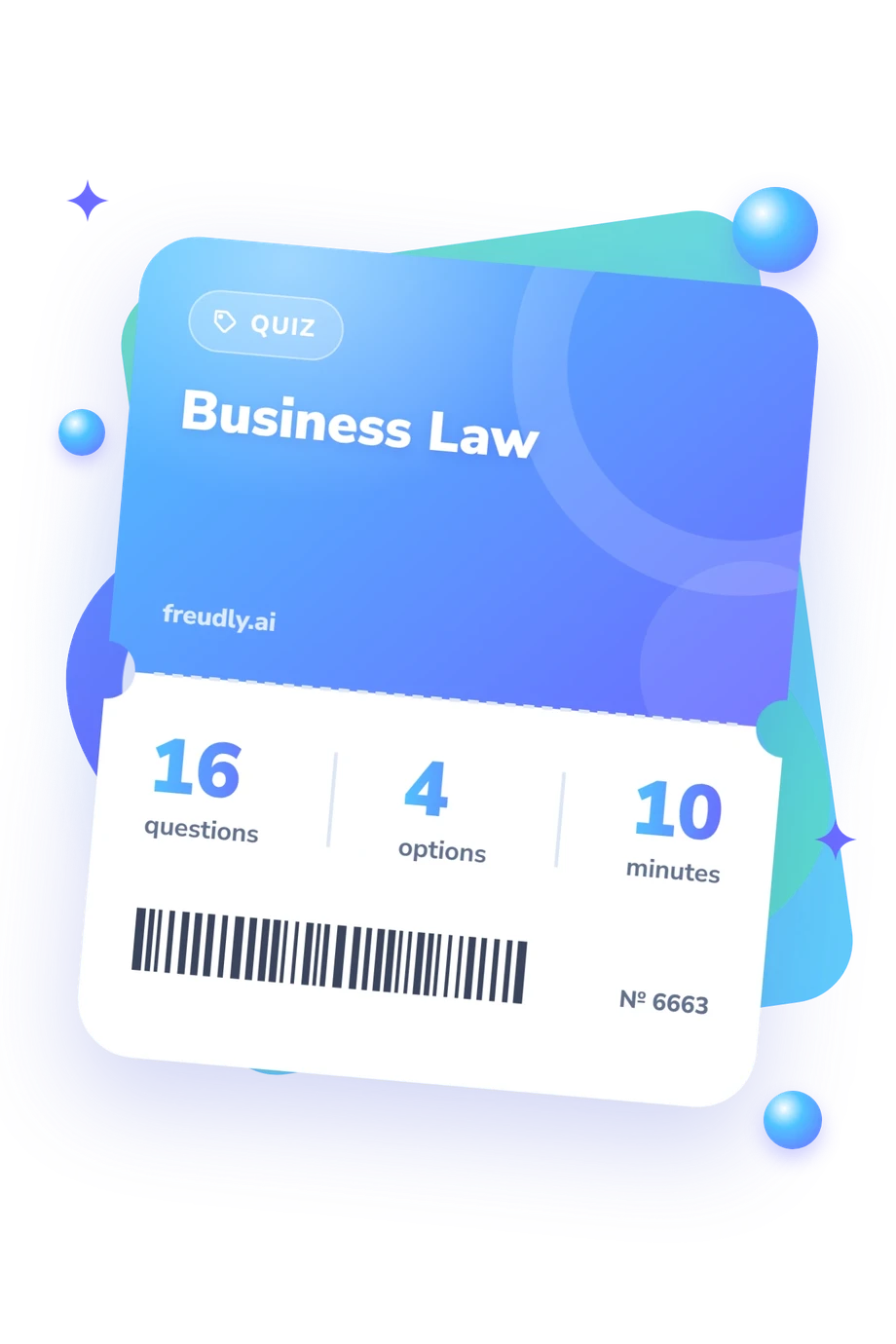
Results use Business Law Knowledge (0-16): Foundation to build (0-6), Developing command (7-12), and Strong foundational knowledge (13-16). These bands describe educational command of major concepts.
Methodology and Evidence Base
Each item presents a brief fact pattern with four answer choices, and the respondent selects the option that best states the governing rule. This selected-response method tests recognition and application of legal concepts for business rather than written legal analysis.
The displayed educational result summarizes that overall foundation, while the questionnaire’s coverage of several topics can guide later review rather than provide separate topic scores.
Its content is conceptually consistent with Valbrune and De Assis (2026), which covers the business-law domains represented here. The examples use primarily U.S. frameworks, including UCC Article 2, common-law contract rules, and bankruptcy principles, so the result is not jurisdiction-neutral. Bird (2018) situates broad business-law knowledge in legal education. It should be read as conceptually consistent with these sources, not as an adaptation of them.
It functions as an online educational questionnaire rather than a standardized instrument; no standardized norms or instrument-specific validation are established for it. These educational bands are not legal advice, and performance can be affected by prior coursework, guessing, attention, current context, and differences in jurisdiction or facts.
- Valbrune, Mirande, and Renee De Assis. Business Law I Essentials 2e. OpenStax, Houston, Texas, 2026.
- American Law Institute and National Conference of Commissioners on Uniform State Laws. Uniform Commercial Code, Article 2: Sales. 1951.
- American Law Institute. Restatement of the Law Second, Contracts. American Law Institute Publishers, 1981.
- Bird, Robert C. "On the Future of Business Law." Journal of Legal Studies Education, vol. 35, no. 2, 2018, pp. 301-320. 10.1111/jlse.12079
Updated: