
Build a Boyfriend Quiz
How the Scales are Structured
Who Usually Takes This Test?
See How You Compare
Below is a preview of how scores are typically distributed across each scale.
Example Questions From the Test
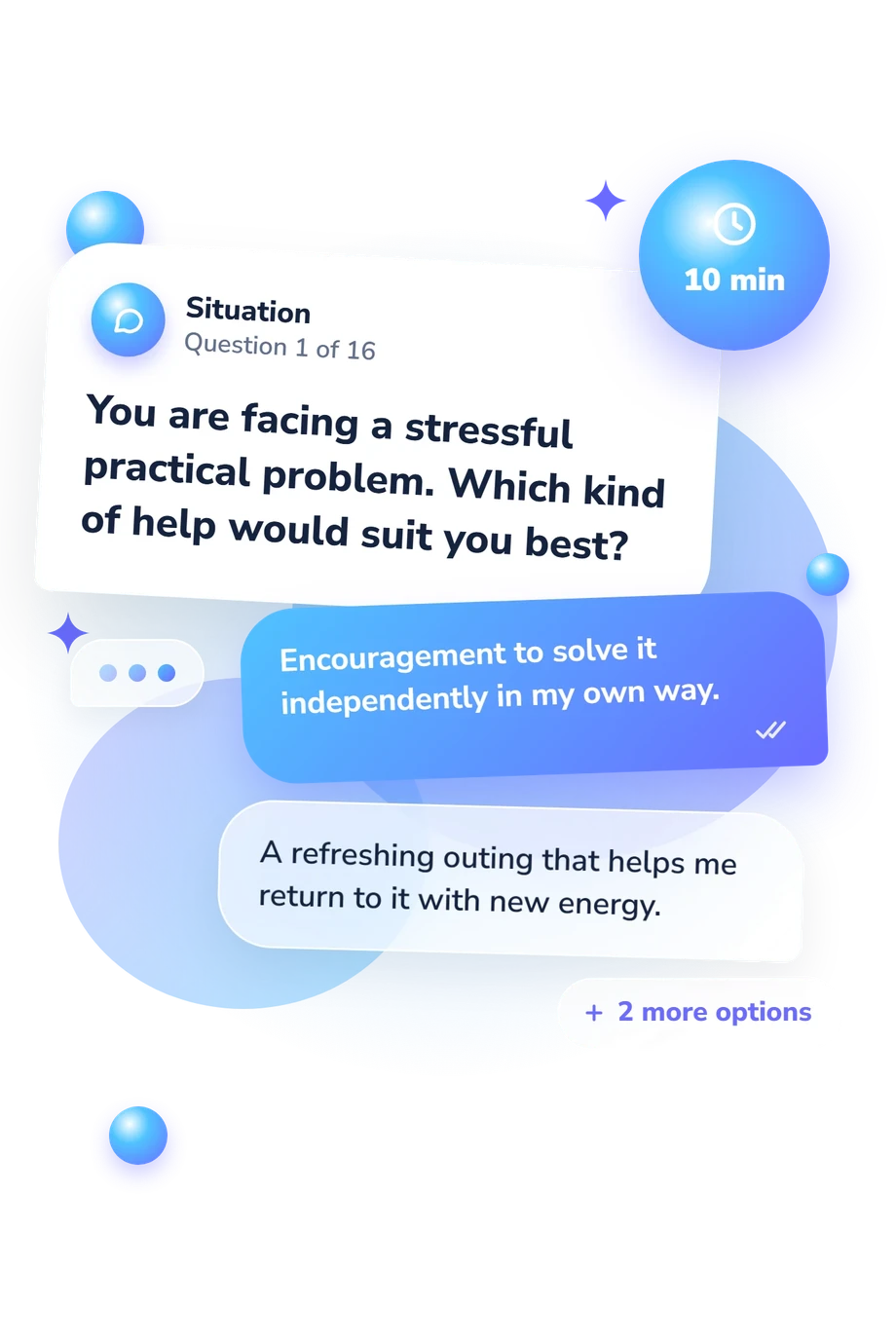
- Encouragement to solve it independently in my own way.
- A refreshing outing that helps me return to it with new energy.
- A conversation that helps me sort through possible approaches.
- Someone who stays beside me, takes on agreed tasks, and follows through.
- Having enough independent time to preserve our separate interests.
- Deepening the routines and traditions that already work for us.
- Mixing familiar rituals with occasional new dates or trips.
- Frequently inventing challenges, surprises, and new experiences to share.
- Let it fade unless it creates a practical problem later.
- Take some space and reconnect through a normal shared activity.
- Briefly compare perspectives once both of us feel calmer.
- Talk through the feelings and assumptions involved until we understand each other.
Build a Boyfriend Quiz - Description and methodology of the test
People who want to understand which partner qualities feel most appealing in an ideal relationship can use this questionnaire to map their preferred relationship dynamics. The Build a Boyfriend Quiz turns everyday choices about support, novelty, ambition, and conversation into a profile of relationship preferences. Its structured prompts help organize the qualities and dynamics that matter to you without reducing attraction to a single personality label.
What This Assessment Explores
These questions suit anyone reflecting on the qualities they want in a romantic partnership. The result describes preferences for an ideal partner, not a fixed label for you or a prediction about a particular relationship. Separating these preferences gives the result more detail than a single personality label:
- Driven Teammate (0-12) measures affinity for shared ambition and active partnership: Present-Focused Bond (0-4), Flexible Partnership (5-8), or Driven Teammate Affinity (9-12).
- Playful Adventurer (0-12) measures appeal of novelty, humor, and energetic experiences: Familiar Rhythm (0-4), Selective Spontaneity (5-8), or Playful Adventurer Affinity (9-12).
- Steady Supporter (0-12) measures preference for reliability, practical care, and calm routines: Freedom First (0-4), Welcome Stability (5-8), or Steady Supporter Affinity (9-12).
- Thoughtful Communicator (0-12) measures the importance of emotional openness, careful listening, and meaningful dialogue: Action-Oriented Connection (0-4), Open When Needed (5-8), or Thoughtful Communicator Affinity (9-12).
Methodology and Scientific Basis
The items use brief relationship scenarios with four answer choices, covering stress, disagreement, future planning, affection, changing plans, and shared activities. Each option reflects a different balance of independence, novelty, practical dependability, teamwork, or emotional exchange, so you choose the response that fits your preference rather than rate a partner’s performance.
The result presents four scale scores. The highest indicates the strongest affinity, while scores within one point form a blended result.
Its conceptual reference is the Ideal Partner Scales described by Fletcher and colleagues in 1999, which present relationship ideals as distinct but related standards. Later work by Fletcher and Simpson explains how ideals guide partner evaluation, while work by Campbell and colleagues examines links between ideals, the self, and flexibility. The online questionnaire is conceptually consistent with this published instrument, not an adaptation of it.
As a reflection tool, the result can help name preferences that are otherwise vague. Because responses are self-reported, current mood, recent experiences, and self-image may influence the profile, so read it as a contextual snapshot of compatibility preferences.
- Fletcher, Garth J. O., Geoff Thomas, Louise Giles, and Jeffry A. Simpson. (1999). Ideals in intimate relationships. Journal of Personality and Social Psychology, 76(1), 72-89. 10.1037/0022-3514.76.1.72
- Fletcher, Garth J. O., and Jeffry A. Simpson. (2000). Ideal Standards in Close Relationships: Their Structure and Functions. Current Directions in Psychological Science, 9(3), 102-105. 10.1111/1467-8721.00070
- Campbell, Lorne, Jeffry A. Simpson, Deborah A. Kashy, and Garth J. O. Fletcher. (2001). Ideal Standards, the Self, and Flexibility of Ideals in Close Relationships. Personality and Social Psychology Bulletin, 27(4), 447-462. 10.1177/0146167201274006
Updated: