
BSD Character Quiz
How the Scales are Structured
Who Usually Takes This Test?
See How You Compare
Below is a preview of how scores are typically distributed across each scale.
Example Questions From the Test
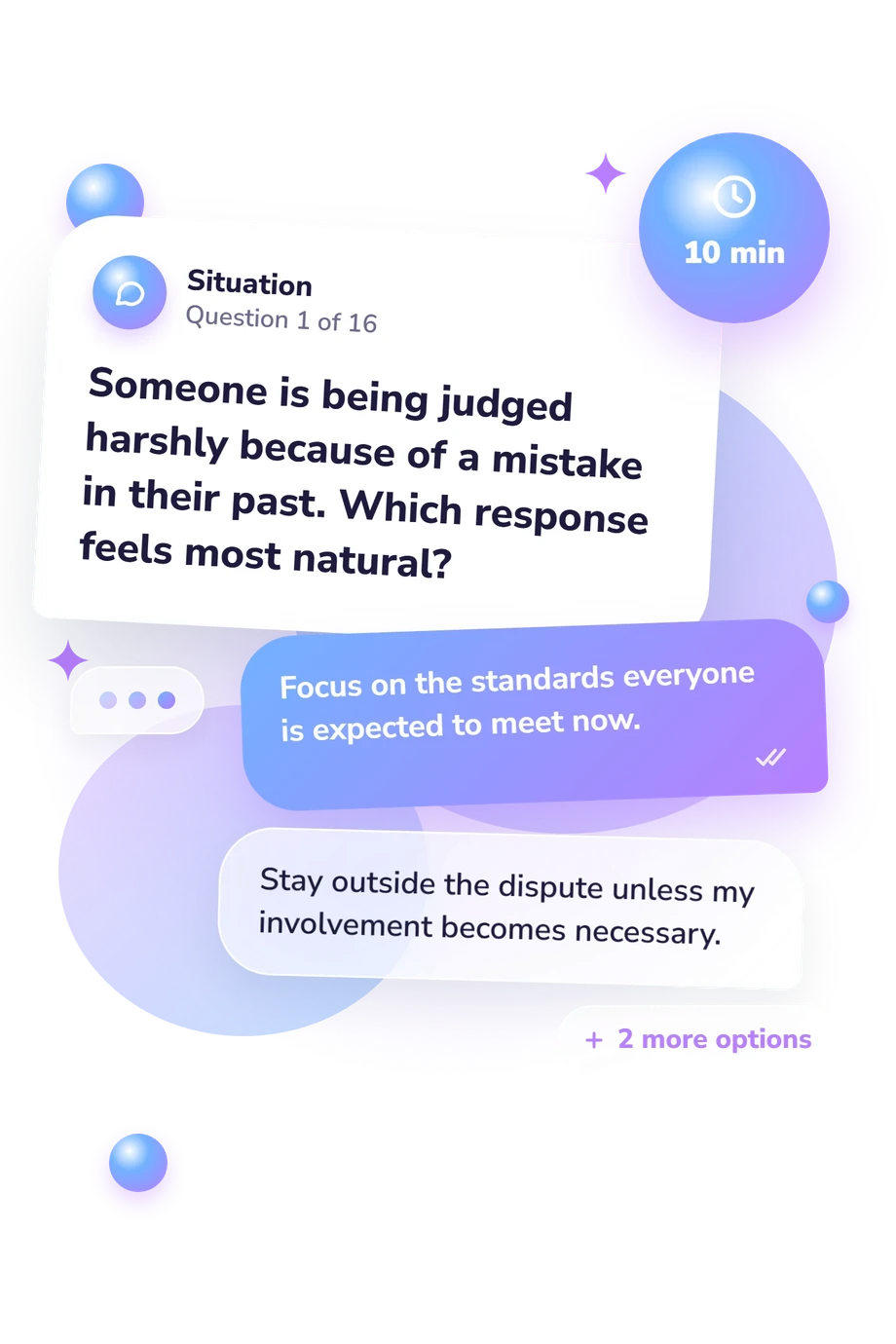
- Focus on the standards everyone is expected to meet now.
- Stay outside the dispute unless my involvement becomes necessary.
- Ask for more context before deciding how much responsibility they carry.
- Try to understand what shaped their actions while still acknowledging the harm.
- Complete the task as instructed; not every oddity needs investigation.
- Make a note of it in case it matters later.
- Spend a moment checking whether it connects to a wider pattern.
- Follow it at once because the unexplained detail is now the most interesting part.
- Whether the process still serves a useful purpose in this situation.
- Whether their method can keep producing results over time.
- Whether exceptions will undermine responsibility and coordination across the team.
- Very little, as long as no immediate problem has appeared.
BSD Character Quiz - Description and methodology of the test
Readers who enjoy character-based self-reflection can use the BSD Character Quiz to compare their own choices with four recognizable decision-making styles. It suits fans looking for a quiz asking which BSD character you are, especially when they want to examine responses to pressure, uncertainty, responsibility, and other people’s needs. The result is a comparative profile, not a fixed identity.
What This Assessment Explores
Four result dimensions show which decision patterns stand out, so someone wondering what BSD character you are can read the outcome as a tendency profile rather than a fixed identity.
The questions cover empathy, responsibility, strategy, observation, and adaptation when plans fail or information is incomplete.
The four dimensions are:
- Atsushi Nakajima Affinity (0-12) measures empathy and protectiveness: Independent Instincts (0-4), Compassionate Adapter (5-8), and Atsushi Affinity (9-12) mark its bands.
- Doppo Kunikida Affinity (0-12) measures preparation and ideals: Flexible Operator (0-4), Practical Idealist (5-8), and Kunikida Affinity (9-12) mark its bands.
- Osamu Dazai Affinity (0-12) measures indirect strategy and perception: Open Approach (0-4), Situational Strategist (5-8), and Dazai Affinity (9-12) mark its bands.
- Ranpo Edogawa Affinity (0-12) measures observation and puzzle-solving: Experiential Thinker (0-4), Pattern Spotter (5-8), and Ranpo Affinity (9-12) mark its bands.
Methodology and Scientific Basis
Each item presents a social or problem-solving situation with four response options. The alternatives contrast direct action with indirect strategy, firm principles with adaptation, attention to vulnerability with task focus, and observation with rapid inference. Respondents choose the reaction that feels most natural.
Scoring converts responses into four affinity scores. The highest is the strongest displayed affinity, while scores within one point indicate a blended result. The bands describe resemblance to a character’s decision style, not intelligence, morality, or psychological health.
The character interpretations are anchored in Bungo Stray Dogs (Asagiri and Harukawa) and the Dazai-focused light novel, which supply the fictional behaviors evoked by the scenarios. They are conceptually consistent with Huang and Fung’s 2024 work on identification with narrative characters, but this questionnaire is not a reproduction or validated adaptation of that scale.
As an online self-reflection tool, the questionnaire has no stated published norms or clinical cutoffs. Familiarity with the series, current mood, self-image, and self-presentation can influence answers. Read the result as a structured comparison, using the BSD character personality quiz to notice patterns rather than make a clinical judgment.
- Asagiri, Kafka, and Sango Harukawa. Bungo Stray Dogs, Vol. 1. Yen Press, 2016. ISBN 9780316554701.
- Asagiri, Kafka, and Sango Harukawa. Bungo Stray Dogs, Vol. 1 (light novel): Osamu Dazai's Entrance Exam. Yen On, 2019. ISBN 9781975303235.
- Huang, Kate Y., and Helene H. Fung. "Measuring identification with narrative characters: The development and validation of a new scale." Current Psychology, vol. 43, no. 30, 2024, pp. 24835-24849. DOI 10.1007/s12144-024-06191-2.
Updated: