
Brave New World Quiz
How the Scales are Structured
Who Usually Takes This Test?
See How You Compare
Below is a preview of how scores are typically distributed across each scale.
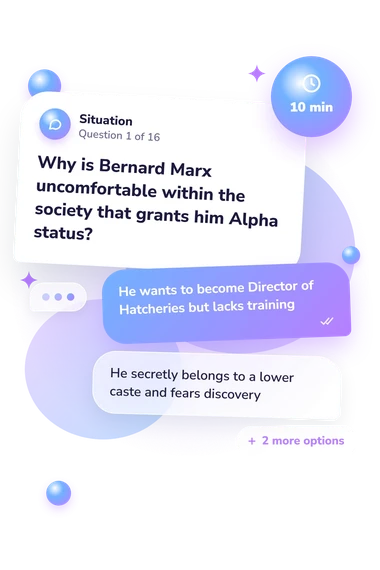
Example Questions From the Test
- Hamlet
- The Tempest
- Romeo and Juliet
- Othello
- The feelies
- The Pregnancy Substitute
- The Bokanovsky Process
- Hypnopaedia
- She remains in an extended soma-induced escape
- She campaigns to make motherhood socially acceptable
- She resumes work at the Hatchery under a new identity
- She is exiled to an island with Bernard and Helmholtz
Brave New World Quiz - Description and methodology of the test
Readers who want to check their grasp of Aldous Huxley’s dystopian novel can use this Brave New World test to review plot, characters, institutions, and ideas. The Brave New World Quiz suits students, book-club members, and independent readers seeking a snapshot of what they remember and which parts deserve closer attention. It rewards familiarity with the text rather than literary jargon.
What This Assessment Explores
Rather than measuring general literary ability, this assessment examines how well a reader connects events, characters, institutions, recurring practices, and central conflicts. The quiz questions from Brave New World combine recall with interpretation, asking what happens, why characters react, and what World State policies reveal.
The items cover four connected areas:
- World State engineering shows how conditioning, caste assignment, reproduction, and hypnopaedia organize life.
- Characters and relationships connect major figures with their motives and conflicts.
- Institutions and rituals explain the roles of soma, the feelies, the Solidarity Service, and the Hatchery.
- Language, art, and freedom test interpretations of Shakespeare, control, and individuality.
Your result is Brave New World Knowledge (0-16): Foundation to Build (0-6) suggests revisiting basic details; Developing Command (7-12) shows solid understanding with finer links to strengthen; Strong Command (13-16) reflects a well-developed grasp of the novel’s world and tensions.
Methodology and Evidence Base
Each item offers a short prompt with four answer choices. The reader selects the option that best fits the novel, and one point is awarded for each correct response. The resulting tally reflects demonstrated knowledge rather than personality. As a Brave New World knowledge test, it rewards evidence from the text over guessing from general familiarity.
Two sources anchor the content. Brave New World (Huxley, 1932) supplies the primary reference for characters, events, institutions, language, and conflicts. Contextual scholarship edited by Jonathan Greenberg and Nathan Waddell helps frame the novel’s social design, literary allusions, and interpretive questions. Together, these works provide context for the topics tested here.
The result bands are descriptive categories for performance on these 16 questions, not population percentiles or a formal measure of reading ability. Scores may reflect recent rereading, classroom preparation, memory for detail, and interpretation of nuanced moments. Use the result as a focused snapshot of areas to revisit; fuller understanding also involves analysis, context, and discussion.
- Huxley, Aldous. Brave New World. London: Chatto & Windus, 1932.
- Greenberg, Jonathan, and Nathan Waddell, editors. 'Brave New World': Contexts and Legacies. Palgrave Macmillan, 2016. 10.1057/978-1-137-44541-4