
Anime Character Quiz
How the Scales are Structured
Who Usually Takes This Test?
See How You Compare
Below is a preview of how scores are typically distributed across each scale.
Example Questions From the Test
- Bend the rule quietly while minimizing disruption.
- Use the formal process, even if it takes longer.
- Ask the person in charge to make an exception.
- Ignore the rule openly, help first, and accept the fallout.
- Negotiate for more freedom before making a decision.
- Refuse quickly because autonomy matters more than the reward.
- Accept if the stability and benefits are worthwhile.
- Lean toward declining unless the restrictions are temporary.
- Choose a destination and let the details unfold as I go.
- Use the time to restore my routines and recharge at home.
- Call someone and leave on a spontaneous mini-adventure.
- Plan one enjoyable outing with clear times and reservations.
Anime Character Quiz - Description and methodology of the test
People who enjoy comparing their choices with familiar heroes can use this assessment to explore the values and instincts behind a favourite fictional style. Rather than assigning a fixed identity, the anime character quiz maps everyday preferences onto four recognizable profiles. It functions as a what anime character am I quiz, but its focus is the reasoning behind decisions about freedom, persistence, connection, compassion, and responsibility.
What This Test Measures
Four dimensions turn answers into character affinities rather than one label. It considers autonomy, leadership, persistence, connection, observation, and care in situations involving conflict, setbacks, responsibility, or belonging. It suits readers seeking the comparison implied by a what anime character are you quiz, connecting a familiar hero with their own choices.
These are the four profiles and the result bands attached to each score:
- Monkey D. Luffy Affinity (0-12) reflects freedom-led choices: Charted Course (0-4), Adventurous Streak (5-8), or Strong Luffy Affinity (9-12).
- Naruto Uzumaki Affinity (0-12) reflects persistence and social courage: Independent Path (0-4), Shared Ninja Spirit (5-8), or Strong Naruto Affinity (9-12).
- Sailor Moon Affinity (0-12) reflects warmth and collective connection: Quiet Orbit (0-4), Shared Moonlight (5-8), or Strong Affinity (9-12).
- Tanjiro Kamado Affinity (0-12) reflects patient compassion and protective responsibility: Direct Resolve (0-4), Steady Compassion (5-8), or Strong Tanjiro Affinity (9-12).
Methodology and Evidence Base
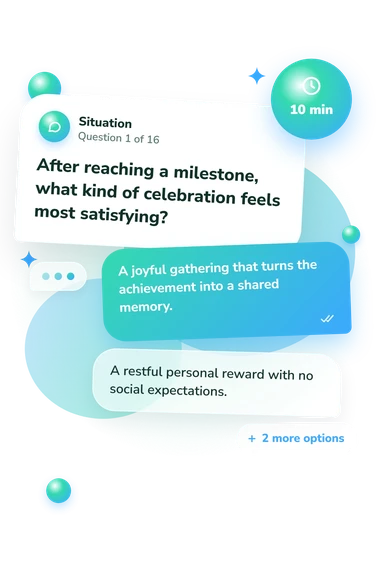
Each item presents a dilemma with four response options. Choices cover leadership, rules, learning, rivalry, apology, friendship, pressure, and responsibility. Select the response closest to your behavior; no factual answer is required. The pattern contributes to four affinity scores, with the highest marking the strongest match.
Framed as a which anime character are you quiz, the test treats scores within one point of the highest as a blended result rather than forcing one winner.
The approach is consistent with the Sorting Hat Quiz (Jakob et al., 2019), but it is not an adaptation of that instrument. Huang, Fung, and Sun (2024) link audience-character similarity with identification, while Cohen (2001) frames identification as engagement with a character’s perspective, goals, or emotions. These sources support interpreting affinity as perceived resemblance.
It also gives the anime quiz who are you prompt a situational format, so choices matter more than trivia. Because this self-report is not norm-referenced or clinically standardized, mood, context, self-awareness, and wishful identification may influence it; read the profile as a reflective snapshot, not a diagnosis or full assessment.
- Lea Jakob, Eduardo Garcia-Garzon, Hannes Jarke, and Fabian Dablander (2019). The Science Behind the Magic? The Relation of the Harry Potter “Sorting Hat Quiz” to Personality and Human Values. Collabra: Psychology, 5(1), 31. 10.1525/collabra.240
- Kate Y. Huang, Helene H. Fung, and Peifeng Sun (2024). The effect of audience-character similarity on identification with narrative characters: A meta-analysis. Current Psychology, 43(8), 7026-7043. 10.1007/s12144-023-04842-4
- Jonathan Cohen (2001). Defining identification: A theoretical look at the identification of audiences with media characters. Mass Communication and Society, 4(3), 245-264. 10.1207/S15327825MCS0403_01