
Animal Leadership Quiz
How the Scales are Structured
Who Usually Takes This Test?
See How You Compare
Below is a preview of how scores are typically distributed across each scale.
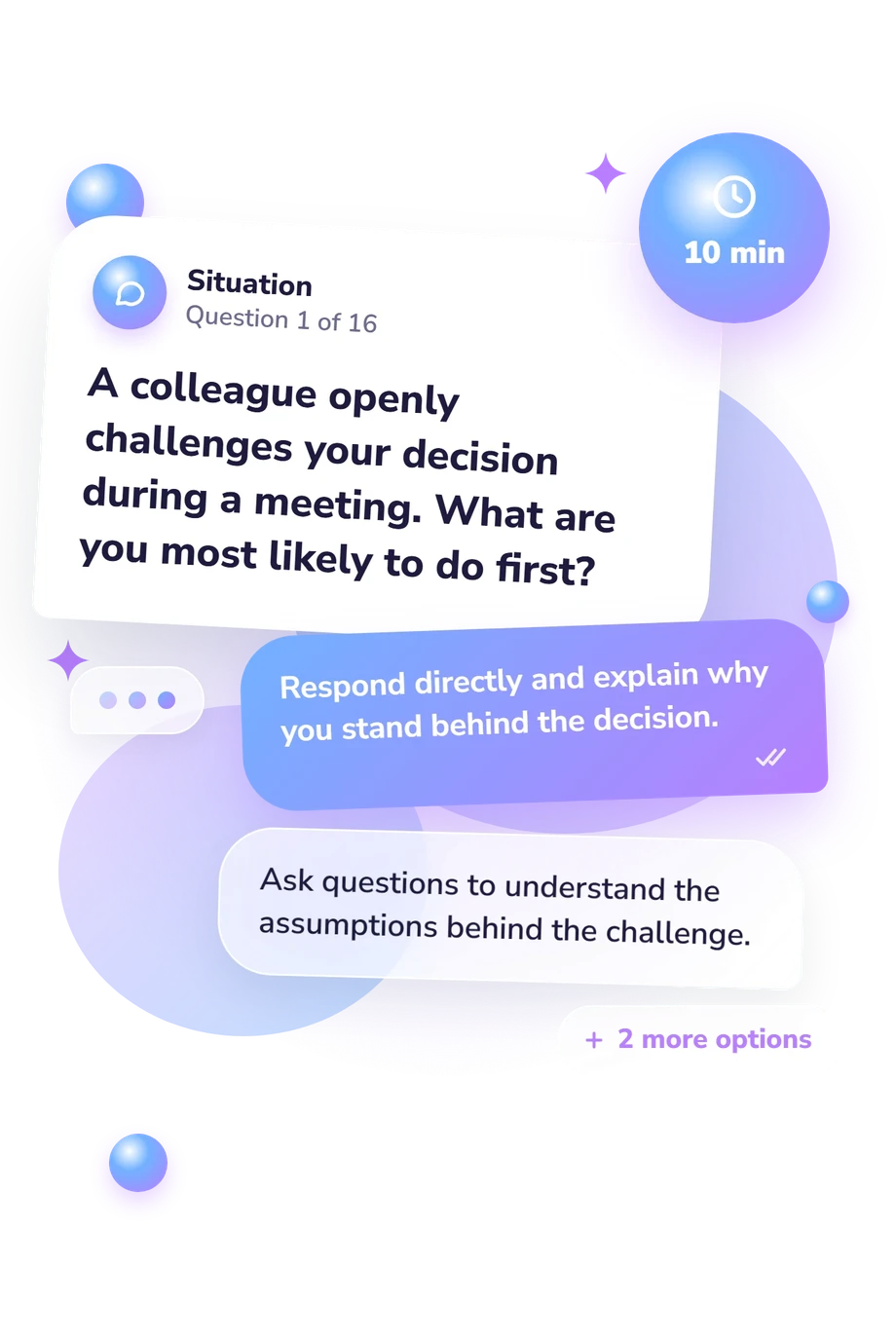
Example Questions From the Test
- Respond directly and explain why you stand behind the decision.
- Ask questions to understand the assumptions behind the challenge.
- Let the moment pass and discuss the disagreement privately afterward.
- Acknowledge the useful part of the objection, then restate the direction.
- Shift attention toward the practical impact, where the broad message remains useful.
- Continue with the planned presentation and ask an analyst to check afterward.
- Present the directional finding while clearly noting the unresolved discrepancy.
- Trace the figures to their sources before deciding which claim can be used.
- Preserve the original course wherever possible to maintain consistency.
- Ask the wider group to agree on how the plan should change.
- Pause to collect enough information for a carefully revised plan.
- Recombine the available resources into a workable new route.
Animal Leadership Quiz - Description and methodology of the test
People who want to understand how they lead under pressure can use this animal leadership quiz as a structured prompt for reflection. As an animal leadership assessment, it is suited to anyone comparing their instincts in decisions, conflict, uncertainty, planning, and team coordination. The result invites reflection on how these instincts appear across different leadership situations.
What This Assessment Explores
Across its scenarios, the questionnaire examines four animal-linked leadership responses involving direction, evidence, change, and relationships. The labels show tendencies, not ranks. It functions as a leadership-style animal quiz.
Displayed scales and bands:
- Dolphin Leadership (0-12) measures inclusion, trust, and shared ownership: Selective Dolphin (0-4), Situational Dolphin (5-8), or Strong Dolphin Affinity (9-12).
- Fox Leadership (0-12) measures flexible tactics, experimentation, and quick learning: Selective Fox (0-4), Situational Fox (5-8), or Strong Fox Affinity (9-12).
- Lion Leadership (0-12) measures decisiveness, visible ownership, and forward momentum: Selective Lion (0-4), Situational Lion (5-8), or Strong Lion Affinity (9-12).
- Owl Leadership (0-12) measures evidence-led reasoning, precision, and considered planning: Selective Owl (0-4), Situational Owl (5-8), or Strong Owl Affinity (9-12).
The highest score marks your strongest affinity; one or more profiles within one point of the highest score may combine into a blended result.
Methodology and Scientific Basis
Each item presents a leadership situation with four response options. The choices sample decision authority, evidence checking, planning, experimentation, conflict handling, recognition, and participation. As an animal leadership test, it turns choices into a comparative profile, not a pass-or-fail grade.
The four displayed profile scores are compared directly. The highest score identifies the strongest affinity, while one or more profiles within one point of the highest score may combine into a blended result, indicating that no single affinity clearly dominates.
The Vroom-Yetton decision model, Goleman’s leadership styles, the skills perspective associated with Mumford and colleagues, and adaptive leadership offer broad conceptual parallels for thinking about these responses. They do not establish this questionnaire’s design, scoring, or validation.
The questionnaire is an online descriptive self-report tool rather than a standardized instrument with published reliability evidence, so its bands are profile descriptions rather than population norms. Current context, self-awareness, and response style can affect answers and the resulting profile.
- Vroom, Victor H., and Philip W. Yetton. Leadership and Decision-Making. University of Pittsburgh Press, 1973. DOI 10.2307/j.ctt6wrc8r.
- Goleman, Daniel. “Leadership That Gets Results.” Harvard Business Review, vol. 78, no. 2, 2000, pp. 78-90.
- Mumford, Michael D., Stephen J. Zaccaro, Francis D. Harding, T. Owen Jacobs, and Edwin A. Fleishman. “Leadership Skills for a Changing World: Solving Complex Social Problems.” The Leadership Quarterly, vol. 11, no. 1, 2000, pp. 11-35. DOI 10.1016/S1048-9843(99)00041-7.
- Heifetz, Ronald A., Marty Linsky, and Alexander Grashow. The Practice of Adaptive Leadership: Tools and Tactics for Changing Your Organization and the World. Harvard Business Press, 2009.
Updated: