
Alter Ego Quiz
How the Scales are Structured
Who Usually Takes This Test?
See How You Compare
Below is a preview of how scores are typically distributed across each scale.
Example Questions From the Test
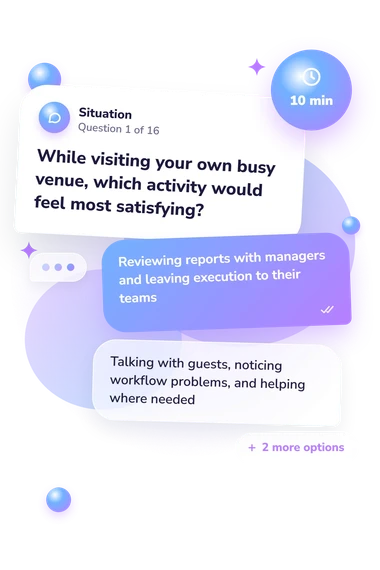
- Reviewing reports with managers and leaving execution to their teams
- Talking with guests, noticing workflow problems, and helping where needed
- Observing the customer experience and sending the team organized feedback
- Meeting potential partners who could bring the concept to new locations
- Capture it in a backlog and stay focused on the current plan
- Check whether it fits the company’s existing strategy
- Discuss the need with potential users before building anything
- Sketch the mechanism and assemble a rough prototype immediately
- A broad client base served through efficient digital tools
- A moderate roster supported by regular personal check-ins
- A small roster whose careers and goals I know in depth
- Several client segments managed by specialized account leads
Alter Ego Quiz - Description and methodology of the test
People who want to explore the professional identity they might express in another setting can use this alter ego quiz to compare instincts about leadership, ambition, invention, taste, and client relationships. It suits readers asking what my alter ego might be at work, especially when considering a new direction or way of leading. The result offers a fictional business archetype rather than a single personality label.
What This Assessment Explores
Situations involving clients, standards, delegation, money, setbacks, launches, and influence reveal professional motives. The highest score is strongest; scores within one point blend. These dimensions show whether you have an alter ego in a different style:
- Jerry Maguire - Relationship-Led Agent (0-12) measures preference for scalable service, trusted advice, or close representation: Scalable-Service Preference (0-4), Trusted Adviser (5-8), or Relationship-Led Agent (9-12).
- Miranda Priestly - Taste-Making Executive (0-12) measures whether influence from elsewhere, discerning leadership, or taste-making authority appeals most: Influence from Elsewhere (0-4), Discerning Leader (5-8), or Taste-Making Executive (9-12).
- Tiana - Hands-On Founder (0-12) measures preference for delegated enterprise, practical entrepreneurship, or hands-on founding: Delegated Enterprise (0-4), Practical Entrepreneur (5-8), or Hands-On Founder (9-12).
- Tony Stark - Visionary Inventor (0-12) measures preference for proven paths, selective innovation, or visionary invention: Proven-Path Preference (0-4), Selective Innovator (5-8), or Visionary Inventor (9-12).
Methodology and Scientific Basis
Each item presents a workplace or business situation with four response options. The choices ask which action, priority, or outcome feels most satisfying, natural, or aspirational. This makes the format a themed self-report exercise, not a reproduction of a published scale. Responses feed four fictional profiles: the highest score shows strongest affinity, while scores within one point form a blend.
Readers can create an alter ego profile from observable preferences rather than treating a character as a fixed personality type. It offers a reflection prompt about leadership, ambition, and motivating environments.
Brokerhof (2021) is the closest conceptual anchor. The questionnaire is conceptually consistent with work on fictional narratives, career identity, and imagined future work selves, but it is not an adaptation of that dissertation. Markus and Nurius’s possible-selves framework explains how an imagined role can clarify a preferred future, while Cohen (2001) links identification with a character’s goals or qualities.
Scoring is questionnaire-specific, not norm-referenced, and the bands are not diagnostic cutoffs. Current context, self-awareness, and response style can shape answers, so read the result alongside lived behavior.
- Brokerhof, Inge Marije. Fictional Narratives at Work: How Stories Shape Career Identity, Future Work Selves and Moral Development. Doctoral dissertation, Vrije Universiteit Amsterdam, 2021. ISBN 9789036106610.
- Markus, Hazel Rose, and Paula S. Nurius. "Possible Selves." American Psychologist 41, no. 9 (1986): 954-969. 10.1037/0003-066X.41.9.954.
- Cohen, Jonathan. "Defining Identification: A Theoretical Look at the Identification of Audiences With Media Characters." Mass Communication & Society 4, no. 3 (2001): 245-264. 10.1207/S15327825MCS0403_01.