
Accidental Diminisher Quiz
How the Scales are Structured
Who Usually Takes This Test?
See How You Compare
Below is a preview of how scores are typically distributed across each scale.
Example Questions From the Test
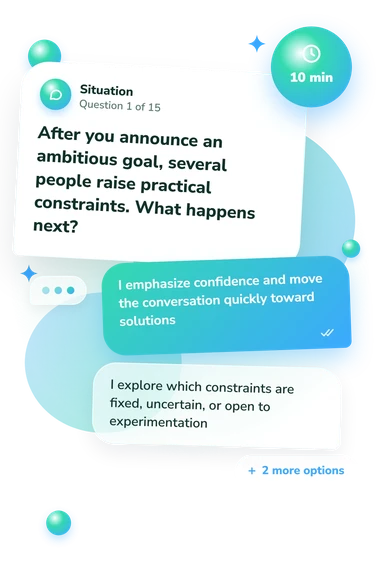
- I emphasize confidence and move the conversation quickly toward solutions
- I explore which constraints are fixed, uncertain, or open to experimentation
- I acknowledge the concerns and ask the group to test them against possible plans
- I keep the energy high by redirecting repeated concerns back to the target
- Agree on a checkpoint and let them continue owning the work
- Quietly complete the key section so the deadline is protected
- Talk through a few possible approaches and let them choose
- Work beside them and rewrite the most difficult portion together
- Accept the result because the outcome and boundaries were met
- Suggest a few optional refinements for next time
- Require the work to follow my preferred method in future
- Redo parts of it so the finished product reflects my standard
Accidental Diminisher Quiz - Description and methodology of the test
Managers, team leads, and colleagues can use the accidental diminisher quiz to examine how support, pace, standards, and intervention habits may narrow others’ contribution or ownership. Conceptually connected to the Multipliers model, this workplace multipliers quiz turns situations into prompts to notice when you contribute, intervene, set standards, or leave room for others. It is most useful when read against real interactions rather than as a fixed label.
What This Assessment Explores
These questions examine how enthusiasm, expertise, urgency, and help can unintentionally reduce a person’s thinking space or ownership. They fit reflection on teamwork, delegation, coaching, and leadership. An accidental diminisher assessment helps identify habits that feel supportive to you but constrain participation for others.
The dimensions are:
- Idea and Airtime Pressure (0-15) shows whether input narrows shared thinking: Shared thinking space (0-5), Airtime can narrow (6-10), or Input often dominates (11-15).
- Pace and Standards Pressure (0-15) shows whether urgency or preferred methods compress contribution: Flexible drive (0-5), Pressure is noticeable (6-10), or Pace may compress contribution (11-15).
- Rescue and Ownership Pressure (0-15) shows whether support becomes taking over: Ownership stays with others (0-5), Rescue reflex appears (6-10), or Ownership may transfer to you (11-15).
Higher bands flag patterns to examine in context; they do not define motive, competence, or impact everywhere.
Methodology and Scientific Basis
Each scenario presents a workplace situation followed by four response choices. The options contrast approaches such as inviting another person’s reasoning, setting boundaries, offering support, stepping in, or directing the work. In this accidental diminisher test, the selected responses are converted into totals on the displayed dimensions, but the range alone does not reveal how many points any single answer contributes.
Its conceptual anchor is the Accidental Diminisher framework (Wiseman, 2010), with the wider Multipliers model providing the language of making others smarter versus unintentionally reducing their contribution. The questionnaire is conceptually consistent with those works and facilitator materials; it is not presented as a standardized reproduction of a published scale.
Interpret the profile as a structured self-reflection tool. Compare higher-scoring patterns with specific meetings, delegations, or coaching moments and ask whether the effect was intended, necessary, and repeated. The bands are reflective summaries rather than validated performance ratings, so results can shift with current context, self-awareness, and response bias. They should be used as a developmental prompt, not a diagnosis.
- The Wiseman Group. Multipliers Facilitator Guide. The Wiseman Group, 2020.
- Wiseman, Liz. "Are You an Accidental Diminisher?" Richard Ivey School of Business Foundation, 2010.
- Wiseman, Liz, and Greg McKeown. Multipliers: How the Best Leaders Make Everyone Smarter. HarperBusiness, 2010. ISBN 9780061964398.
- Wiseman, Liz. "Intelligence Multipliers: How Smart Leaders Double the Power of Their Workforce for Free." Leader to Leader, vol. 2011, no. 59, 2011, pp. 52-58. DOI 10.1002/ltl.456