
193 Countries Quiz
How the Scales are Structured
Who Usually Takes This Test?
See How You Compare
Below is a preview of how scores are typically distributed across each scale.
Example Questions From the Test
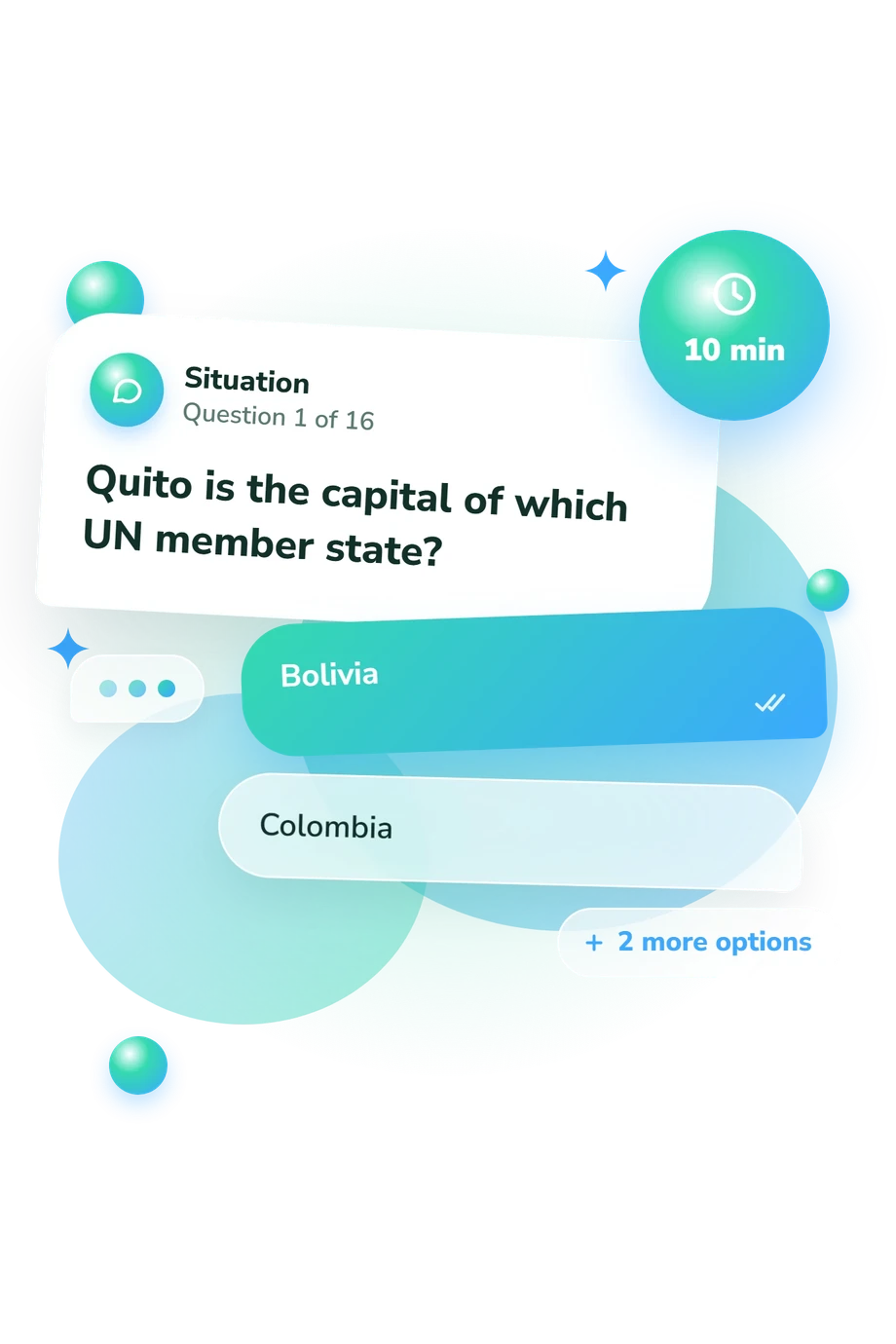
- Bolivia
- Colombia
- Ecuador
- Paraguay
- Georgia
- Azerbaijan
- Türkiye
- Greece
- Mauritius
- Maldives
- Sri Lanka
- Seychelles
193 Countries Quiz - Description and methodology of the test
Readers who want to check their world geography without a lengthy study session can use this 193 Countries Quiz to see which areas deserve review. As a UN countries quiz, it suits learners, travelers, and curious adults seeking a practical snapshot of their geographic knowledge and a direction for further study.
What This Assessment Explores
This questionnaire tests practical country recognition rather than memorization in isolation. Items connect capitals with states, infer destinations from borders, use coastlines and regions, and distinguish UN membership. Together, the items make this a 193 UN member states quiz, checking knowledge through connected geographic clues.
Key dimensions:
- Capital recognition shows how readily you connect national capitals with the countries they represent.
- Border and route clues reveal how well neighboring states help you locate a destination.
- Regional geography measures your use of continents, seas, islands, and landlocked positions.
- UN membership questions test whether you can identify states within the stated international framework, while 193 Countries Knowledge (0-16) places the result in Foundations to build (0-6), Developing world knowledge (7-12), or Strong global knowledge (13-16).
The outcome is a focused snapshot of country knowledge, not a complete profile of geographic skill.
Methodology and Scientific Basis
Each item uses four answer choices. The respondent selects one answer option, which may be a country, a group of countries, a pair of countries, or a statement, and the scoring rule gives one point for each correct answer, producing the reported total. Some questions test direct recall of a capital; others require inference from a border, coastline, island, route, or membership clue.
The Location Knowledge assessment (Dunn, 2011) offers a conceptual comparison because it treats place identification as part of geographic knowledge and spatial thinking. Bein, Hayes, and Jones (2009) provide another comparison through research on geography skills over time. These sources support the relevance of location knowledge, but do not show that this questionnaire is adapted from either instrument. The United Nations Member States reference supplies the membership frame for this 193 nations quiz, whose scope is 193 member states.
For interpretation, the displayed bands are descriptive categories for performance on these questions, while scores can be affected by schooling, travel, language, regional familiarity, guessing, and attention. The result from this 193 UN countries quiz can guide review of capitals, borders, and UN membership.
- Dunn, James M. (2011). Location Knowledge: Assessment, Spatial Thinking, and New National Geography Standards. Journal of Geography, 110(2), 81-89. 10.1080/00221341.2010.511243
- Bein, F. L., Hayes, J. J., & Jones, T. G. (2009). Fifteen Year Follow-Up Geography Skills Test Administered in Indiana, 1987 and 2002. Journal of Geography, 108(1), 30-36. 10.1080/00221340902886798
- United Nations. Member States. United Nations. Accessed September 17, 2026.
Updated: