
Self-Efficacy in Relation to Illness Questionnaire Test
How the Scales are Structured
Who Usually Takes This Test?
See How You Compare
Below is a preview of how scores are typically distributed across each scale.
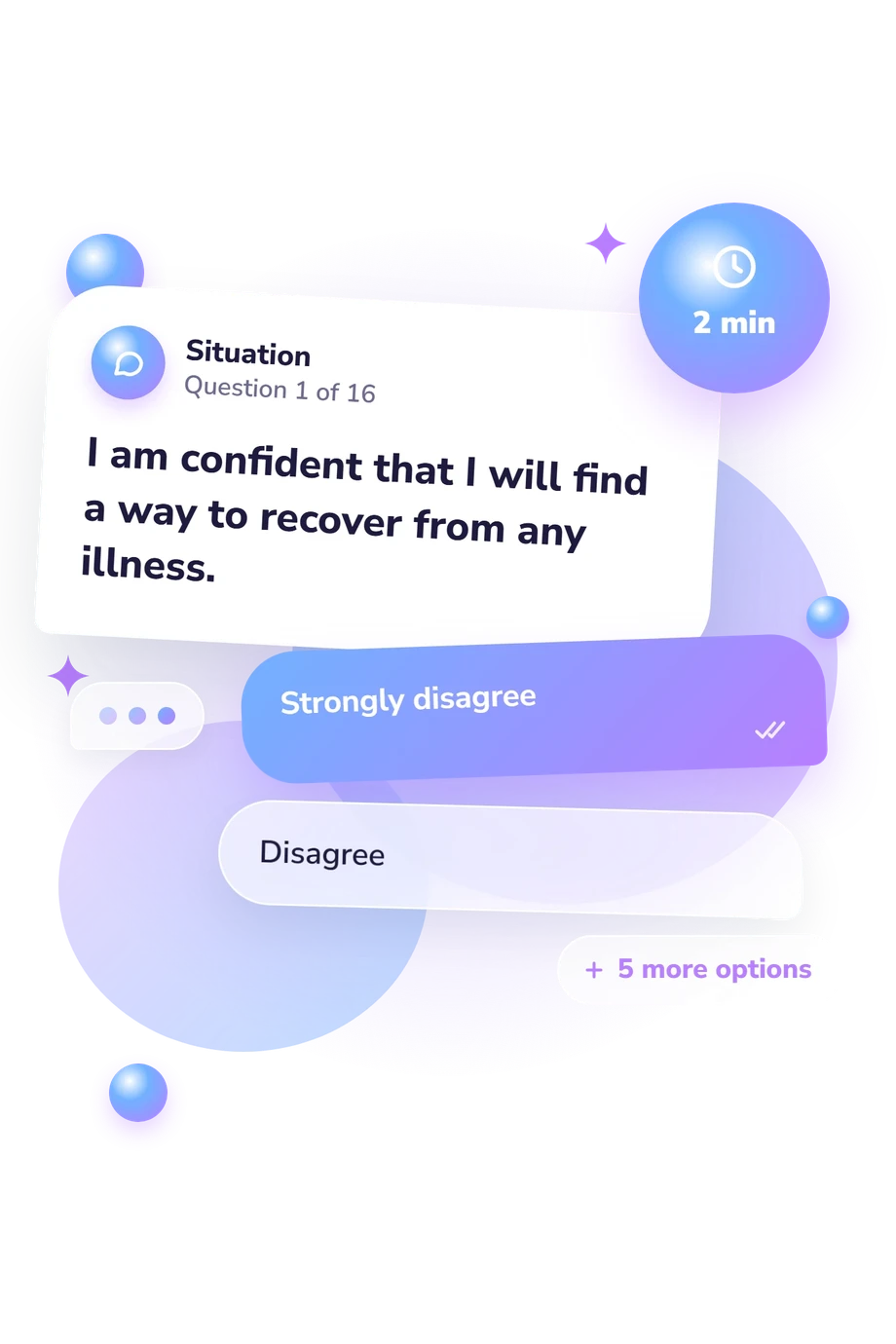
Example Questions From the Test
- Strongly disagree
- Disagree
- Somewhat disagree
- Neither agree nor disagree
- Somewhat agree
- Agree
- Strongly agree
- Completely disagree
- Disagree
- Somewhat disagree
- Neither agree nor disagree
- Somewhat agree
- Agree
- Completely agree
- Completely disagree
- Disagree
- Somewhat disagree
- Neither agree nor disagree
- Somewhat agree
- Agree
- Completely agree
Self-Efficacy in Relation to Illness Questionnaire Test - Description and methodology of the test
People considering how they want to approach illness-related decisions may find this illness self-efficacy questionnaire useful. It can support reflection on whether additional information, preparation, or practical support would make future health decisions feel more manageable. The Self-Efficacy in Relation to Illness Questionnaire Test offers a focused way to consider that question. Its result can help organize thoughts about personal readiness without reducing illness to a score.
What This Assessment Explores
The questionnaire concerns perceived capability: the belief that one can influence coping and treatment behavior, rather than medical severity or symptom frequency.
The result addresses coping with illness, responding to worsening, following treatment, changing routines, and preserving dignity. Viewed as self-efficacy in illness, a higher result suggests stronger confidence and readiness to participate in recovery; a lower result may indicate doubt or need for support.
One scale, Self-Efficacy Related to Illness and Treatment, ranges from 8-56: Low self-efficacy 8-32, Moderate self-efficacy 33-40, and High self-efficacy 41-56.
The statements revisit three recurring situations rather than producing separate scores:
- Coping confidence shows how capable the respondent feels when illness creates obstacles.
- Treatment and lifestyle participation reflects confidence in following care and sustaining changes.
- Persistence and dignity indicate whether the respondent expects to keep seeking workable ways forward.
Methodology and Scientific Basis
Methodologically, this treatment self-efficacy assessment uses self-report statements with seven response levels, from strong disagreement to strong agreement. The respondent rates anticipated capability rather than symptoms or a clinician’s observation. The questionnaire presents one displayed score; no additional point-allocation rule is stated.
Its closest conceptual reference is the Treatment-related self-efficacy scale (Rasskazova & Tkhostov, 2016), which addresses confidence in treatment and illness management. That study provides conceptual context for the themes, not evidence that this online version has been validated. Schwarzer and Renner distinguish action self-efficacy from coping self-efficacy, a useful lens for the items’ combination of health-behavior preparation and confidence under difficulty. Bandura’s social-cognitive framework links perceived capability with effort, persistence, and responses to obstacles.
The displayed score is read through three ordered bands, which organize reflection from less to more perceived capability. Because no population norms are stated for this online version, current context, self-awareness, expectations, and candor can influence the self-report score.
- Rasskazova, E. I., & Tkhostov, A. Sh. (2016). Approbation of Methods for Diagnosing the Locus of Control of Illness Causes and Treatment and Self-Efficacy in Relation to Treatment. Bulletin of the South Ural State University. Series: Psychology, 9(1), 71-83. 10.14529/psy160108
- Schwarzer, R., & Renner, B. (2000). Social-Cognitive Predictors of Health Behavior: Action Self-Efficacy and Coping Self-Efficacy. Health Psychology, 19(5), 487-495. 10.1037/0278-6133.19.5.487
- Bandura, A. (1977). Self-Efficacy: Toward a Unifying Theory of Behavioral Change. Psychological Review, 84(2), 191-215. 10.1037/0033-295X.84.2.191
Updated: