
Freudly+971 508685814hello@freudly.ai
Freudly
career guidance

Vocational Interests Questionnaire Test
Take the online Vocational Interests Questionnaire Test - AI psychologist FreudlyYou can take Vocational Interests Questionnaire Test here. Online version of a simple and accurate psychological test with interpretation.en
With 24 questions completed in about 5 minutes, the Vocational Interests Questionnaire Test maps your preferences across practical, creative, investigative, active, organizational, and people-focused work. Your result can clarify appealing occupational environments and support thoughtful self-reflection when considering study, career options, or changes in professional direction.
Questions: 245 minutes
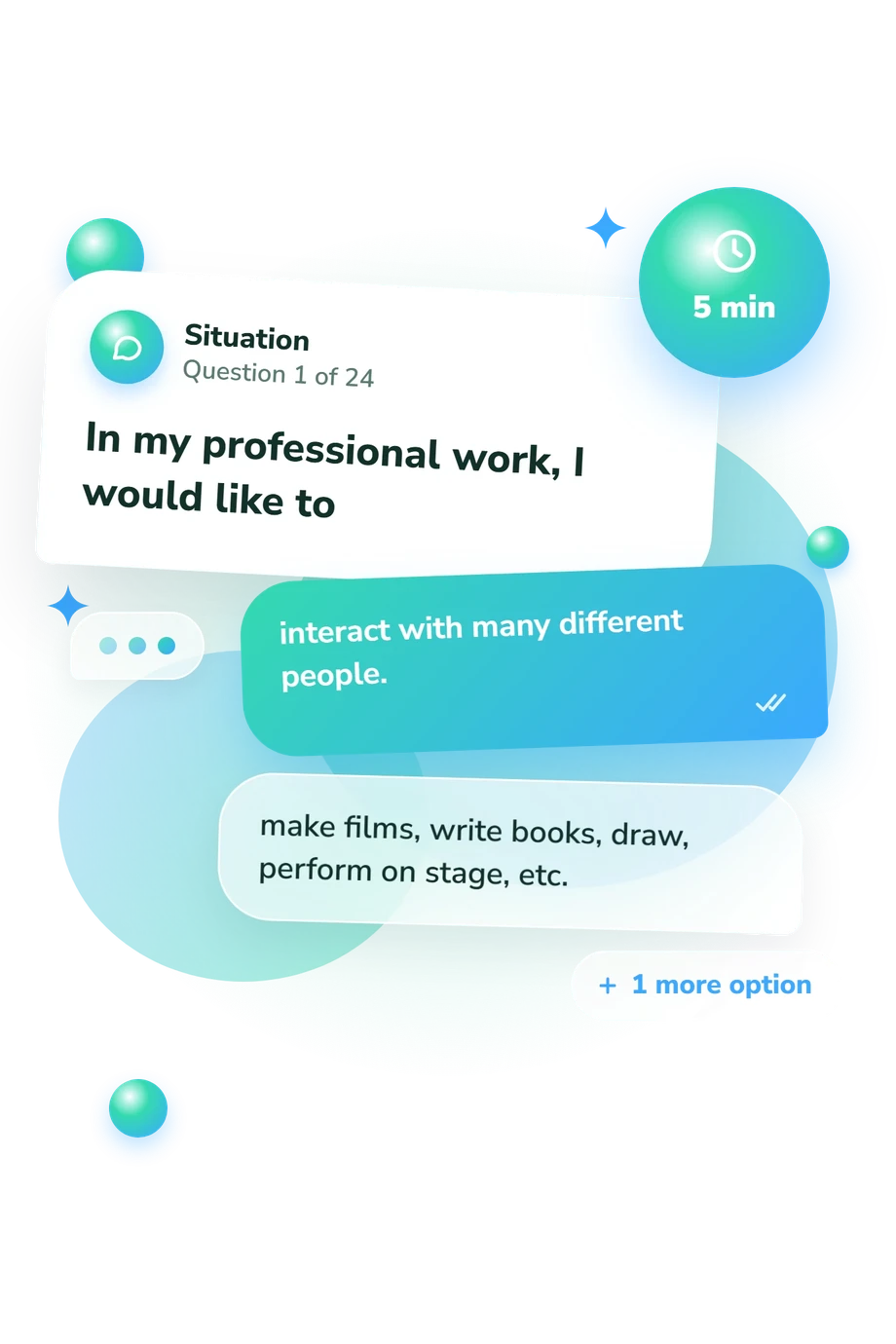
Vocational Interests Questionnaire Test: situation and reply bubbles
October 2, 2025October 2, 2025Material has been updatedOctober 2, 2025Material has been published
32,802 views
3,532 completions
2,823 likes
Daniel HallPsychologist · Test reviewer
2,823 likes
Scale Explorer

How the Scales are Structured

Planning and Economic ActivitiesPaEA
Measures interest in structured planning and economic tasks such as calculations, organizing, office routines, and text analysis that require accuracy and orderliness.
example score5/12
5/12Moderate inclinationexample score
0 – 4Low inclination
5 – 9Moderate inclination
10 – 12High inclination
A score of 5 indicates a moderate inclination toward planned economic activities, suggesting some comfort with structured, detail-focused tasks without this being a dominant interest.
Extreme ActivitiesEA
Measures how strongly a teenager is drawn to high-adrenaline, risk-involving, and operationally intense activities such as sports, travel, military, or emergency-style work.
example score5/12
5/12Moderateexample score
0 – 4Low
5 – 9Moderate
10 – 12High
A score of 5 suggests a moderate interest in extreme or high-intensity activities, with some openness to challenging and physically demanding environments.
Aesthetic ActivitiesAA
Measures interest in creative and aesthetic fields such as art, music, and literature, along with originality and a drive for quality.
example score3/12
3/12Lowexample score
0 – 3Low
4 – 9Moderate
10 – 12High
A score of 3 suggests a low inclination toward aesthetic activities, with creative interests likely less central compared to other areas.
Manufacturing WorkMW
This scale measures interest and inclination toward industrial work such as material processing, repair, assembly, and technical maintenance.
example score8/12
8/12Moderateexample score
0 – 6Low
7 – 9Moderate
10 – 12High
A score of 8 suggests a moderate interest in manufacturing-related tasks, indicating comfort with hands-on technical work but not as a dominant preference.
Investigative ActivitiesIA
Measures interest in scientific inquiry and problem analysis, reflecting rational, independent, and analytical thinking.
example score6/12
6/12Moderateexample score
0 – 4Low
5 – 9Moderate
10 – 12High
A score of 6 indicates a moderate inclination toward research tasks, suggesting interest in analysis and evidence-based reasoning without a strong, dominant focus on research.
Working With PeopleWWP
Measures how strongly a teen is inclined toward roles that involve frequent interaction, understanding, and influencing or supporting other people.
example score5/12
5/12Moderateexample score
0 – 4Low
5 – 9Moderate
10 – 12High
A score of 5 indicates a moderate interest in people-oriented work, suggesting some comfort with communication and support roles without a strong preference for them.
just completed the test
DATA-BASED USER COHORTS

Who Usually Takes This Test?

Undecided high school teens
46%OF USERS
Students in grades 8–11 who feel stuck choosing a future path and want a quick picture of what kinds of work naturally fit them.
Parents of career-seeking teens
32%OF USERS
Parents who want clearer, more objective guidance to support their child’s choices without pushing their own preferences.
School counselors and teachers
22%OF USERS
Educators using a short, engaging questionnaire to steer career guidance sessions and tailor recommendations for each student.
BASED ON AGGREGATED, ANONYMIZED DATA FROM TENS OF THOUSANDS OF FREUDLY USERS.
Benchmarking

See How You Compare

Once you complete the test, your results are compared with real-world data from people in your country.
Below is a preview of how scores are typically distributed across each scale.
Shaded area — where most people score
Dot — the average
You — your score lands on each curve after the test— your score, after the test
Planned Economic ActivitiesPEA
You?
Average6.5
Typical rangeTypical4.6 – 8.5
Possible0 – 12
Extreme ActivitiesEA
You?
Average3.3
Typical rangeTypical1.5 – 5
Possible0 – 12
Aesthetic ActivitiesAA
You?
Average5.7
Typical rangeTypical4.1 – 7.4
Possible0 – 12
Work in ManufacturingWiM
You?
Average4.5
Typical rangeTypical2.3 – 6.7
Possible0 – 12
Research ActivityRA
You?
Average7.7
Typical rangeTypical5.8 – 9.5
Possible0 – 12
Working with PeopleWwP
You?
Average6.7
Typical rangeTypical4.6 – 8.7
Possible0 – 12
Featured On
SAMPLE QUESTIONS

Example Questions From the Test

    • interact with many different people.
    • make films, write books, draw, perform on stage, etc.
    • do calculations; handle documentation.
    • the opportunity to follow the author’s train of thought
    • the artistic style and the author’s or director’s craft
    • the plot and the characters’ actions
    • a) for public service;
    • b) in science;
    • c) in the arts.
WHAT THE TEST MEASURES

Vocational Interests Questionnaire Test - Description and methodology of the test

career guidance
tendencies

People considering a study path, a new role, or a professional change can use this profile to examine which kinds of work feel engaging. The Vocational Interests Questionnaire Test offers a structured look at practical, creative, analytical, active, organizational, and interpersonal preferences. As a career interests test, it gives readers language for comparing work environments and deciding which directions deserve closer exploration.

What This Assessment Explores

This vocational interest assessment maps attraction to work tasks and settings, not competence. It suits people comparing study or career directions.

The six dimensions are:

  • Planning and Economic Activities (0-12) measures organized, analytical interests; Low inclination 0-4, Moderate inclination 5-9, High inclination 10-12.
  • Extreme Activities (0-12) measures interest in demanding, risk-related settings; Low 0-4, Moderate 5-9, High 10-12.
  • Aesthetic Activities (0-12) measures creative and artistic interests; Low 0-3, Moderate 4-9, High 10-12.
  • Manufacturing Work (0-12) measures technical, hands-on interests; Low 0-6, Moderate 7-9, High 10-12.
  • Investigative Activities (0-12) measures scientific and analytical interests; Low 0-4, Moderate 5-9, High 10-12.
  • Working With People (0-12) measures service, leadership, and teaching interests; Low 0-4, Moderate 5-9, High 10-12.

Higher bands indicate stronger stated attraction within an area; they do not demonstrate skill or guarantee fit.

Methodology and Scientific Basis

Each item presents three alternatives representing contrasting preferences, such as working with people, investigating ideas, making or maintaining things, organizing information, creating, or seeking demanding conditions. The respondent chooses the option that best matches personal interest. This forced-choice format makes the profile comparative: a preference is recorded against the alternatives offered.

Responses are grouped by the questionnaire’s scoring key into domain totals. A higher result indicates more endorsed preferences in that direction, while a middle result may reflect mixed interests rather than indifference. As a career choice questionnaire, it is most useful when readers compare the profile with actual activities, preferred conditions, developing skills, and available opportunities.

Conceptually, the structure is consistent with the Jovaiša-Rezapkina Professional Inclinations Questionnaire and vocational-orientation work by Leonas Jovaiša and Galina Rezapkina. It is not presented as an adaptation or standardized reproduction of either source, and its online scoring display is not a normed assessment. Self-report results can shift with current experience, mood, and self-awareness, so this profile describes preferences without establishing ability or a final career choice.

Author: John L. Holland
Literature:
  • Rezapkina, Galina Vladimirovna. Selection into Specialized Classes. Moscow: Genesis, 2005. 124 pp. ISBN 5-98563-012-9.
  • Jovaiša, Leonas. Problems of Vocational Orientation of Schoolchildren. Moscow: Pedagogika, 1983. 129 pp.

Updated:

Popular tests
Comments
Leave a Comment