
Freudly+971 508685814hello@freudly.ai
Freudly
cbt

COPE Inventory Test

Take the online COPE Inventory Test - AI psychologist FreudlyYou can take COPE Inventory Testhere. Online version of a simple and accurate psychological test with interpretation.en
Understand how you cope with stress in just 6 minutes, including problem-solving, avoidance, support seeking, and faith-based coping. Get a clear profile you can use to strengthen resilience and target healthier strategies.
Start Online Test
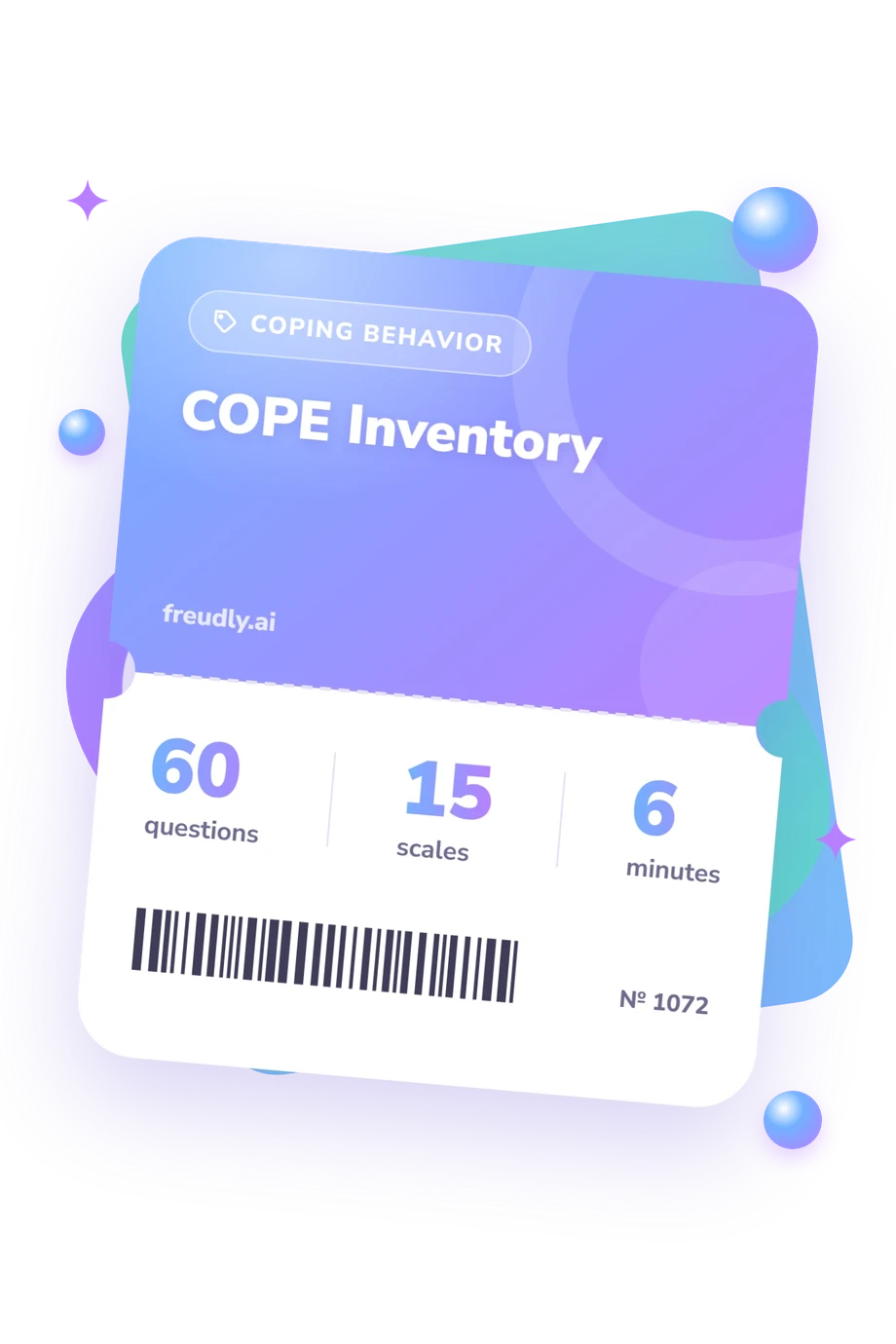
Questions: 606 minutes
08:30
October 2, 2025
October 2, 2025
Material has been updated
October 2, 2025
Material has been published
32,018 views
4,024 completions
2,996 likes
Verified by Daniel Hall
Psychologist with 25 years of experience
Share
Scale Explorer

How the Scales are Structured

example score
2/4
Suppression of Competing Activities (SoCA)
Measures how much a person reduces competing activities and distractions to stay focused on dealing with a stressful situation.
Low focus
High focus
12: Low focus | 2.14: High focus
A score of 2 indicates a low tendency to suppress competing activities, meaning distractions may still take up some attention during stress.
example score
3/4
Acceptance (A)
Measures how much a person acknowledges the reality of a stressful situation and accepts what has happened in order to adapt and move forward.
Low acceptance
Moderate acceptance
High acceptance
12: Low acceptance | 2.13: Moderate acceptance | 3.14: High acceptance
A score of 3 indicates moderate acceptance, suggesting you generally recognize the situation as it is and can begin adapting while still experiencing some difficulty fully coming to terms with it.
example score
2/4
Use of Sedatives (UoS)
Measures the tendency to cope with stress by using alcohol, medications, or drugs to dampen emotions or avoid the problem.
Low use
Moderate use
High use
11.9: Low use | 22.9: Moderate use | 34: High use
A score of 2 indicates a moderate tendency to use sedatives as a coping strategy, suggesting it may be used occasionally rather than as a primary response to stress.
example score
3/4
Emotional Social Support (ESS)
Measures the tendency to seek sympathy, understanding, and moral support from others when under stress.
Low use
Moderate use
High use
12: Low use | 2.13: Moderate use | 3.14: High use
A score of 3 indicates a moderate tendency to seek emotional support from others as a way to cope with stress.
example score
2/4
Restraint Coping (RC)
Measures the tendency to pause and inhibit immediate action in order to respond to stress more deliberately.
Low inhibitory coping
High inhibitory coping
12: Low inhibitory coping | 2.14: High inhibitory coping
A score of 2 indicates a relatively low tendency to hold back action and wait for the right moment, suggesting you may be more likely to act sooner when stressed.
example score
2/4
Behavioral Disengagement (BD)
Measures the tendency to cope with stress by reducing efforts or disengaging from addressing the stressor.
Low avoidance
High avoidance
12: Low avoidance | 2.14: High avoidance
A score of 2 indicates low behavioral avoidance, suggesting you generally maintain engagement with the problem rather than withdrawing effort.
example score
3/4
Planning (P)
Measures the extent to which a person copes with stress by thinking through actions and developing concrete behavioral strategies.
Low planning
Moderate planning
High planning
12: Low planning | 2.13: Moderate planning | 3.14: High planning
A score of 3 indicates moderate planning, suggesting the person often thinks through steps and prepares strategies in stressful situations.
example score
2/4
Humor (H)
Measures how often a person uses jokes and laughter to reduce tension and reframe a stressful situation.
Low use
Moderate use
High use
12: Low use | 2.13: Moderate use | 3.14: High use
A score of 2 suggests humor is used infrequently or only in some situations as a way of coping with stress.
example score
3/4
Turning to Religion (TtR)
Measures the extent to which a person copes with stress by turning to faith, religious beliefs, or God for support and meaning.
Low use
Moderate use
High use
12: Low use | 2.13: Moderate use | 3.14: High use
A score of 3 indicates a moderate tendency to use religious or faith-based coping as a source of emotional stabilization and meaning during stress.
example score
3/4
Denial (D)
Measures the tendency to cope with stress by rejecting or minimizing the reality of the situation.
Low denial
High denial
12: Low denial | 2.14: High denial
A score of 3 indicates a higher tendency to use denial in stressful situations, which may reduce distress in the moment but can limit engagement with the problem.
example score
2/4
Active Coping (AC)
Measures how often a person uses proactive, problem-focused actions to deal with stress.
Low
High
12: Low | 2.14: High
A score of 2 indicates a lower level of active coping, meaning proactive problem-solving is used less consistently under stress.
example score
3/4
Instrumental Social Support (ISS)
This scale measures how much a person seeks practical help, advice, or information from others when coping with stress.
Low use
Moderate use
High use
12: Low use | 2.13: Moderate use | 3.14: High use
A score of 3 indicates a moderate tendency to seek practical support and advice from others as part of coping with stress.
example score
2/4
Focus on and Venting of Emotions (FoaVoE)
Measures the tendency to focus on unpleasant emotions and actively express them when under stress.
Low
High
12: Low | 2.14: High
A score of 2 indicates a lower tendency to dwell on and express negative emotions in stressful situations, suggesting emotions are less central in coping.
example score
2/4
Mental Disengagement (MD)
Measures the tendency to cope with stress by mentally disengaging from the problem through distraction (e.g., daydreaming or sleeping).
Low use
High use
12: Low use | 2.14: High use
A score of 2 indicates a low level of mental escape, suggesting distraction is used occasionally but is not a primary coping strategy.
example score
3/4
Positive Reinterpretation and Growth (PRaG)
Measures the tendency to reinterpret stressful situations in a positive way and focus on personal growth and new meaning.
Low
Moderate
High
12: Low | 2.13: Moderate | 3.14: High
A score of 3 suggests a moderate level of positive reframing, meaning the person often tries to find constructive meaning in stress but may not do so consistently.
Start Online Test
just completed the test
DATA-BASED USER COHORTS

Who Usually Takes This Test?

Stressed working adults
41%OF USERS
People dealing with work or life pressure who want to understand their usual coping style and build healthier responses.
Therapy and counseling clients
34%OF USERS
Clients and patients who take it to map coping strategies, spot avoidance patterns, and choose practical targets for change with a specialist.
Teens under pressure
25%OF USERS
Adolescents facing school, family, or social stress who want to see how they cope and what support helps them most.
BASED ON AGGREGATED, ANONYMIZED DATA FROM TENS OF THOUSANDS OF FREUDLY USERS.
Benchmarking

See How You Compare

Once you complete the test, your results are compared with real-world data from people in your country.
Below is a preview of how scores are typically distributed across each scale.
Suppression of competitive activity (Soca)
Average
3.1
Normal range
2.73.5
min.
1
max.
4
This curve shows how scores are typically distributed.
Once you complete the test, your result will appear on the scale so you can see how you compare.
Acceptance (A)
Acceptance (A)
Average
1.8
Normal range
1.32.2
min.
1
max.
4
This curve shows how scores are typically distributed.
Once you complete the test, your result will appear on the scale so you can see how you compare.
Use of “Sedatives” (Uo“)
Average
3
Normal range
2.63.4
min.
1
max.
4
This curve shows how scores are typically distributed.
Once you complete the test, your result will appear on the scale so you can see how you compare.
Emotional social support (Ess)
Average
3.1
Normal range
2.63.5
min.
1
max.
4
This curve shows how scores are typically distributed.
Once you complete the test, your result will appear on the scale so you can see how you compare.
Controlling Coping (CC)
Average
2.4
Normal range
1.92.9
min.
1
max.
4
This curve shows how scores are typically distributed.
Once you complete the test, your result will appear on the scale so you can see how you compare.
Behavioral Avoidance of the Problem (BAotP)
Average
2.9
Normal range
2.43.3
min.
1
max.
4
This curve shows how scores are typically distributed.
Once you complete the test, your result will appear on the scale so you can see how you compare.
Planning (P)
Planning (P)
Average
2.2
Normal range
1.82.6
min.
1
max.
4
This curve shows how scores are typically distributed.
Once you complete the test, your result will appear on the scale so you can see how you compare.
Humor (H)
Humor (H)
Average
2.1
Normal range
1.62.6
min.
1
max.
4
This curve shows how scores are typically distributed.
Once you complete the test, your result will appear on the scale so you can see how you compare.
Appeal to Religion (AtR)
Average
3.2
Normal range
2.63.7
min.
1
max.
4
This curve shows how scores are typically distributed.
Once you complete the test, your result will appear on the scale so you can see how you compare.
Denial (D)
Denial (D)
Average
2.2
Normal range
1.82.6
min.
1
max.
4
This curve shows how scores are typically distributed.
Once you complete the test, your result will appear on the scale so you can see how you compare.
Active coping (Ac)
Active coping (Ac)
Average
2.7
Normal range
2.23.2
min.
1
max.
4
This curve shows how scores are typically distributed.
Once you complete the test, your result will appear on the scale so you can see how you compare.
Instrumental social support (Iss)
Average
3
Normal range
2.53.4
min.
1
max.
4
This curve shows how scores are typically distributed.
Once you complete the test, your result will appear on the scale so you can see how you compare.
Focus on emotions (Foe)
Average
2
Normal range
1.62.5
min.
1
max.
4
This curve shows how scores are typically distributed.
Once you complete the test, your result will appear on the scale so you can see how you compare.
Mental Escape from the Problem (MEftP)
Average
3.2
Normal range
2.73.8
min.
1
max.
4
This curve shows how scores are typically distributed.
Once you complete the test, your result will appear on the scale so you can see how you compare.
Positive reframing (Pr)
Average
3.1
Normal range
2.63.5
min.
1
max.
4
This curve shows how scores are typically distributed.
Once you complete the test, your result will appear on the scale so you can see how you compare.
Featured On
SAMPLE QUESTIONS

Example Questions From the Test

This instrument is designed to examine how people respond to difficulties. There are many ways to cope with life challenges, and responses may vary across situations. Please indicate what you do and how you feel when you encounter a difficult situation. There are no right or wrong answers, as individuals respond differently to different situations. It is important to understand how you, specifically, respond when faced with a difficult situation.
    • No
    • Occasionally
    • Sometimes
    • Often
    • No
    • Rarely
    • Sometimes
    • Often
    • No
    • Rarely
    • Sometimes
    • Often
WHAT THE TEST MEASURES
About This Assessment
Stress Coping Questionnaire, COPE Test

COPE Inventory Test - Symptoms and Signs

cbt
coping behavior

This measure is designed to assess coping responses commonly used when individuals encounter stress. The COPE Inventory provides a structured self-report approach to characterizing coping strategies across a range of behavioral and cognitive responses (Weintraub). It contains 60 items and typically takes about 6 minutes to complete.

Results are generally used to describe relative reliance on different coping styles, which may include problem-focused efforts, emotion-focused strategies, disengagement or avoidance, and seeking support. The COPE Inventory can support clinical case formulation and treatment planning by identifying coping patterns that may be associated with distress, impairment, or risk behaviors, and by informing targets for skills development and intervention monitoring.

Author: Charles S. Carver, Jagdish K. Weintraub, Michael F. Scheier
Literature: Folkman, S., & Lazarus, R. S. Coping as a mediator of emotion. Journal of Personality and Social Psychology. 1988.; Carver, C. S. You want to measure coping but your protocol’s too long: Consider the Brief COPE. International Journal of Behavioral Medicine. 1997.; Skinner, E. A., Edge, K., Altman, J., & Sherwood, H. Searching for the structure of coping: A review and critique of category systems for classifying ways of coping. Psychological Bulletin. 2003.; Compas, B. E., Connor-Smith, J. K., Saltzman, H., Thomsen, A. H., & Wadsworth, M. E. Coping with stress during childhood and adolescence: Problems, progress, and potential in theory and research. Psychological Bulletin. 2001.; Carver, C. S., Scheier, M. F., & Weintraub, J. K. Assessing coping strategies: A theoretically based approach. Journal of Personality and Social Psychology. 1989.
Popular tests
Comments
Leave a Comment