
Freudly+971 508685814hello@freudly.ai
Freudly
religiosity

Brief Religious Coping Questionnaire (B-RCOPE) Test
Take the online Brief Religious Coping Questionnaire (B-RCOPE) Test - AI psychologist FreudlyYou can take Brief Religious Coping Questionnaire (B-RCOPE) Testhere. Online version of a simple and accurate psychological test with interpretation.en
Understand how faith shapes your coping in hard times in about 3 minutes. Fast, 13 items, showing when spirituality supports you and when it adds stress to guide care.
Start Online Test
Questions: 133 minutes
08:30
October 2, 2025
October 2, 2025
Material has been updated
October 2, 2025
Material has been published
19,337 views
1,922 completions
1,542 likes
Verified by Daniel Hall
Psychologist with 25 years of experience
Share
Scale Explorer

How the Scales are Structured

example score
13/24
Negative Religious Coping (NRC)
Measures the extent of spiritual struggle and distress-based religious coping (e.g., doubt, feeling abandoned or punished) during stressful events.
Low
Moderate
High
08: Low | 916: Moderate | 1724: High
A score of 13 falls in the Moderate range, suggesting a noticeable but not extreme degree of spiritual tension or negative religious coping in difficult situations.
example score
15/28
Positive Religious Coping (PRC)
Measures how often a person uses supportive, meaning-focused religious or spiritual coping strategies during stress or hardship.
Low use
Moderate use
High use
09: Low use | 1019: Moderate use | 2028: High use
A score of 15 indicates a moderate level of positive religious coping, suggesting these supportive faith-based strategies are used sometimes but not consistently across difficult situations.
Start Online Test
just completed the test
DATA-BASED USER COHORTS

Who Usually Takes This Test?

Believers facing a crisis
41%OF USERS
People going through illness, loss, conflict, or major change who want to see whether faith is helping them cope or adding stress.
Clients in counseling
34%OF USERS
People already in therapy or pastoral care who want a quick picture of their positive and negative spiritual coping patterns.
Caregivers and chaplaincy trainees
25%OF USERS
Helpers supporting others in hospitals, churches, or community settings who want to understand how someone’s spirituality affects coping under pressure.
BASED ON AGGREGATED, ANONYMIZED DATA FROM TENS OF THOUSANDS OF FREUDLY USERS.
Benchmarking

See How You Compare

Once you complete the test, your results are compared with real-world data from people in your country.
Below is a preview of how scores are typically distributed across each scale.
Negative (N)
Negative (N)
Average
8.6
Normal range
5.611.6
min.
0
max.
24
This curve shows how scores are typically distributed.
Once you complete the test, your result will appear on the scale so you can see how you compare.
Positive (P)
Positive (P)
Average
20.8
Normal range
16.924.7
min.
0
max.
28
This curve shows how scores are typically distributed.
Once you complete the test, your result will appear on the scale so you can see how you compare.
Featured On
SAMPLE QUESTIONS

Example Questions From the Test

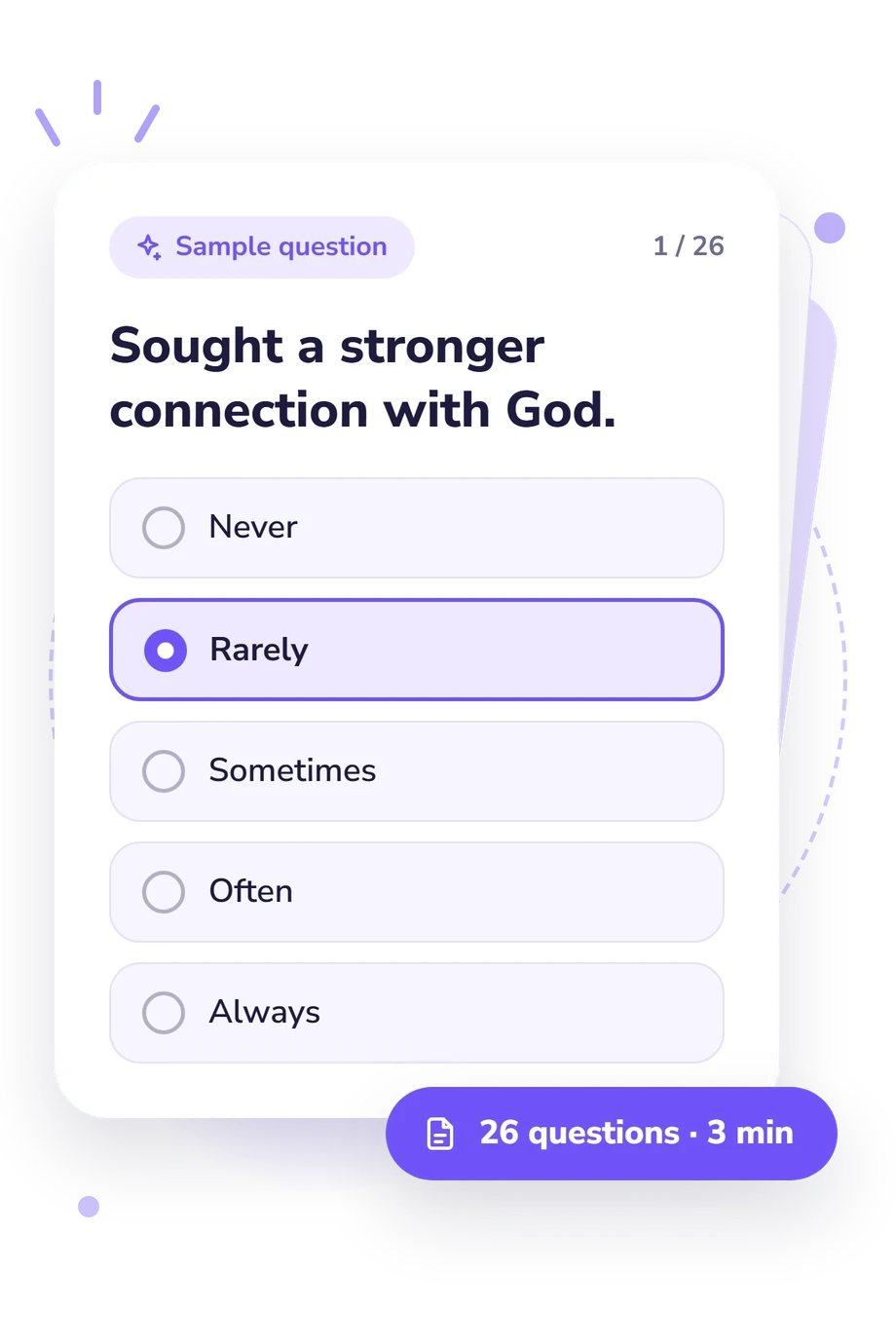
In the list of statements below, there are no right or wrong answers; the best answer is the one that most accurately reflects your experience. Although some items use the word “God,” when responding, please use the term for God (or a Higher Power) that is most meaningful to you. Please select “not at all / not applicable” for any statements that, within your worldview, simply do not make sense. Think about how you try to understand and cope with difficult life situations. To what extent are the experiences listed below characteristic of the way you cope with them?
    • Never
    • Rarely
    • Sometimes
    • Often
    • Always
    • Never
    • Rarely
    • Sometimes
    • Often
    • Always
    • Never
    • Rarely
    • Sometimes
    • Often
    • Always
WHAT THE TEST MEASURES
About This Assessment
Brief Religious Coping Questionnaire, B-RCOPE Test

Brief Religious Coping Questionnaire (B-RCOPE) Test - Symptoms and Signs

religiosity
coping behavior

This measure assesses how individuals draw on religious or spiritual resources when coping with stress, illness, or other adverse experiences. The Brief Religious Coping Questionnaire (B-RCOPE) is designed to capture both potentially supportive and potentially distressing forms of religious coping.

It includes 13 items and typically takes about 3 minutes to complete. Respondents rate how frequently they use specific coping thoughts or practices, allowing clinicians and researchers to characterize coping patterns (e.g., positive coping such as seeking spiritual support or meaning, and negative coping such as spiritual struggle, doubt, or perceived abandonment).

In clinical and research settings, the Brief Religious Coping Questionnaire (B-RCOPE) may be used to inform case conceptualization and treatment planning by identifying areas where religious coping may function as a resource or a source of additional distress.

Author: Kenneth I. Pargament
Literature: Pargament, K. I., Smith, B. W., Koenig, H. G., & Perez, L. Religious coping and the RCOPE. Journal of Scientific Study of Religion. 1998.
Popular tests
Comments
Leave a Comment