
Coping Humor Scale (CHS) Test
How the Scales are Structured
Who Usually Takes This Test?
See How You Compare
Below is a preview of how scores are typically distributed across each scale.
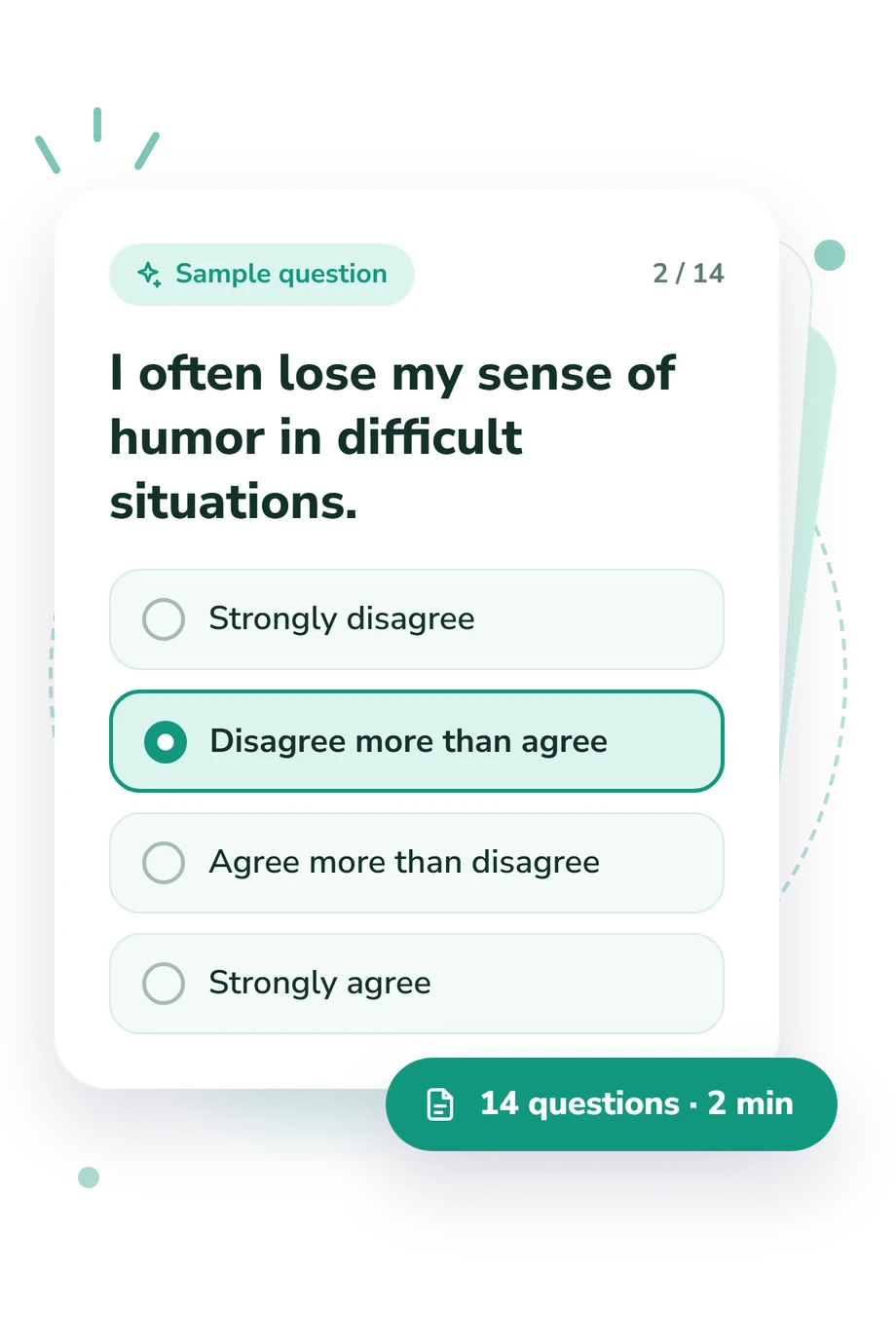
Example Questions From the Test
- Strongly disagree
- Disagree more than agree
- Agree more than disagree
- Strongly agree
- Strongly disagree
- Disagree more than agree
- Agree more than disagree
- Strongly agree
- Strongly disagree
- Disagree somewhat
- Agree somewhat
- Strongly agree
Coping Humor Scale (CHS) Test - Description and methodology of the test
For readers who want to understand their responses to pressure, this assessment examines whether humor remains available when problems feel stressful or difficult. The Coping Humor Scale (CHS) Test describes a reported coping tendency rather than general wit, helping respondents consider how they reframe hardship, introduce levity, or turn toward laughter during demanding situations. As a humor coping questionnaire, this assessment helps respondents notice humor's availability under pressure.
What This Assessment Explores
The items focus on situations in which a person may lose, preserve, or deliberately use humor under pressure. They ask about seeing problems as less serious after finding something funny, making a joke in tense moments, choosing laughter over tears, and viewing humor as a way to manage difficulties. As a humor coping assessment, this questionnaire helps readers distinguish a stress-related coping pattern from entertainment preferences or an ability to amuse others.
The result is organized around these aspects:
- Coping Humor: 7-28 indicates how much humor is used as a coping strategy. Low use (7-17) reflects infrequent reliance, Moderate use (18-25) an intermediate pattern, and High use (26-28) more frequent reliance.
- Reframing difficulty describes whether humor can make problems feel less serious or more bearable.
- Humor during tension shows whether a person creates or notices something funny in difficult moments.
Methodology and Scientific Basis
Each statement uses four agreement choices, moving from disagreement toward agreement. The online form adapts the published seven-item Coping Humor Scale described by Martin and Lefcourt in 1983. Items 1 and 4 are negatively worded and reverse-scored; the seven values are summed to produce the result. The bands describe that total; the online adaptation has not been separately standardized.
Martin's 1996 book discusses the CHS alongside the Situational Humor Response Questionnaire. Nezlek and Derks's 2001 study examines links among humor, coping, adjustment, and social interaction, while Doosje and colleagues' 2012 work places humor-coping measures within stress-and-coping frameworks. Together, these works support the construct's relevance.
Because the format depends on self-report, current mood, memory, self-awareness, and willingness to acknowledge humor under pressure can influence the result. Read this humor coping scale result as a context-sensitive indicator of a reported style, not a population norm.
- Martin, R. A., & Lefcourt, H. M. (1983). Sense of humor as a moderator of the relation between stressors and moods. Journal of Personality and Social Psychology, 45(6), 1313-1324. 10.1037/0022-3514.45.6.1313
- Martin, R. A. (1996). The Situational Humor Response Questionnaire (SHRQ) and Coping Humor Scale (CHS): A decade of research findings. Humor, 9(3-4), 251-272. 10.1515/humr.1996.9.3-4.251
- Nezlek, J. B., & Derks, P. (2001). Use of humor as a coping mechanism, psychological adjustment, and social interaction. Humor, 14(4), 395-413. 10.1515/humr.2001.011
- Doosje, S., Landsheer, J. A., De Goede, M. P. M., & Van Doornen, L. J. P. (2012). Humorous coping scales and their fit to a stress and coping framework. Quality & Quantity, 46(1), 267-279. 10.1007/s11135-010-9348-2
Updated: