
Chemical Dependence Risk Assessment Test
How the Scales are Structured
Who Usually Takes This Test?
See How You Compare
Below is a preview of how scores are typically distributed across each scale.
Example Questions From the Test
- Never
- Sometimes
- Not sure
- Often
- Always
- Never
- Sometimes
- Not sure
- Often
- Always
- Never
- Sometimes
- Not sure
- Often
- Always
Chemical Dependence Risk Assessment Test - Description and methodology of the test
For adolescents, parents, or adults supporting them, the Chemical Dependence Risk Assessment Test offers a structured way to examine patterns associated with vulnerability to substance dependence. A chemical dependence screening result can organize reflection on impulse control, rule-breaking, emotional confusion, family conflict, and self-control. It is most useful when answers describe recent, typical behavior and the result highlights topics worth discussing more closely.
What This Assessment Explores
Rather than asking only about substance use, the questionnaire samples psychosocial situations associated with adolescent vulnerability. It covers emotional reactivity, hasty decisions, difficulty stopping, confusion, rule-breaking, reliability, self-respect, fear of failure, and family guidance. The substance dependence risk assessment therefore reflects a broad behavior pattern rather than one isolated incident.
One displayed scale assesses the likelihood of developing substance dependence in adolescents. Chemical Dependence Risk runs from 57-285: Low risk 57-150; At-risk range 151-285. A score above 150 suggests membership in the risk group, while the result does not identify the factors behind the score.
These themes show what the respondent is asked to examine:
- Emotional regulation shows whether strong feelings disrupt clarity or control.
- Impulsivity and rule-related behavior indicate hasty choices or violations.
- Family relationships capture conflict, criticism, advice-seeking, and rejection sensitivity.
- Self-evaluation and reliability describe confidence, responsibility, and dependability.
Methodology and Scientific Basis
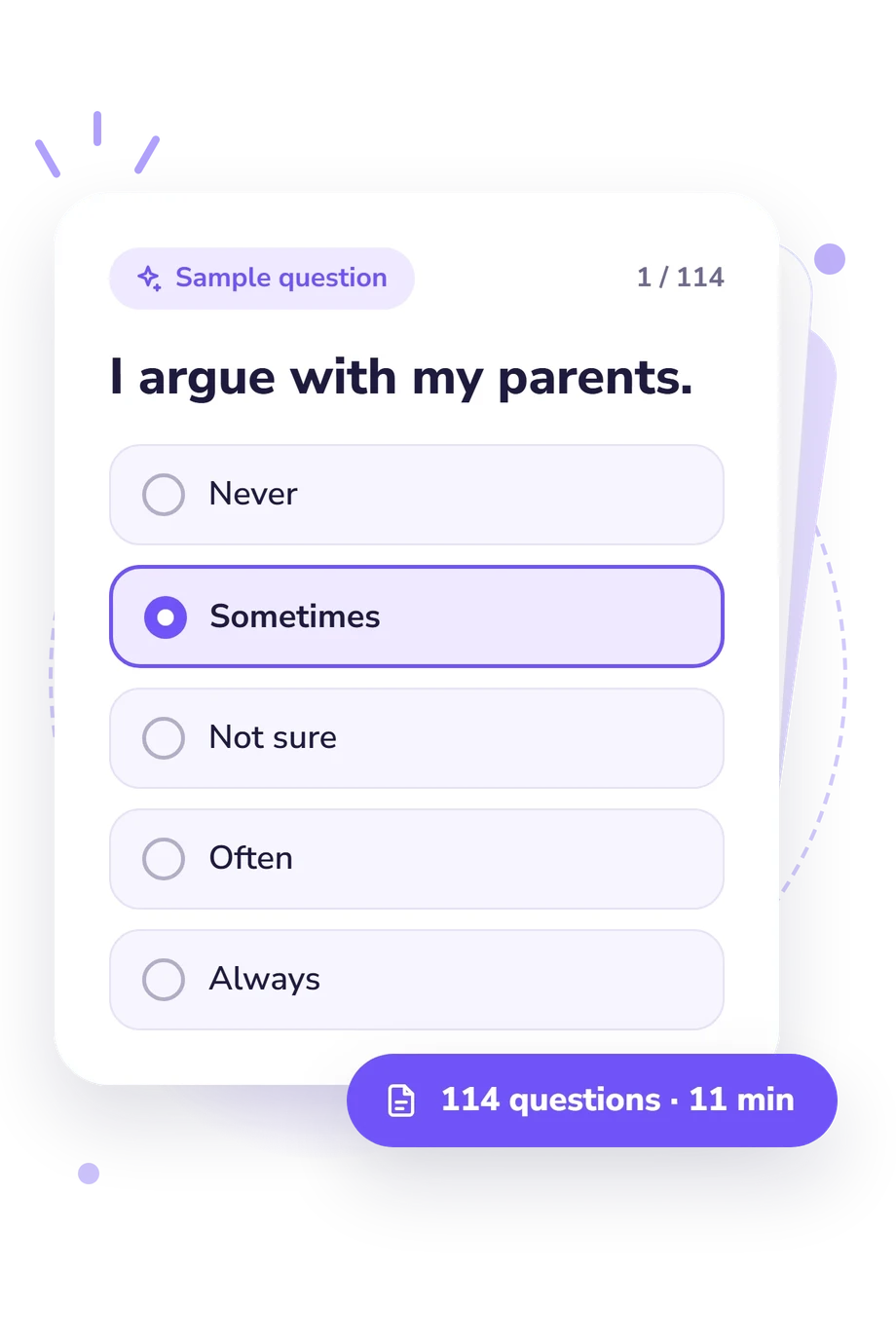
The displayed question format uses five ordered choices, usually Never, Sometimes, Not sure or Hard to say, Often, and Always. Questions and first-person statements ask the respondent to judge frequency, fit, or typical behavior. Responses produce one displayed total; no separate subscales or detailed weighting rule is stated for this form.
Its closest named evidence is Personal Experience Scales (Henly & Winters, 1989), a psychosocial measure developed for adolescents with alcohol- and drug-related involvement. This questionnaire is conceptually consistent with that work, not a reproduction of its wording, norms, or validation sample. The 1993 study reported further validation of those published scales, but it did not establish reliability or validity for this online questionnaire.
The displayed form provides result bands but does not state normative data, validation statistics, or an item-weighting rule for this online adolescent substance use assessment. Self-report can vary with mood, memory, privacy, social pressure, and current circumstances. Treat the result as preliminary screening rather than a diagnosis, with persistent concerns considered through broader assessment.
- Henly, George A., and Ken C. Winters. "Development of Psychosocial Scales for the Assessment of Adolescents Involved with Alcohol and Drugs." The International Journal of the Addictions, 24(10), 973-1001, 1989. 10.3109/10826088909047324
- Winters, Ken C., Randy Stinchfield, and George A. Henly. "Further Validation of New Scales Measuring Adolescent Alcohol and Other Drug Abuse." Journal of Studies on Alcohol, 54(5), 534-541, 1993. 10.15288/jsa.1993.54.534
- Marlatt, G. Alan, and Judith R. Gordon. Relapse Prevention: Maintenance Strategies in the Treatment of Addictive Behaviors. Guilford Press, 1985.
Updated: