
Self-Confidence Scale (RAS) Test
How the Scales are Structured
Who Usually Takes This Test?
See How You Compare
Below is a preview of how scores are typically distributed across each scale.
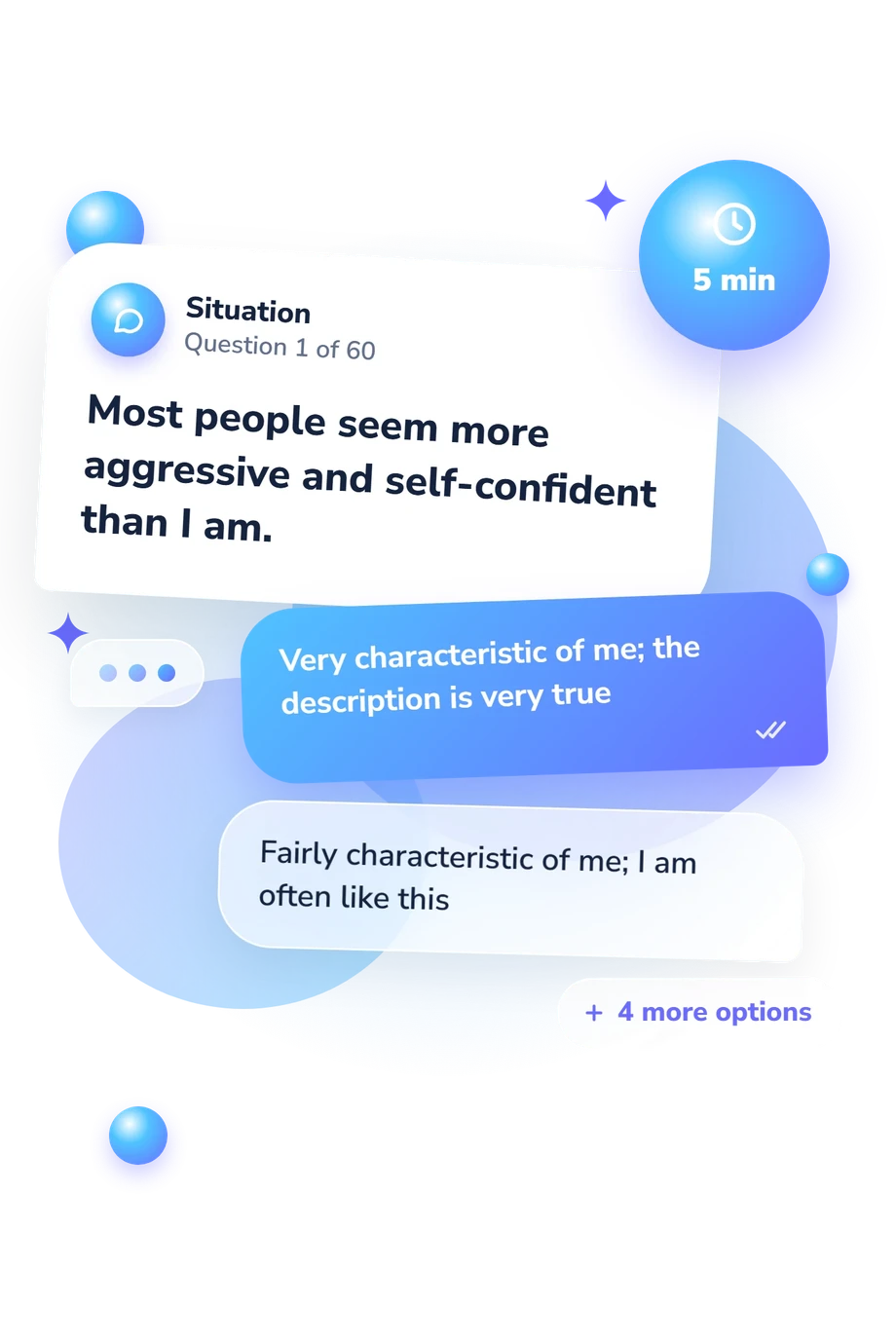
Example Questions From the Test
- Very characteristic of me; very true
- Fairly characteristic of me; often like this
- Somewhat characteristic of me; more true than not
- Somewhat uncharacteristic of me; more untrue than true
- Not characteristic of me; untrue
- Not at all characteristic of me; completely untrue
- Very characteristic of me; very true
- Fairly characteristic of me; I am often like this
- Somewhat characteristic of me; more true than not
- Somewhat uncharacteristic of me; more untrue than true
- Not characteristic of me; untrue
- Not at all characteristic of me; completely untrue
- Very characteristic of me; very true
- Fairly characteristic of me; I am often like this
- Somewhat characteristic of me; more true than untrue
- Somewhat uncharacteristic of me; more untrue than true
- Uncharacteristic of me; untrue
- Completely uncharacteristic of me; completely untrue
Self-Confidence Scale (RAS) Test - Description and methodology of the test
People who want a clearer picture of how they speak up, set limits, and respond during disagreement can use the Self-Confidence Scale (RAS) Test as a structured self-reflection exercise. As a self-confidence assessment, it is intended for readers examining everyday communication patterns, including hesitation, reluctance to refuse requests, discomfort with confrontation, or difficulty expressing a considered opinion. The result summarizes a general style of self-expression rather than a single event.
What This Assessment Explores
This assertiveness questionnaire examines how readily a person expresses preferences, protects boundaries, and stays engaged when others disagree. Situations include fair treatment, refusal, new conversations, praise, complaints, and voicing a different view. The items also capture hesitation and embarrassment.
The question themes cover the main behaviors reflected in the result:
- Assertiveness ranges from -90 to 90 and measures self-confidence and the ability to assert interests while respecting others’ rights. Higher scores indicate greater assertiveness; lower scores suggest passivity or difficulty with self-expression; mid-range scores reflect balance. Bands: Low assertiveness (-90-0), Balanced (1-53), High assertiveness (54-90).
- Expressing opinions shows whether the respondent states a view or stays silent.
- Boundaries and refusal show comfort with saying no or challenging unwanted behavior.
- Social and conflict situations describe directness during introductions, disagreement, and criticism.
Methodology and Scientific Basis
Each statement uses six response options that move from very characteristic or true to completely uncharacteristic or untrue. This self-report format asks the respondent to judge typical behavior rather than recall one incident. Answers are combined into one overall score, so interpretation reflects the response pattern across situations instead of any single item.
The questionnaire is conceptually consistent with the Rathus Assertiveness Schedule (Rathus, 1973), but it is not presented here as an adaptation of that published instrument. Quillin, Besing, and Dinning (1977) reported a standardization study of the schedule, while Rathus and Nevid (1977) examined its concurrent validity in a psychiatric population. Their findings describe the published schedule; they do not establish norms for this online version.
As an assertiveness self-assessment, the result is most useful for recognizing patterns in self-expression. It can be influenced by honest responding, self-awareness, current relationships, and situational stress. A single score cannot show why someone holds back or distinguish a stable tendency from a temporary circumstance.
- Rathus, S. A. (1973). A 30-item schedule for assessing assertive behavior. Behavior Therapy, 4(3), 398-406. 10.1016/S0005-7894(73)80120-0
- Quillin, J., Besing, S., & Dinning, D. (1977). Standardization of the Rathus Assertiveness Schedule. Journal of Clinical Psychology, 33(2), 418-422. 10.1002/1097-4679%28197704%2933%3A2%3C418%3A%3AAID-JCLP2270330217%3E3.0.CO%3B2-Y
- Rathus, S. A., & Nevid, J. S. (1977). Concurrent validity of the 30-item assertiveness schedule with a psychiatric population. Behavior Therapy, 8(3), 393-397. 10.1016/S0005-7894(77)80074-9
Updated: