
Freudly+971 508685814hello@freudly.ai
Freudly
family adaptation

Marital Psychological Distance Scale Test
Take the online Marital Psychological Distance Scale Test - AI psychologist FreudlyYou can take Marital Psychological Distance Scale Testhere. Online version of a simple and accurate psychological test with interpretation.en
Understand how close or distant partners feel in about 13 minutes. Targeted results pinpoint friction points like boundaries, shared plans, and support to guide counseling and next steps.
Start Online Test
Questions: 6913 minutes
08:30
October 2, 2025
October 2, 2025
Material has been updated
October 2, 2025
Material has been published
17,850 views
1,612 completions
1,313 likes
Verified by Daniel Hall
Psychologist with 25 years of experience
Share
Scale Explorer

How the Scales are Structured

example score
9/19
Values Distance (VD)
Measures how closely spouses align in core life attitudes and values.
Low alignment
Moderate alignment
High alignment
06: Low alignment | 713: Moderate alignment | 1419: High alignment
A score of 9 indicates moderate value alignment, suggesting some shared beliefs alongside notable differences that may influence day-to-day decisions.
example score
10/13
Social Ties Distance (STD)
This scale measures how involved spouses are in each other’s social contacts and shared social life.
Low integration
Moderate integration
High integration
04: Low integration | 59: Moderate integration | 1013: High integration
A score of 10 indicates high social integration, suggesting strong openness and involvement in each other’s social ties.
example score
2/6
Daily Routine and Time-Use Habits Distance (DRaTUHD)
Measures how closely spouses’ daily routines and time-management habits align with each other.
Low alignment
Moderate alignment
High alignment
02: Low alignment | 34: Moderate alignment | 56: High alignment
A score of 2 indicates low alignment in temporal habits, suggesting notable differences in daily routines and time use that may require extra coordination.
example score
3/8
Personal Belongings Distance (PBD)
Measures how open and trusting spouses are about access to each other’s personal belongings and property.
More guarded
Some openness
Very open
02: More guarded | 35: Some openness | 68: Very open
A score of 3 suggests some openness around personal items, with noticeable boundaries still present between partners.
example score
2/10
Territorial Distance (TD)
Measures how much spouses share versus separate personal space and everyday territory within the relationship.
Separated territory
Mixed territory
Shared territory
03: Separated territory | 47: Mixed territory | 810: Shared territory
A score of 2 suggests the couple tends to keep personal space and day-to-day territory relatively separate rather than openly shared.
example score
11/13
Physical Distance (PD)
Measures the degree of physical closeness between spouses, including comfort with touch and time spent together.
Low physical closeness
Moderate physical closeness
High physical closeness
04: Low physical closeness | 59: Moderate physical closeness | 1013: High physical closeness
A score of 11 falls in the High physical closeness range, suggesting strong comfort with physical intimacy and shared physical presence.
example score
8/69
Overall Closeness (OC)
Measures overall psychological intimacy and perceived harmony between spouses across key areas of the relationship.
Low closeness
Moderate closeness
High closeness
027: Low closeness | 2850: Moderate closeness | 5169: High closeness
A score of 8 falls in the Low closeness range, suggesting a relatively high degree of psychological distance and limited emotional connection across the measured areas.
Start Online Test
just completed the test
DATA-BASED USER COHORTS

Who Usually Takes This Test?

Couples feeling emotionally distant
41%OF USERS
Partners who sense growing detachment or frequent misunderstandings take it to pinpoint where closeness has weakened.
Couples in counseling or workshops
34%OF USERS
Spouses working with a therapist or in a relationship program use it to identify specific tension areas and track progress.
Newlyweds and life-transition couples
25%OF USERS
Couples adjusting to changes like a new baby, relocation, or career stress take it to check alignment on boundaries, plans, and support.
BASED ON AGGREGATED, ANONYMIZED DATA FROM TENS OF THOUSANDS OF FREUDLY USERS.
Benchmarking

See How You Compare

Once you complete the test, your results are compared with real-world data from people in your country.
Below is a preview of how scores are typically distributed across each scale.
Distance of Values (DoV)
Average
14.2
Normal range
11.517
min.
0
max.
19
This curve shows how scores are typically distributed.
Once you complete the test, your result will appear on the scale so you can see how you compare.
Social distance (Sd)
Average
7.6
Normal range
5.39.9
min.
0
max.
13
This curve shows how scores are typically distributed.
Once you complete the test, your result will appear on the scale so you can see how you compare.
The Distance of Temporal Habits (TDoTH)
Average
2.3
Normal range
1.53.1
min.
0
max.
6
This curve shows how scores are typically distributed.
Once you complete the test, your result will appear on the scale so you can see how you compare.
Personal space (Ps)
Personal space (Ps)
Average
5.5
Normal range
4.17
min.
0
max.
8
This curve shows how scores are typically distributed.
Once you complete the test, your result will appear on the scale so you can see how you compare.
Distance of the territory (Dott)
Average
7.4
Normal range
5.69.2
min.
0
max.
10
This curve shows how scores are typically distributed.
Once you complete the test, your result will appear on the scale so you can see how you compare.
Physical Body Distance (PBD)
Average
5.2
Normal range
2.97.5
min.
0
max.
13
This curve shows how scores are typically distributed.
Once you complete the test, your result will appear on the scale so you can see how you compare.
Overall closeness score (Ocs)
Average
21.3
Normal range
11.331.3
min.
0
max.
69
This curve shows how scores are typically distributed.
Once you complete the test, your result will appear on the scale so you can see how you compare.
Featured On
SAMPLE QUESTIONS

Example Questions From the Test

You are invited to participate in a survey on issues facing the contemporary family. Please read each pair of statements carefully and select the one that best reflects your views. There are no “good” or “bad” statements; all describe aspects of modern family life in different ways—some may fit certain families and not others. Please try to recall or imagine what is characteristic of your family.
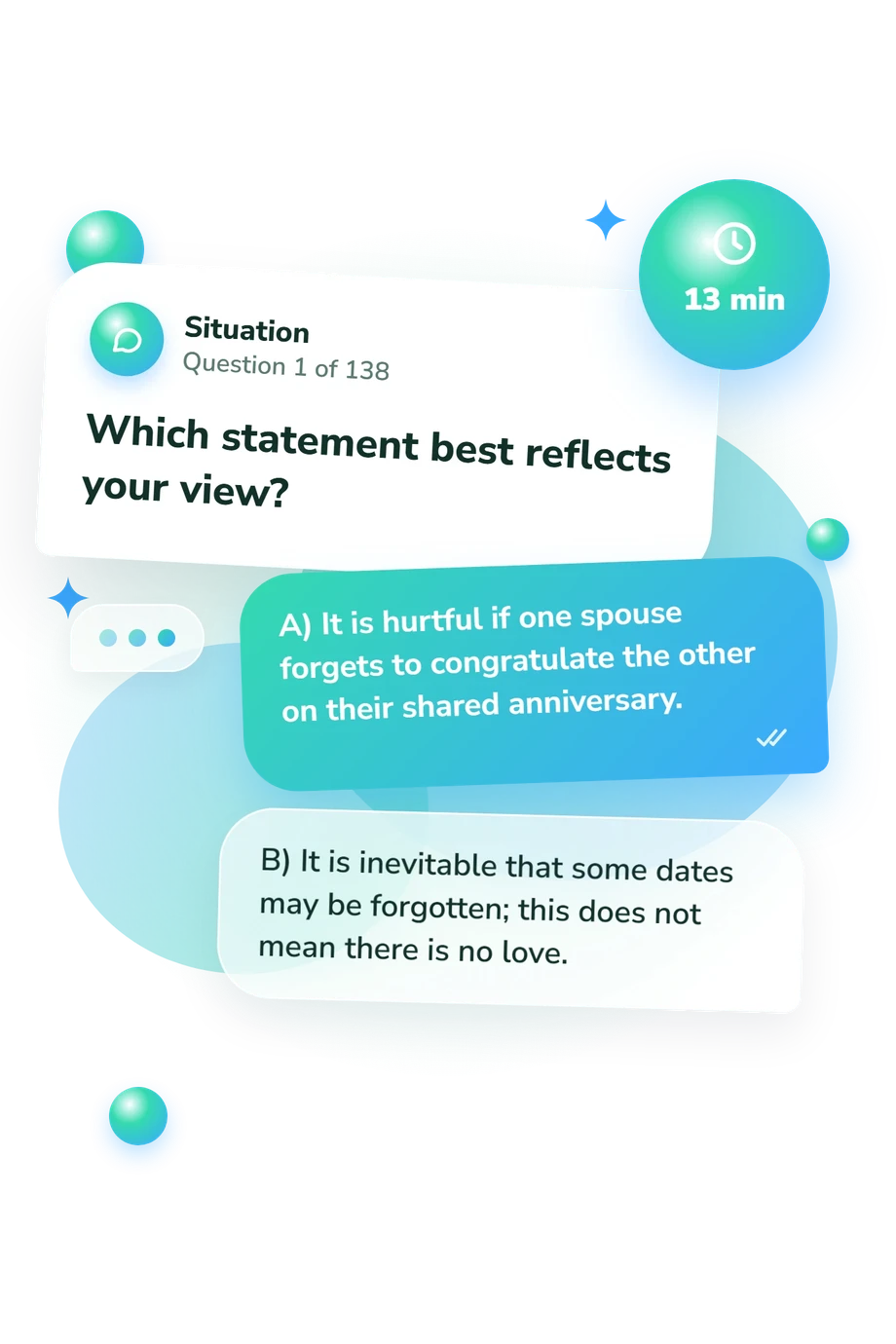
    • A) It is hurtful if one spouse forgets to congratulate the other on their shared anniversary.
    • B) It is inevitable that some dates may be forgotten; this does not mean there is no love.
    • A) Most married people always feel like the master of the house, even if relatives live with them.
    • B) Many married people like to get up earlier than others because only then do they feel as if they are alone in the home and feel like the master of the house.
    • A) It is quite possible to eat without waiting for the family to gather at the table.
    • B) Eating lunch alone is very difficult; I cannot eat a bite.
WHAT THE TEST MEASURES
About This Assessment

Marital Psychological Distance Scale Test - Symptoms and Signs

family adaptation
family

This measure is designed to assess perceived closeness versus separation within a couple relationship. The Marital Psychological Distance Scale provides a structured self-report approach to characterizing relational distance across multiple domains of marital functioning.

Originally developed by C. E. Christensen and J. H. Larson, it includes 69 items and typically requires about 13 minutes to complete. Item content broadly samples areas commonly implicated in marital adjustment (e.g., emotional connection, perceived support, boundaries, and shared activities), supporting clinically focused discussion of where partners experience alignment or strain.

The Marital Psychological Distance Scale can be used in clinical or psychoeducational settings to facilitate case conceptualization and to help identify potential targets for intervention, while results should be interpreted in the context of additional assessment data and the couple’s presenting concerns.

Author: C. E. Christensen, J. H. Larson
Literature: Spanier, G. B. Measuring dyadic adjustment: New scales for assessing the quality of marriage and similar dyads. Journal of Marriage and the Family. 1976.
Popular tests
Comments
Leave a Comment